RESEARCH | BFG



Chapters
Introduction
Part 1: Why are crypto-assets redefining philanthropy?
- Chapter 1: From the donor's perspective: New motivations, new levers
- Chapter 2: From the solidarity actors' perspective: Strategic and operational impact
- Chapter 3: From the beneficiary's perspective: direct and inclusive aid
Part 2: How are crypto-assets deployed for philanthropic purposes?
- Chapter 4: Crypto-asset donation mechanisms
- Chapter 5: Towards programmable, verifiable, and measurable aid?
- Chapter 6: Crypto philanthropy through engagement
Risks, Challenges, and Future Prospects
Credits & infos
L’Association « Blockchain for Good » publie des analyses indépendantes et les opinions exprimées dans ce rapport n’engagent que leurs auteurs et aucunement nos partenaires, la Chaire « Blockchain & Platform » de l’Ecole Polytechnique, créé avec le soutien de Capgemini, NomadicLabs et la Caisse des dépôts et des Consignations, la Banque Publique d’Investissement (Bpifrance), le Groupe Caisse des dépôts et la Credit Agricole Corporate Investment Bank.
La blockchain, ça n’existe pas . Pourquoi ? Tout simplement parce qu’il y a plusieurs types de blockchains, parmi lesquels, pour largement schématiser, les blockchains publiques et les blockchains privées. Or, lorsque l’on parle de « la » blockchain, comment savoir de laquelle il s’agit, alors qu’elles sont intrinsèquement différentes ? La première blockchain publique s’appelle Bitcoin et a été conceptualisée entre 2007 et 2008, puis mise en œuvre en janvier 2009 par une personne ou un groupe de personnes répondant au nom de Satoshi Nakamoto, disparu(e.s) depuis décembre 2010. Une autre blockchain publique notable s’appelle Ethereum et a été créée en juillet 2015. Depuis, près de 20 000 blockchains publiques, dont la plupart n’ont probablement aucune utilité, ont été créées et sont référencées sur le site d’information coinmarketcap.com.
Le concept fondamental associé au mot “blockchain” est la décentralisation.
Une blockchain publique ou commune est un grand livre numérique décentralisé et sécurisé auquel quiconque peut participer, pour écrire, effectuer des transactions, les lire, les vérifier ou encore les sécuriser, le tout sans intermédiaire central . Quant aux blockchains privées, il s’agit, pour l’entreprise ou le groupe d’acteurs qui en a le contrôle et la gouvernance, de plus ou moins optimiser des processus, parfois déjà existants, souvent organisés en silos, et dont la principale problématique est d’en assurer le registre, afin de résoudre l’inefficience de la circulation des informations dans de telles organisations pyramidales.
Lorsque l’on parle de la blockchain alors que l’on se réfère à Bitcoin ou Ethereum et leurs dérivés , il s’agit de blockchains publiques ou communes, qui reposent sur la combinaison de plusieurs technologies dont certaines leur sont préexistantes : « les protocoles de réseau pair-à-pair », des « techniques de cryptographie » et, innovation fondamentale apportée par Bitcoin, le « mécanisme de consensus par la preuve de travail » . La savante combinaison de ces trois technologies aboutit à un registre distribué, à une chaîne de blocs de transactions reliées entre elles depuis la première, et que l’on appelle « blockchain » dans le langage courant. Mais, comme l’explique Alexandre Stachtchenko, président de l’Association pour le Développement des Actifs Numériques (ADAN), « l’innovation majeure de Bitcoin, c’est le consensus sans intermédiaire dans un réseau informatique permettant de gérer et de transférer de la valeur en ligne » .
Ce consensus sans intermédiaire, propre aux blockchains publiques, permet d’opérer un système de monnaie électronique pair-à-pair, ouvert à tous, sans autorisation préalable ni censure. Quiconque est libre d’utiliser ou non le service opéré par la blockchain publique, qui sert, dans le cas de Bitcoin, à recevoir, détenir ou envoyer une monnaie électronique pair-à-pair, des bitcoins, partout dans le monde. Ce qui fait dire à Yorick de Mombynes, conseiller référendaire à la Cour des comptes, que « Bitcoin est un dispositif acéphale, décentralisé, ouvert. Nul n’a de pouvoir sur lui. Il n’a ni leader ni gestionnaire. Il appartient à tous et à personne. Ces caractéristiques forment un ensemble exceptionnellement novateur, aux antipodes des systèmes fondés sur la hiérarchie, (...), le monopole légal et le centralisme [1] » .
Alors que la diversité des usages n’a de limite que l’imagination de leurs concepteurs, les blockchains servent aujourd’hui quatre grands types d’usage : (1) échanger des actifs numériques en pair-à-pair, (2) s’identifier de manière décentralisée, voire de manière anonyme, (3) tenir un registre infalsifiable de données, ou encore (4) programmer des actifs numériques, chacun pouvant être combinés avec les autres.
Échanger des actifs numériques en pair-à-pair, cela veut dire échanger de l’argent numérique de la main à la main, à l’instar de l’argent liquide. Alors que pour certains, Bitcoin et les crypto-monnaies stables* n’ont pas d’utilité, d’autres y voient au contraire un formidable outil d’émancipation monétaire, notamment pour des dizaines de millions de personnes vivant sous des régimes autoritaires ou des économies instables. 
C’est notamment le cas des vingt et un défenseurs des droits de l'homme, originaires d’une vingtaine de pays dans le monde, ayant récemment adressé une lettre au Congrès américain, et pour qui « les utilisateurs du dollar et de l'euro n'ont probablement pas connu la dévaluation extrême de leur monnaie ou l'emprise froide d'une dictature. Pour la plupart des Occidentaux, les horreurs du colonialisme monétaire, la politique financière misogyne, les comptes bancaires gelés, les sociétés de transfert de fonds qui exploitent les migrants et l'incapacité à se connecter à l'économie mondiale sont peut-être des idées lointaines. Pour la plupart d'entre nous et nos communautés - et pour la majorité des gens dans le monde - ce sont des réalités quotidiennes. S'il existait des "solutions bien meilleures déjà utilisées" pour surmonter ces défis, nous le saurions [2] ».
Envoyer et recevoir de l’argent sans intermédiaire, quasiment sans frais, et sans aucune contrainte géographique. Se protéger de la dévaluation de sa monnaie. Commercer avec l’étranger, sans restriction bancaire. Selon l’indice mondial d'adoption des crypto-monnaies 2021, édité par Chainanalysis, il s’avère que le plus fort taux d’adoption des crypto-monnaies concerne les personnes qui n’ont pas accès aux banques ou dont les banques imposent des restrictions, comme au Nigéria par exemple, qui interdit à ses ressortissants de procéder à des virements vers l’étranger de plus de 500 $. Ainsi, « de nombreux marchés émergents sont confrontés à une importante dévaluation de leur monnaie, ce qui pousse les résidents à acheter des crypto-monnaies sur des plateformes P2P afin de préserver leurs économies [3] » poursuit le rapport The 2021 Geography of Cryptocurrency Report [4] publié par Chainanalysis. Recourir à une crypto-monnaie stable (stable-coin*), un crypto-actif à parité fixe avec une monnaie fiduciaire, par exemple le dollar, permet ainsi à des personnes de convertir leur salaire ou leurs économies dans une monnaie plus stable, et de se prémunir ainsi contre la dévaluation de leur propre monnaie. Une réalité quotidienne pour les habitants de pays comme le Nigeria, la Turquie, le Liban ou encore l'Argentine , dont les monnaies s'effondrent. Certaines crypto-monnaies stables, comme celle proposée par Agrotoken en Argentine, sont même adossées à des actifs réels comme la tonne de soja, de sorte à protéger les agriculteurs contre l’inflation.
S’identifier de manière décentralisée, voire de manière anonyme, c’est pouvoir bénéficier d’un système d’identité respectueux de la vie privée. Et surtout de résoudre la contradiction selon laquelle certains pays, caractérisés par une défaillance des institutions n’arrivent pas fournir à leurs ressortissants un moyen de prouver leur identité et de l’autre, dans les pays développés, les individus bénéficient d’un anonymat très relatif, que ce soit pour des raisons commerciales et financières, ou encore politiques et sécuritaires. Alors que la population mondiale compte 7,9 milliards d'individus, un milliard de personnes [5] ne peuvent pas prouver leur identité, ce qui est déterminant, pour au moins dix des Objectifs de développement durable selon la Banque Mondiale [6] . L’apport des blockchains dans le domaine de l’identité numérique est de passer d’un modèle centralisé où l’utilisateur crée un identifiant/mot de passe et dissémine ses informations personnelles auprès de chaque service avec lequel il interagit, à un modèle décentralisé, où l’utilisateur reste maître de ses données personnelles.
Tenir un registre infalsifiable de données, c’est l’opportunité de repenser le caractère centralisé de n’importe quel registre officiel, que ce soit le cadastre à l’échelle d’un pays, un registre de propriété foncière, un registre de diplômes, mais aussi le registre d’une chaîne de traçabilité faisant intervenir une multitude d’acteurs et dont les interactions deviennent ainsi plus ou moins transparentes.
Programmer des actifs numériques, cela veut dire mettre en œuvre des contrats informatiques, inarrêtables, incensurables et distribués sur tous les noeuds d’une blockchain publiques appelés « smart contracts* » ou « contrats autonomes* » . Ils permettent d’effectuer des transactions plus complexes, par exemple, si un produit est livré, alors le paiement est enclenché automatiquement. S’il neige pendant dix jours, un contrat d’assurance paramétrique envoie automatiquement une indemnité aux agriculteurs l’ayant souscrite. Une énergie renouvelable produite localement peut être tracée avec un token* et revendue en pair à pair via un contrat autonome. Le contrat autonome permet d’exécuter des clauses préalablement établies de manière automatique : si le produit n’est pas livré, le paiement n’a pas lieu et dès que le produit est livré, le paiement a lieu automatiquement. Si un agriculteur est assuré contre les tempêtes et que l'événement météorologique se produit, le paiement de son assurance est automatique, tout comme la manière de s’assurer, de manière décentralisée, que l'événement météorologique s’est bien passé. Lorsqu’une personne participe à un dispositif d’auto-consommation collective d’énergie, il revend automatiquement le surplus d’électricité qu’il produit ou achète automatiquement ce dont il a besoin.
Parce qu’il n’y a pas d’organe central, on dit des blockchains publiques sans permission qu’elles permettent de distribuer la confiance à travers un réseau, ou encore, qu’elles sont une « technologie du consensus [7] ». Elles permettent à ses utilisateurs d’opérer des transactions plus ou moins complexes et de se faire confiance sans se connaître. Ces technologies sont au cœur d’un changement de paradigme qui oppose les tenants d’un ancien monde, en pleine mutation, et les tenants d’un nouveau monde, encore en construction, comme l’expliquait David Pucheu, chercheur à l'Université Bordeaux Montaigne, lors de la conférence « Blockchain, imaginaires religieux et théologie » organisée au Collège des Bernardins le 17 mars 2021, « le New Edge, prolongation du New Age des années 1970, oppose à l’ancien monde, centralisé, coercitif et hiérarchisé, un nouveau monde, décentralisé, auto-organisé et horizontal, inscrit dans une dynamique évolutionniste (mais par des moyens techniques et non "occultes") [8] » .
Mais comme un moyen technique ne dépend que de l’usage qui en est fait, les blockchains peuvent servir au meilleur comme au pire : à l’émergence d’un système monétaire alternatif et universel, tout comme à la mise en oeuvre d’un eYuan (le eCNY) [9] , incroyable instrument de surveillance monétaire développé par Pékin.
En moins de quinze ans, d’innombrables projets dits blockchains ont ainsi été lancés, testés, expérimentés par des organisations de tout type et dans des domaines extrêmement variés. Alors que la technologie ne cesse de s’améliorer, qu’elle attire de plus en plus de développeurs informatiques et d’utilisateurs et parce que les premières innovations deviennent matures, le temps semble venu, pour bon nombre d’observateurs, d’interroger son utilité sociétale et d’identifier les domaines dans lesquelles elles apportent une plus-value pour ceux qui s’en servent, la société et les objectifs communs notamment portés par la communauté internationale.
Blockchain for good
Dès 2013, des projets « blockchains » estampillés « for good » sont lancés par des associations à but non lucratif comme BitGive, ou élaborés au sein d’Organisations non gouvernementales et d’Organisations internationales dont les missions sont par nature alignées avec les Objectifs de développement durable.
En 2015, l’UNICEF conduit une première expérience sur la blockchain Bitcoin pour tester un « système d’identité immuable » et explique ainsi que « si nous pouvions prendre la photo d'une personne, la relier à ses informations personnelles (date de naissance, nom, etc.), coder ces éléments et publier un lien cryptographiquement sécurisé vers les informations codées sur la blockchain, ce lien, parce qu'il se trouverait sur un réseau public et sans autorisation, durerait "pour toujours" et constituerait une identité immuable » . En 2016, l’UNICEF monte un fond de capital-risque pour accompagner de jeunes entreprises technologiques sur des marchés émergents [10] .
En novembre 2018, ce fonds compte 72 investissements dans les domaines des data science et de l’intelligence artificielle, des blockchains et de l’Extended Reality, dont 33 dans des startups basées dans des pays où l’UNICEF est active [11] . Une dizaine d’autres agences des Nations Unies ont initié, à partir de 2017, un certain nombre de projets blockchains menés individuellement ou collectivement, dans des domaines aussi variés que les chaînes d'approvisionnement, le paiement et le transfert d’argent en monnaie numérique, le traçage du bétail, l’identité numérique ou encore l’enregistrement des terres. 
Un rapport de la Joint Inspection Unit des Nations Unies qualifie ces initiatives, en 2020, « d’opportunités sans précédent de collaboration inter-agences [13] » tout en mesurant l’étendue des travaux à mener pour mettre en œuvre une feuille de route transversale à ces dernières. Pour Thomas Davin, Directeur du Bureau de l’innovation à l’UNICEF, « nous n’avons vu aucune autre évolution technologique avec une croissance aussi forte au cours des dernières années – ou plus de potentiel pour résoudre tous les problèmes imaginables – que celle de Bitcoin, d’Ethereum et d’autres applications de la technologie blockchain [14] ».
Pourtant, « peu de pays se montrent favorables à l’adoption des blockchains et des crypto -monnaies dans leurs systèmes [15] » explique Okonjo Iweala, directrice générale de l’Organisation mondiale du commerce (OMC), probablement parce que cela rendrait transparent des processus que les bénéficiaires actuels préfèrent garder opaques. Et si des initiatives blockchains pourraient être utilisées pour « réduire la pauvreté, renforcer l'autonomie des femmes et leur permettre d'accéder facilement aux marchés financiers », ajoute Okonjo Iweala, le problème est, qu’à l’heure actuelle, « nous sommes encore loin de concrétiser cette vision [16] » .
L’objet de ce rapport
Notre interrogation de départ, posée dans le rapport que nous avons publié en juin 2020 [17] reste pour le moins inchangée : « En quoi des initiatives s’appuyant sur des blockchains, publiques ou privées, participent-elles à la réalisation des Objectifs de développement durable ? Quelles blockchains, quels objectifs de développement durable ? Dans quel but et comment ? Quels projets décentralisés fonctionnent ? Dans quels domaines et selon quelle gouvernance ? ».
Or en quatre ans, le paysage des cryptomonnaies a profondément évolué
Les difficultés à répondre à ces questions tiennent tout autant à l’immaturité de nombreux projets blockchains qu’à la transversalité des Objectifs de développement durable qui sont tous étroitement liés, « le succès de l’un dépendant souvent de la résolution de problématiques généralement associées à un autre objectif [18] ».
Comme il est impossible de généraliser un discours sur une classe de technologies aussi vaste que les blockchains, et surtout parce que les blockchains sont tout sauf une fin en soi, nous nous sommes attachés à identifier et analyser un certain nombre de projets et initiatives blockchains dont l’activité s’inscrit dans la poursuite d’un ou plusieurs Objectifs de développement durable.
Ce rapport s’appuie sur un important travail de collecte de données, mené séparément depuis 2018 par l’association Positive Blockchain et l’association Blockchain for Good, puis conjointement depuis le début de l’année 2021. Disponible en open data, cet annuaire de 1273 initiatives blockchains, dont 692 sont actives en juin 2022, constitue le matériau à partir duquel ce rapport est rédigé. 
Méthodologie
L’annuaire
Les associations françaises Blockchain for Good et Positiveblockchain ont procédé, chacune de leur côté, à une première collecte de données en 2018. Il s’agissait de référencer les projets blockchains se rapportant à la poursuite d’un ou plusieurs Objectifs de développement durable. En 2020, les deux associations se sont associées pour créer « l’open-database of blockchain for good projects » accessible sur positiveblockchain.io.
Une importante mise à jour a été effectuée de février à juin 2022 par Lucas Zaehringer, Ronald Steyer, Flavio Santalucia et Susanne Köhler et toute l’équipe de PositiveBlockchain, Carlotta Cochis, Pr. Dr. Paula Ungureanu et toute l’équipe de recherche et d’assistants de l’Université de Modène, Taira Ishikura et Serena Tan de l’Ethereum Foundation, Pierre Champsavoir et Jacques-André Fines Schlumberger de Blockchain for Good, Junie Maffock de Blockchain for Africa, Chinedu Onyeaso et Benjamin Onuoha de l’Africa Blockchain Alliance, Peter Johnson de Ayadee Foundation, Daniel Kimotho de Clabs, Roxana Dumitrescu, Master student, et des contributions extérieures de l’Africa Blockchain Alliance & consortium partners et de l’Unicef Innovation Fund.
Ce travail de collecte d’information, effectué tout au long de l’année par un important réseau de contributeurs, permet, deux fois par an, de mettre à jour les données de l’annuaire. De plus, une fois par an, tous les projets actifs de l’annuaire sont revus un à un afin d’identifier les projets qui ont cessé leur activité et ceux qui perdurent.
Cet annuaire n’est pas exhaustif mais aspire à être suffisamment complet pour donner un aperçu des tendances à l'œuvre dans le domaine des projets à impact construits sur des blockchains publiques.
Quels sont les secteurs d’activité ?
Les projets et initiatives blockchains identifiés par le réseau de contributeurs sont classés dans l’annuaire par secteur d’activité, que nous avons préalablement réparti en quatorze catégories clés et 68 sous-catégories, et dont les intitulés et hiérarchies ont été discutées en ligne en mars 2021 et mai 2021 sur deux documents collaboratifs, ouverts à la discussion avec PositiveBlockchain.io et blockchainforgood.fr. Tous les projets sont référencés dans les 14 catégories suivantes :
- Agriculture et alimentation
- Aide et philanthropie
- Climat et environnement
- Contenu numérique et arts
- Éducation et emploi
- Énergie
- Finances et assurances
- Gouvernement et démocratie
- Santé
- Identité et propriété
- Internet et télécommunications
- Logistique et traçabilité
- Produits et consommation
- Transport et infrastructure
Notre parti-pris a été de rendre l’annuaire en ligne simple d’utilisation, afin qu’il puisse être compris, exploré et se faire facilement réapproprier par un large public.
47 Active Blockchain Projects
Why are crypto-assets reshaping the codes of philanthropy? Who are the crypto-donors, what are their core motivations, and how do they operate? For actors in the solidarity sector, what are the impacts —both from an operational and strategic perspective? And, of course, what are the stakes and benefits for the beneficiaries of this aid?
With this in mind, how are these assets concretely deployed? Beyond the technical mechanisms of giving, what defines these new forms of aid that are now programmable, verifiable, and measurable?
These are just some of the questions addressed in this report.
Introduction
This report examines the convergence of the development aid, philanthropic aid, and donation sectors with Distributed Ledger Technologies (DLTs), also known as blockchains, crypto-assets, cryptocurrencies, or simply "crypto." This subject of study is referred to as crypto-philanthropy: the application of crypto-assets, in all their forms, for solidarity purposes. The following section provides contextual background.
Official Development Assistance (ODA), intended to "promote economic development and welfare[1]," remains the primary official instrument mobilized by the international community to support countries in the Global South, even though it represents only a fraction of global financial flows. This planned aid—which includes project aid, program aid, and technical cooperation—is a model that originated after the Second World War and was structured as early as the 1960s.
To qualify as Official Development Assistance, aid must meet four strict criteria defined by the OECD's Development Assistance Committee (DAC). It must be provided by official agencies; it must be destined for countries included on a specific list of beneficiaries; its main objective must be the promotion of economic development and welfare; and finally, the aid must be concessional. This means it must be provided in the form of grants, or loans where the "grant element" is at least 25%[2].
In financial terms, Official Development Assistance provided by members of the Development Assistance Committee (DAC) reached $161.2 billion in 2020 and $224 billion in 2023, including $66 billion from the United States, the leading donor[3]. It should be noted that emergency humanitarian aid constitutes one of the specific modalities of Official Development Assistance, amounting to $25.9 billion in 2023.
To be precise, we must also mention aid granted by states outside the Development Assistance Committee (DAC)—notably China, India, Brazil, Turkey, and the Gulf countries, among others—who represent increasingly significant donors[4]. According to the most recent figures from the UN and the OECD, estimated aid from "South-South cooperation" amounted to $16.5 billion in 2022. However, this figure is considered[5] largely underestimated, particularly regarding China, whose financial flows are often classified as commercial loans or investments rather than "aid."
The isolationist and fiscal shift in the United States, along with very recent measures taken by the American administration in March 2025, have sent a shockwave through the sector. The OECD's "steepest decline[6]" scenario for 2025–2027 indicates an 82% drop in USAID allocations for 2025 compared to 2024[7], leading to forecasts of a drastic reduction in global Official Development Assistance (ODA).
"This reduction in American aid does not occur in isolation[8]," explains Guillaume Soto-Mayor, President of Egregor. He continues, "It falls within a broader context in which the neoliberal development model, dominant since the 1980s, is being called into question. The promises of broad-based growth through trade liberalization and the privatization of public services have gone unfulfilled. On the contrary, inequalities have widened, institutional trust has collapsed, and the structural mechanisms of poverty and conflict persist[9]."
Private philanthropic aid, distinct from Official Development Assistance (ODA) and mobilized by foundations or civil society organizations, amounted to $43.9 billion from foundations, according to the latest comparative data from the OECD (2019–2021 average[10]).
Finally, although outside the scope of this report, it is necessary to mention migrant remittances to low- and middle-income countries—funds sent by diasporas to their families—which are projected to reach $685 billion in 2024, according to the latest World Bank estimates[11].
Alongside Official Development Assistance (ODA) and contributions from major foundations, individual donations represent one of the primary drivers of funding for solidarity organizations, despite their absence from official OECD statistics. In the United States, these individual donations accounted for $319 billion in 2023[12]. In France, donations from individuals amounted to €5.4 billion in 2023 and 2024, according to France Générosités[13]. According to the Panorama national des générosités 2024, produced by France Générosités in collaboration with the Observatoire Philanthropie & Société of the Fondation de France, the total amount of donations from individuals and corporations to public interest organizations is estimated at €9.2 billion for 2022[14].
In other European countries, such as the United Kingdom or the Netherlands, individual donations also dominate the philanthropic landscape, reaching £13.9 billion in the UK, according to the Giving Report[15] published by the Charities Aid Foundation in 2024 , and nearly 60% of private donations in the Netherlands, according to the Giving in the Netherlands report[16] published in 2022 by the University of Amsterdam.
Although massive, these flows remain relatively invisible on an international scale as they transit through millions of channels—direct donations, digital platforms, emergency appeals, and bequests—without centralized global tracking. Yet, they play a decisive role by funding the operational continuity of NGOs, enabling rapid responses in times of crisis, and constituting the foundation of their social legitimacy. In a context where Official Development Assistance (ODA) is clearly regressing and certain major donors are reducing their commitments, individual generosity emerges as an essential resource, complementary to public funding.
It is in this landscape that crypto-philanthropy fits. Not as a substitute for Official Development Assistance (ODA), but as an extension of individual donation forms, driven by new donors and new technical tools. Although the total amount of donations is still modest, reaching one billion dollars in 2024, it could grow significantly and amount to 90 billion dollars by 2035, according to a report published by The Giving Block[17].
However, crypto-philanthropy extends far beyond the mere topic of donations; it signifies a paradigm shift for every stakeholder involved—in governance, fundraising, and aid delivery in all its forms—by exploiting the characteristics of these Distributed Ledger Technologies. It introduces new channels and funding sources from new types of donors, increased transparency and traceability of financial flows involving fewer actors, and improved operational efficiency on a global scale.
As Guillaume Soto-Mayor highlights, “the mechanisms and tools of crypto-philanthropy can be used to avoid the pitfalls of the past: no conditionalities that weaken the regulatory capacity of States, no programmes that create dependency rather than autonomy. Distributed ledger technologies offer unprecedented opportunities for transparency and traceability of financial flows, reducing intermediaries and risks of misappropriation. Cooperation could be more deeply rooted in local realities rather than imposed from the outside. Traceability must not become a new tool of technocratic control but could here serve mutual accountability and strengthen trust in local and international solidarity networks[18].”
As with the previous report published by the association Blockchain for Good in 2022, the question driving this new edition is: “Why and how can crypto-assets impact solidarity chains, local and international, from the donor to the beneficiary?”.
To answer this without oversimplifying, it is essential to recall that humanitarian and development aid does not amount to a simple financial transfer. NGOs possess indispensable technical expertise (market analysis, definition of amounts, inter-agency coordination, beneficiary protection, monitoring, and accountability) that structures every assistance program. Web3 technologies do not replace these skills but can reinforce them in specific stages: securing flows, reducing costs, traceability, or ensuring continuity in unstable environments.
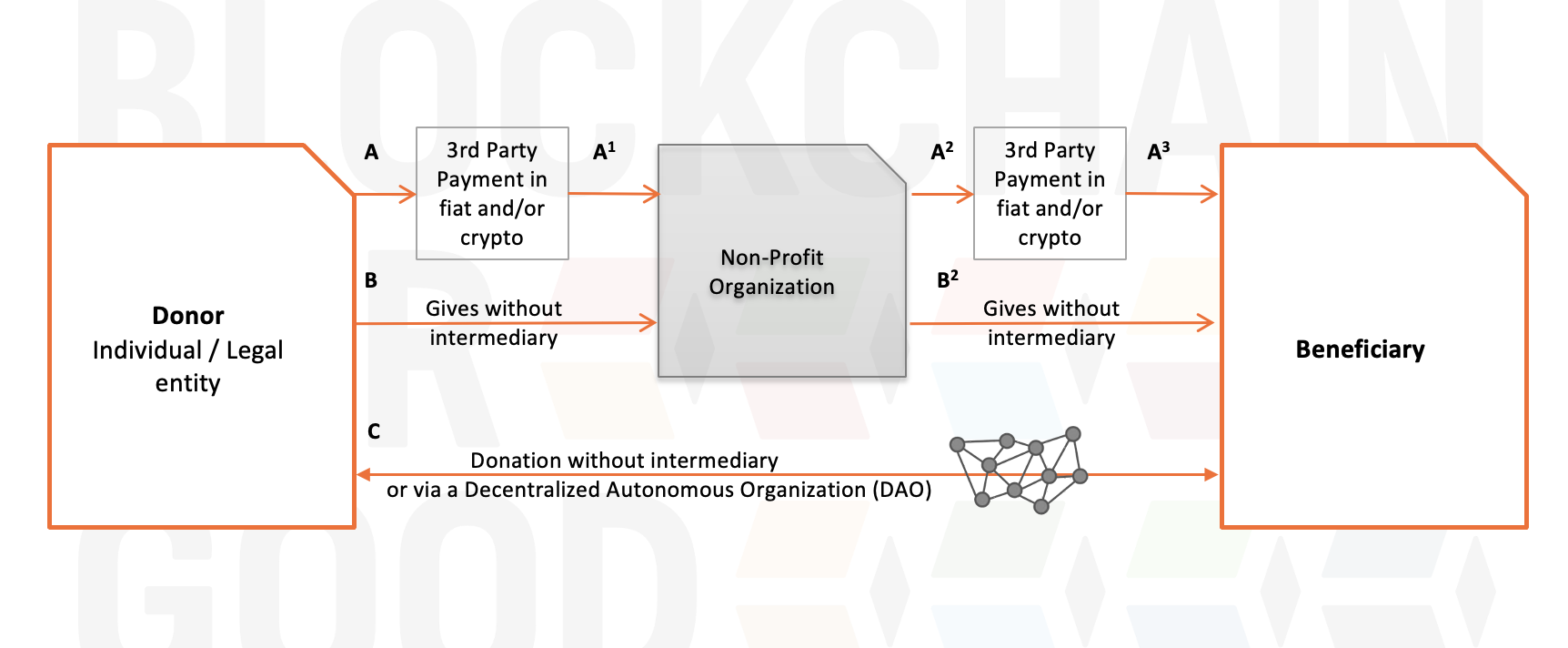
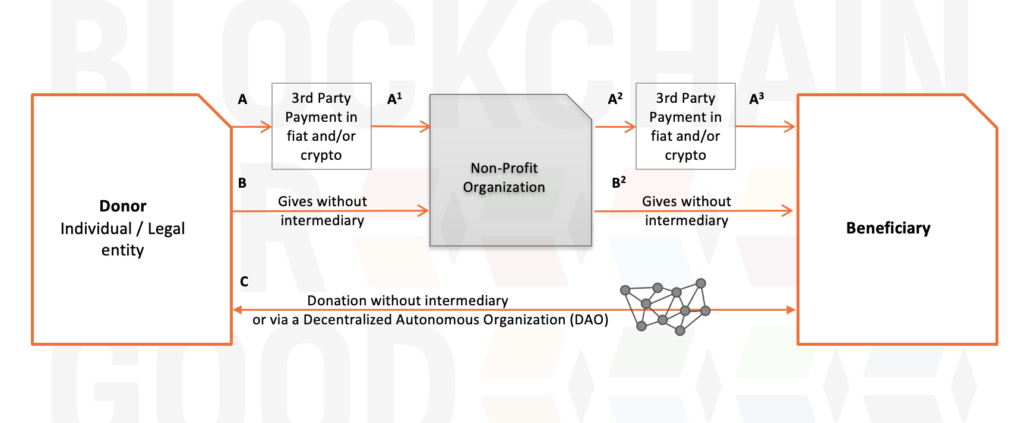
The graph below (see infra) shows a continuum of financial disintermediation and the evolution of donation and value transfer mechanisms between a donor and a beneficiary. It is not a question of replacing NGOs but of understanding how they adopt these decentralized tools to optimize their operations, or even their organization.
On this graph, Flow A represents a classic financial flow where the donor uses a third-party payment processor to send funds to the organization, which then uses the same type of intermediary to transfer aid to the beneficiary. Flow B illustrates the theoretical scenario where the donor gives directly to the organization, which in turn gives directly to the beneficiary. This flow eliminates third-party payment processors by utilizing wallet-to-wallet transfers, with the NGO remaining the central entity of trust and management.
Finally, Flow C depicts where the traditional NGO transforms into a structure managed by computer code and a community— a Decentralized Autonomous Organization (DAO) like Big Green DAO or Giveth DAO (see infra)—facilitating direct connection, transparency, and the governance of operations and decisions.
Source image : Association Blockchain for Good
Report Structure
To ensure the emerging subject of crypto-philanthropy is as accessible as possible, we have selected a narrative structure centered on all stakeholders: donors, solidarity actors, and finally, aid beneficiaries. The report begins by examining the impact on each stakeholder—the "why"—before detailing the mechanisms and tools—the "how"—and concluding with global challenges and future perspectives. This organization allows for an in-depth exploration of the technical and strategic aspects of Web3 mechanisms applied to philanthropy.
Furthermore, we prioritize an explanation through use cases, drawing upon the directory of impact projects built on public blockchains[19], which the Blockchain for Good association has been compiling since 2018.
This PDF report has a corresponding online publication. If you wish to discuss, annotate, or correct certain information within the body of the text, please docs.google.com. Select the word, sentence, or paragraph you wish to discuss and draft your comment.
As noted at the end of the work, an artificial intelligence (AI) tool was used to facilitate certain drafting tasks. This has now been established as a “crypto-philanthropy conversational agent,” whose responses are based on the present report and the 79 sources used in its drafting. If you speak french, you can access it here (with a Google account):
notebooklm.google.com
Part 1: Why are crypto-assets redefining philanthropy?
While the traditional financial sector is only just beginning to grasp the impact of Distributed Ledger Technologies (DLTs) on currency, the adoption of crypto-assets for solidarity purposes is also poised to initiate a significant digital transformation of the sector. Crypto-philanthropy is no longer a trend to watch, but a reality to be reckoned with, and its growing adoption by donors, organizations of all types, and beneficiaries shows no signs of slowing down.
To analyze the influence of crypto-assets on the philanthropic sector, we will address a central question from three angles. First, we will examine how crypto-assets are redefining philanthropy from the donor's perspective. We will attempt to outline their profile, then explore their new motivations and the levers for action offered by Web3, the benefits they derive from it, and these new forms of engagement, particularly through decentralized organizations.
Next, we will answer this question from the perspective of solidarity actors, by studying the impact of crypto-assets not only on external operations and fund transfers but also on the operational costs of their activity. New inter-agency coordination mechanisms and new governance structures between stakeholders will illustrate these innovations specific to Web3.
Finally, we will address the question of why crypto-assets, and more broadly Distributed Ledger Technologies, are transforming philanthropy from the beneficiary's perspective.
Beyond the promises of financial inclusion—already partially addressed by mobile money solutions in local currency—we will highlight what Web3 contributes, notably programmable, traceable, and borderless monetary transfers usable outside banking systems, decentralized identity mechanisms facilitating access to aid, as well as more direct and interoperable distribution models.
Chapter 1: From the donor's perspective: New motivations, new levers
The emergence of crypto-philanthropy is inseparable from the profile of the crypto-donor. The field of Distributed Ledger Technologies (DLTs) has given rise to a new class of philanthropists, often young and, in some cases, possessing recently acquired wealth, who—according to the most recent report by The Giving Block[20]—can be subdivided into “crypto evangelists,” driven by a conviction in the transformative potential of blockchain, and “optimistic investors,” primarily motivated by the tax efficiency of their contributions. This chapter aims to analyze the appeal of this new mode of giving. In the first section (1.1), we will identify the fundamental value propositions for the donor, notably the transparency and verifiable accountability enabled by these public ledgers, as well as the tax benefits that incentivize giving in crypto-assets. The second section (1.2) will describe how these donors adopt and initiate new forms of Decentralized Autonomous Organizations (DAOs) and Web3-native projects, illustrating a capacity for rapid and massive mobilization intrinsic to this culture.
A Unique Donor: Vitalik Buterin,
Ethereum, Meme Coins, and Crypto-Donations
Vitalik Buterin, the co-founder of Ethereum, is known for his generous and sometimes atypical philanthropic donations. These contributions consist not only of Ethers (ETH), the native crypto-asset of the blockchain he helped create, but also of meme coins or "shitcoins" that he receives in large quantities. These are crypto-assets often created based on a joke or an internet phenomenon and which lack utility, such as the Trump Coin.
A common practice in the crypto-asset universe involves sending tokens to the crypto-asset wallet addresses of influential figures, such as Vitalik Buterin. Creators of new crypto-assets, particularly meme coins, thus transfer astronomical quantities of their tokens to him. The objective is twofold: on the one hand, it allows them to claim a connection, however tenuous, with an emblematic figure of the sector; on the other hand, it removes a significant portion of the tokens from circulation, which can artificially inflate their value. Buterin thus finds himself holding billions of dollars in tokens he never purchased.
Rather than retaining these assets he never bought, Buterin has chosen to regularly liquidate them for the benefit of charitable causes. He explains this approach by his desire not to be a "locus of power" that could influence the market for these tokens and by a personal ethic that compels him to transform these speculative maneuvers into concrete and positive actions.
- As early as 2017, he allocated the equivalent of 763,970 dollars in Ether to the Machine Intelligence Research Institute. In 2018, he continued with a donation of 2.4 million dollars to the SENS Research Foundation, which is dedicated to longevity research.
- In May 2021, facing the severe wave of Covid-19 in India, he made a historic donation of 50 trillion Shiba Inu (SHIB) tokens—then valued at approximately 1.2 billion dollars—to the India Covid Relief fund. This massive transfer, representing 5% of the total SHIB supply, had a notable impact on the token’s price. In 2022, following the invasion of Ukraine, he financially supported organizations such as "Aid for Ukraine" and the "Unchain Fund," stating: "Ethereum is neutral, but I am not."
- Existential risks and health: Also in May 2021, he donated 665 million dollars to the Future of Life Institute for the regulation of artificial intelligence, and 336 million dollars in Dogelon Mars ($ELON) to the Methuselah Foundation, which also focuses on life extension. More recently, in 2022, he contributed 9.4 million dollars in USDC, a dollar-pegged stablecoin, to the University of Maryland to fund research on air disinfection and the fight against airborne diseases.
- In 2023, he made a donation of 15 million dollars in USDC stablecoin to the University of California San Diego to create an institute dedicated to the study of airborne diseases. In June of the same year, he continued his commitment to fighting pandemics by allocating, in partnership with the Crypto Relief fund, 100 million dollars in USDC stablecoin for research on Long Covid and air quality improvement.
- On several occasions between late 2024 and early 2025, he extended his support to the developers of the crypto-asset mixer Tornado Cash, Roman Storm and Alexey Pertsev, by donating over 400,000 dollars in ETH to their legal defense fund, thereby affirming his commitment to the right to develop open-source software.
- In January 2025, Buterin sold or exchanged several dozen meme coins, including notably DOGE, SHIB, and CULT, as well as other lesser-known tokens, generating 2.5 million dollars. These funds were recovered in the form of USDC stablecoin and ETH to be donated to the Kanro fund, initially created to combat the COVID-19 pandemic, as well as to RiseUp, an organization dedicated to privacy protection[21].
1.1 Value propositions for the crypto-donor
This section details the key incentives driving this audience to use crypto-assets for philanthropy. We first examine how distributed ledgers offer a form of trust based on proof and verifiable accountability (1.1.1), and then analyze the tax advantages in France and the United States, which constitute a major value proposition for the strategic donation of crypto-assets (1.1.2).
1.1.1 Transparency and verifiable accountability
The charitable sector relies heavily on donor trust. Among donors, some question whether their funds are being used efficiently and are truly reaching the intended beneficiaries. The use of a distributed public ledger provides a structural response to this by offering anyone a verifiable, immutable audit, thereby redefining the foundations of trust in philanthropy. For Aouatef Khelloqi[22] from RadicalxChange Foundation, this constitutes a fundamental characteristic of the Web3 donor: "The traditional philanthropist receives an annual report. They trust the institution. The Web3 donor verifies the transaction on-chain. It is a culture of permanent proof, not deferred trust[23]".
The appeal of Distributed Ledger Technologies (DLTs) in the field of philanthropy lies primarily in the unparalleled transparency and traceability these ledgers are intended to offer. Donors can now precisely track the use of their contributions 'end-to-end,' from the moment the donation is made to its concrete application in the field. This increased visibility strengthens trust and engagement, as donors are assured that their funds are actually reaching the intended beneficiaries and are being used in accordance with stated objectives.
For example, the UNICEF Ventures Crypto Fund[24] has received 15 donations since 2019—2,780 Ethers (ETH) and 8 Bitcoins (BTC)—and has made 51 investments in ETH and 4 investments in BTC. Each of these donations and investments is visible on a block explorer, software that allows users to read and verify transactions made via a public blockchain. For example, the Ethereum Foundation transferred 1 BTC[25] and 100 ETH[26] to UNICEF HQ on October 7, 2019.
Furthermore, the speed of transactions and the significant reduction in processing fees constitute another major advantage. By bypassing traditional financial intermediaries, often synonymous with delays and additional costs, these technologies make the donation process more efficient and direct, enabling organizations to allocate more resources to their mission. Funds can be transferred almost instantly, anywhere in the world, which is crucial in emergency situations or for organizations operating with limited resources. Whether financing development projects in distant countries or providing rapid humanitarian aid, donations can cross borders with unprecedented agility.
1.1.2 The tax incentive structure
Finally, the tax lever can further incentivize generosity. In many tax systems, donations to charitable organizations are tax-deductible. By optimizing tax payments through these deductions, donors find an additional motivation to give. This tax incentive, combined with the other advantages mentioned, creates an ecosystem conducive to more committed, transparent, and effective philanthropy, thereby stimulating generosity and maximizing the social impact of contributions. Below is an overview of the tax regimes in France and the United States.
The tax treatment of crypto-assets by the Internal Revenue Service (IRS) in the United States is key to understanding their powerful philanthropic appeal. The IRS classifies crypto-assets not as currency, but as "property," in the same way as stocks or real estate. The resulting mechanism offers what can be termed a "double tax advantage." When a donor sells an appreciated asset (such as bitcoin or ether held for more than one year and which has increased in value) for dollars, they must first pay long-term capital gains tax.
This rate can reach up to 23.8% at the federal level, comprising the maximum rate of 20% and the Net Investment Income Tax of 3.8%. However, if this same donor chooses to donate the crypto-assets directly to a qualified charitable organization (registered under 501(c)(3) status), they are totally exempt from this capital gains tax. In addition to this exemption, they can generally deduct the full fair market value of the asset at the time of the donation from their taxes.
Let us take a concrete example. Imagine a donor who purchased 1 Bitcoin for $10,000. Two years later, its value has reached $50,000, generating an unrealized capital gain of $40,000. Either the donor sells their Bitcoin for $50,000. They must pay a capital gains tax on the $40,000. Applying a rate of 23.8%, this represents a tax burden of $9,520. The net amount they can then donate to the charitable organization is $40,480.
Or, they transfer their bitcoin directly to the organization. They pay no tax on the $40,000 capital gain. The organization receives the full value of $50,000. Furthermore, the donor can potentially deduct this $50,000 from their taxable income. With the second option, the donation received by the organization is nearly 24% larger, and the donor avoids a tax burden of nearly $10,000. This tax rule transforms charitable giving into a powerful tool for portfolio management and financial planning. For investors holding significant and highly appreciated positions in crypto-assets, direct donation is a tax-efficient method for disposing of an asset.
This creates a strong incentive to prioritize donating assets that have experienced the highest appreciation, which, in a bull market, is often the case with crypto-assets. This mechanism largely explains why the average amount of a crypto donation is so spectacularly higher than that of a cash donation. It is not merely a matter of greater generosity, but of financially optimal behavior.
Although the French tax system is structured differently, it also offers a significant advantage for donations in crypto-assets. For an individual investor (non-professional), capital gains realized upon the disposal of crypto-assets against a fiat currency (such as the euro) are subject to a single flat-rate levy of 30%—the "flat tax"—for total annual disposals exceeding €305 (Art. 150 VH bis of the General Tax Code - CGI). The crucial point for philanthropy is that donating crypto-assets to a third party, including a public interest association, is not considered a chargeable event for capital gains tax. In other words, the donor transfers the asset without having to realize their capital gain, thereby avoiding triggering taxation at the 30% rate. Not only does the donation generate no income tax, but it also allows the donor to partially reduce the overall capital gain of their portfolio, from which they will benefit during subsequent disposals for consideration.
In principle, the donation operation remains subject to standard gift duties, but it will be totally exempt if the donee is one of the persons covered by the list in Article 795 of the CGI, among which are foundations or associations recognized as being of public utility whose activity is of a philanthropic, educational, social, or cultural nature. This means that the recipient organization will be able to allocate the entirety of the donation to its mission. In addition to this exemption, in the case of a donation to a general interest organization or one recognized as being of public utility, the donor benefits from an income tax reduction of 66% of the donation amount, within the limit of 20% of taxable income (Art. 200 and 238 bis of the CGI).
The law does not reserve the benefit of this reduction solely for "cash" donations; donations "in kind" (meaning here "assets other than money") are also eligible, and crypto-assets, in the absence of being specifically excluded, fall into this latter category. Even if the French framework does not present the "double advantage" as explicitly as the American system, the main benefit appears identical: a total tax exemption from Transfer Duties for Free (DMTG) for the beneficiary of the donation (of public utility), and the avoidance of capital gains tax for the donor. For a French donor holding a significant latent capital gain, the ability to transfer this asset to a charity without triggering 30% taxation is a major incentive, subject to having fulfilled their tax obligations regarding crypto-assets, such as the declaration of taxable disposals and the declaration of foreign accounts.
1.2 Decentralized organizations and applications
The emergence of crypto-philanthropy is intrinsically linked to the collective and ideological nature of Web3, which is organized around communities capable of rapid mobilization. We explore how these initiatives are driven by a global crypto community, often young and technologically savvy, capable of raising massive funds in emergency situations (1.2.1), and the philanthropic values of Web3 (1.2.2)—notably decentralization and the absence of fees—which amplify the ideals of transparency and efficiency specific to local and international solidarity.
Source image : Association Blockchain for Good
1.2.1 Driven by a crypto community
Crypto-philanthropy is driven by a global community that is young, technologically savvy, and often in possession of newly created wealth. Every public blockchain and crypto-asset— bitcoin, Ethereum, Cardano, Stellar, Avalanche, Algorand, Polygon, etc.—is supported by a community of users, software developers, and curious individuals involved to varying degrees in each of these ecosystems.
This community as a whole is also capable of mobilizing rapidly and on a large scale, as exemplified by the mobilization around Julian Assange, the founder of WikiLeaks, which was organized through the Decentralized Autonomous Organization (DAO), AssangeDAO, in early 2022. It raised approximately 16,600 Ethers (ETH)—equivalent to over 50 million dollars at the time—from thousands of contributors worldwide, with the aim of funding his legal fees. This communal dimension is one of the fundamental characteristics of Web3 and is explained, according to Aouatef Khelloqi, by “community before institution. The traditional philanthropist gives to an organization. The Web3 donor gives with a community via mechanisms such as Gitcoin’s quadratic funding[27]. The decision becomes collective and horizontal[28]”.
Beyond the emotion aroused by disasters or international crises, a certain segment of the crypto community has invested in the philanthropy sector and mobilized, such as Giveth[29], founded in 2016, which defines itself as an “altruistic community” aiming to make giving transparent and fee-free using blockchains; or Gitcoin[30], launched in 2017, whose initial objective is to create tools to fund and support the development of open-source software.
What is a DAO?
A DAO, or Decentralized Autonomous Organization, is a form of networked organization governed by computer code rather than by human management. Perfectly horizontal, this structure operates without a central authority, relying on rules encoded in computer programs in the form of smart contracts, replicated across the nodes of a public blockchain, thereby ensuring its unalterable and censorship-resistant nature. Members interact and make decisions collectively through voting and automated mechanisms. The entire system is secured by cryptography and verifiable by all, as rules and transactions are immutably recorded on the public ledger.
Founded in 2016 in Barcelona, Spain, by Griff Green, Jordi Baylina, and several other members of the White Hat Group[31], Giveth is a decentralized, open-source platform initially created on the public Ethereum blockchain. Its objective is to "eliminate bureaucracy and enable non-profit organizations to create a high level of transparency and accountability towards donors[32]"'. The platform is dedicated to charitable and social projects and charges no commission on donations.
Transactions between donors and beneficiaries are verifiable via a block explorer, allowing anyone to track where the money goes in real time. Giveth also rewards donor generosity by awarding them its own crypto-asset, called GIV, which grants them voting rights to participate in community decisions. While in May 2022 the platform counted approximately 1,500 "social utility projects[33]" , it federates over 10,000 as of October 2025.
By eliminating intermediaries and transforming donors into stakeholders, it offers an original alternative to traditional philanthropic circuits. The platform operates as a 'crowdfunding hub,' connecting thousands of impact projects with a global network of contributors.
Beyond this simple disintermediation, an interesting innovation of Giveth lies in its economic and governance model, the 'GIVeconomy'. In 2021, the community launched several services with the aim of creating "an economy owned and governed by those who give[34]". Today, this circular economy relies on the GIV, a token that aligns the interests of project participants. The 'GIVbacks' mechanism illustrates this approach. Rather than merely collecting funds, the system rewards generosity by redistributing GIV tokens to donors, effectively transforming them into actors within the ecosystem by conferring voting power. This mechanism allows token holders—those who have made a donation—to participate in the organization's strategic decisions via a Decentralized Autonomous Organization (DAO) that manages the treasury and the evolution of the protocol. This structure transforms Giveth into a foundation managed not by a restricted board of directors, but by its community of users and benefactors.
Tech deep diveIn addition to its historical support for Gnosis Chain (formerly xDAI) and Ethereum, the decentralized application (DApp) Giveth was redesigned in 2021 and has operated, since October 2025, on a multi-chain ecosystem including Optimism, Polygon, Polygon zkEVM, and Solana. This multi-chain architecture aims to reduce transaction fees and make donations, particularly micro-donations, accessible to a wider audience. One billion GIV tokens were issued at the launch of the GIVeconomy. 100 million GIV tokens are already liquid, and the remaining 900 million will be allocated to the GIVstream and released gradually over a period of 5 years until December 23, 2026. The credit card payment option, formerly experimental, is now a standard feature, lowering the barrier to entry for donors uninitiated to Web3. The founding principle remains unchanged: the entirety of the collected funds goes to the project holder, without platform commission, the only residual fees being the very low transaction costs of the supported networks.
Another flagship project within this crypto community is Gitcoin. At the heart of the Distributed Ledger Technology (DLT) economy, a critical portion of the infrastructure relies on open-source software, frequently coded by passionate yet often unremunerated developers. To address this paradox, the Gitcoin platform introduced a novel funding allocation model that weights the number of donors more heavily than the individual donation amounts. Launched in November 2017 by Kevin Owocki, Gitcoin emerged from the dual realization of the chronic underfunding of free software and the inefficiency of traditional recruitment methods. The platform enables the direct remuneration of developers for their contributions to open-source software development. Although Gitcoin began as a personal project, it rapidly gained support from ConsenSys[35], which accelerated its development. The cornerstone of Gitcoin is its Quadratic Funding mechanism. Theorized in 2018 in the research paper “Liberal Radicalism: A Flexible Design for Philanthropic Matching Funds[36]”—co-authored by Vitalik Buterin, founder of Ethereum; Zoë Hitzig, then a PhD candidate in economics at Harvard University; and Glen Weyl, an economist and researcher at Microsoft Research—this model fundamentally alters the rules of fund allocation.
Rather than favoring the largest donations, this system amplifies the voice of the many. “Quadratic funding maximizes the social utility of allocated funds because the objective is to favor projects that benefit the many rather than a privileged few[37]” explains Aouatef Khelloqi. In concrete terms, a project supported by 100 people donating €1 each will receive significantly more matching funding than a project receiving €100 from a single donor. Mathematically, the matching amount is proportional to the square of the sum of the square roots of each individual contribution. The objective is to prioritize the signal sent by a broad base of support, deemed more relevant than the will of a single large funder[38].
To date, via Gitcoin Grants[39], the platform has facilitated the distribution of over $67 million to approximately 5,000 projects. The platform has thus established itself as a pillar of financing for the Ethereum ecosystem, ensuring the maintenance and development of essential software infrastructure and research. However, it has also opened up to financing other initiatives, such as the UNICEF pilot in 2022. UNICEF became one of the first major international organizations to experiment with Gitcoin’s Quadratic Funding, with the raised funds used to finance startups developing open-source software to improve the lives of children and youth in emerging countries[40].
The adoption of this mechanism now extends beyond the purely technological sphere to take root in the real and local economy. In 2022, The Oakland Fund for Public Innovation[41] conducted a pioneering experiment in “Plural Funding” to democratize the allocation of philanthropic resources. By mobilizing local residents via a digital voucher system, the fund allocated $19,000 to four local non-profits (including The People’s Conservatory and Black Cultural Zone), demonstrating that Quadratic Funding could strengthen the local associative fabric[42].
Following a similar logic of local economic support, the Downtown Stimulus initiative was deployed in Boulder, Colorado, in response to the Covid-19 crisis. Designed by the RadicalxChange Foundation, this program aimed to support struggling local businesses. Residents could purchase credits usable at local businesses, and each contribution triggered matching funds calculated according to the quadratic formula. This system made it possible to subsidize businesses in proportion to their actual popular support rather than the wealth of a few customers[43].
The scope of this model also extends to large-scale social movements. In June 2020, amidst global mobilization for racial justice, Gitcoin organized a dedicated fundraising campaign titled “Support Black Lives”. By applying Quadratic Funding to donations for organizations working towards racial equality and civil rights, the initiative raised $44,000 from individual donors; this amount was supplemented by a matching fund of $40,000, massively amplifying community support for activist causes[44].
Because Quadratic Funding relies more on the number of participants than on the amounts collected, digital identity tools to verify the authenticity of individuals become crucial for ensuring the integrity of the vote.
1.2.2 The philanthropic values of Web3
Far from opposing centralized and decentralized organizational models, the emergence of crypto-philanthropy offers an opportunity to address certain structural challenges within philanthropy while consolidating the sector's cardinal values. By analyzing the principles of transparency, efficiency, and governance, it appears that Web3 technologies do not constitute a rupture, but rather an extension or prolongation of certain philanthropic ideals, proposing innovative tools to achieve common goals—notably, transparency reinforced by Distributed Ledger Technologies (DLTs), unprecedented operational efficiency, and emerging participatory governance models.
Trust, the cornerstone of any philanthropic endeavor, relies in the realm of crypto-philanthropy on a donor's ability to verify the allocation and impact of their funds. DLTs address this requirement for accountability by providing an immutable and publicly verifiable transaction ledger. This inherent traceability allows charitable action to be subject to continuous observation, thereby reducing information asymmetries and risks of mismanagement. Platforms such as BitGive, via its GiveTrack service, illustrate this application by enabling non-profit organizations to share financial information and project results in real time.
Donors, particularly during humanitarian crises, value low transaction costs, speed of execution, and the assurance that the majority of their donation reaches the beneficiaries without being absorbed by administrative fees and intermediaries[45]. Web3 thus allows for the bypassing of traditional banking systems, which are often slow and costly, especially for cross-border transfers[46].
BitGive, for example, reported that less than 1% of donations were spent on fees[47]. For its part, the decentralized application Giveth built its model on a promise of 0% commission, ensuring that the entirety of collected funds is remitted to the projects. This near-intermediary-free efficiency embodies an optimization that donors, concerned with the direct impact of their contribution, actively seek.
Finally, Web3 introduces new governance models that respond to a criticism sometimes leveled at traditional philanthropy, perceived as a top-down and insufficiently inclusive exercise. Decentralized Autonomous Organizations (DAOs) allow donors to participate more actively in decision-making, transforming the donation into a voting act for the organization's strategic direction[48]. This principle is implemented both by native Web3 actors and by pre-existing entities adopting these tools. Big Green DAO, an American foundation working for food sovereignty, uses this model to decentralize its funding decisions. Similarly, Grassroots Economics in Kenya integrates decentralized mechanisms for the management of complementary local currencies. These approaches offer an alternative to decision-making sometimes perceived as "individualistic and conducted behind closed doors[49]" and foster deeper stakeholder engagement, an aspiration shared by the most modern currents of participatory philanthropy. As we will see in this report, crypto-philanthropy deploys a technological arsenal that amplifies the values at the heart of philanthropy and aid by offering the opportunity to experiment with novel solutions to long-standing challenges.
Chapter 2: From the solidarity actors' perspective: Strategic and operational impact
For non-profit organizations, the integration of crypto-assets and Distributed Ledger Technologies (DLTs) goes far beyond simply diversifying funding sources. It represents a major opportunity for optimization, both strategic and operational. This chapter examines how solidarity actors are exploiting these technologies to address certain systemic challenges of international aid. The first section (2.1) focuses on the global optimization of operations, examining the efficiency of monetary transfers to populations, such as experiments using stablecoins for direct aid, and the impact on operational costs. The second section (2.2) explores innovations specific to Web3, notably inter-agency coordination models, illustrated by systems like the World Food Programme's (WFP) Building Blocks, and decentralized governance structures (DAOs) like the Big Green DAO, which allow for a drastic reduction in structural costs by entrusting decision-making to stakeholders directly on the ground.
2.1 Global optimization of operations
For non-profit organizations, Distributed Ledger Technologies (DLTs) constitute not only a new collection channel but also an infrastructure for optimizing the entire aid chain. This section focuses on the promises of improved operational efficiency. We will see how crypto-assets enable direct aid to populations (2.1.1) through programs such as Voucher and Cash Assistance (VCA)—hereafter referred to as "cash assistance"—by bypassing the failures of the traditional banking system, particularly those related to transaction slowness and costs. We then analyze how this disintermediation allows for the optimization of operational costs (2.1.2), thereby freeing up additional resources for action on the ground.
2.1.1 Direct aid to populations
Cash assistance (VCA) consists of providing direct aid to identified beneficiaries. In 2022, this type of aid represented an amount of 10 billion dollars, a 30% increase compared to the previous year[50]. Concretely, it is estimated that nearly one in five people receiving humanitarian aid—or 19% of beneficiaries globally—benefited from this more flexible and empowering approach.
Cash assistance provides money directly to beneficiaries, whether in the form of physical cash, mobile transfers, or, rarely, bank deposits. The selection of the transfer mechanism must be based on a rigorous contextual evaluation and not on simple technological considerations. "This decision results from an analysis including market studies, protection risk assessment, beneficiary preferences as well as merchant capacities and inter-agency coordination[51]" emphasizes Inès d'Haultfoeuille, Director of Development at Egregor.
In this regard, while the adoption of stablecoins remains subject to the same feasibility protocols and inter-agency coordination as traditional transfer modalities, this method offers great flexibility and preserves the dignity of aided individuals, allowing them to purchase the goods and services they deem priority on local markets, thereby stimulating the local economy. Voucher assistance, for its part, distributes exchange vouchers, in paper or electronic format, which can only be used to acquire specific goods and services—such as food, hygiene items, or shelter—from pre-selected merchants. This approach ensures that aid is used for precise purposes while offering beneficiaries a certain degree of choice. The difficulty in guaranteeing that this direct aid reaches those who need it most in countries at war, under embargo, facing a natural disaster, or any other crisis is immense. Inadequate, nonexistent, or sometimes destroyed banking infrastructure, corruption, and the coercion of an authoritarian government against certain groups are all obstacles to the proper delivery of cash aid.
Crypto-assets, and notably stablecoins, have rapidly been the subject of numerous pilots to evaluate their effectiveness as Voucher and Cash Assistance in the distribution of financial aid. These have been conducted jointly by charitable organizations, international organizations, NGOs, startups, and local actors, whether in Afghanistan, Ukraine, Syria, or Nepal, to cite but a few examples.
In Syria, as in many other countries, the distribution of cash assistance via informal networks (IMTAs) presents challenges regarding costs, delays, security, and fund traceability. Despite the lifting of US sanctions in 2025 and political shifts, transferring funds remains complex due to the lack of banking infrastructure, currency devaluation, and security risks.
An experiment was conducted to evaluate the effectiveness of a stablecoin in distributing financial aid to farmers and agricultural businesses. The project, conducted in Syria between August 2024 and April 2025 by the NGO Mercy Corps in partnership with HesabPay (see infra), aimed to transfer 30,000 US dollars in USDC stablecoin directly to the crypto-asset wallets of approximately one hundred farmers and their families, reaching between 400 and 500 individuals in the Al-Hasakah region in the country's northeast. Beyond mere fund transfers, these farmers were also able to purchase agricultural inputs from local suppliers pre-selected by Mercy Corps.
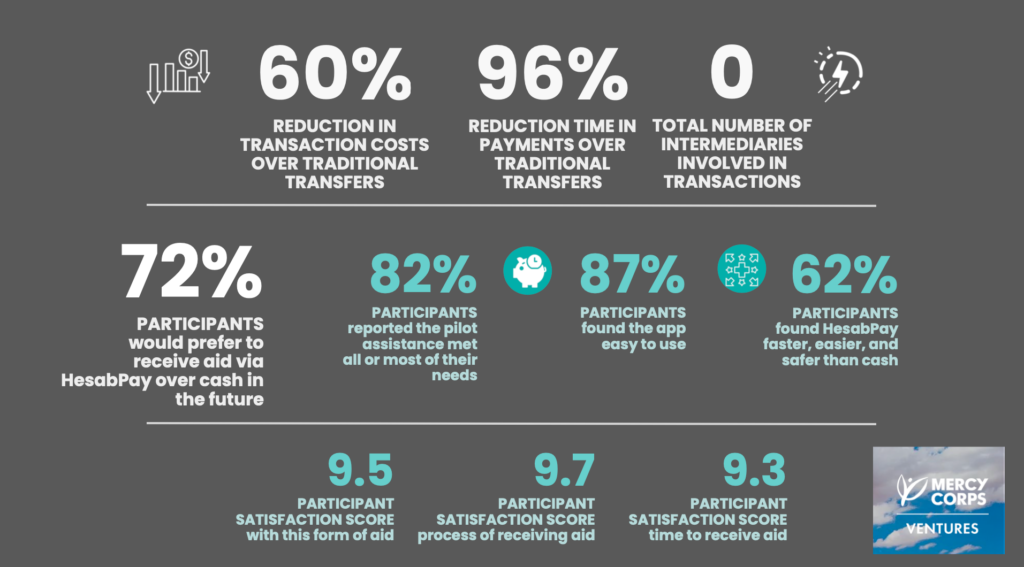
The project sought to measure gains in terms of cost, speed, security, and ease of use. The results of the pilot project indicate that the total cost of the operation via stablecoin represented only 6% of the aid amount, compared to 10% for electronic vouchers and 15% for cash transfers—representing "a cost reduction of 60% compared to cash and 40% compared to [assistance] vouchers[52]". Distribution times also decreased significantly: "funds were received in less than a day, compared to an average of 28 days previously, representing a 96% reduction in waiting time for beneficiaries[53]". Furthermore, the decentralized nature of the project enabled the elimination of all intermediaries between Mercy Corps and the beneficiaries. Every dollar transferred arrived directly in the farmer's digital wallet, with full transaction traceability, thereby eliminating the risks of misappropriation or fraud. A participating farmer highlighted that this system "protects [his] rights" securely and prevents "favoritism or the loss of banknotes". Beyond receiving funds, the wallet allowed farmers to pay local agricultural suppliers directly for their inputs. For suppliers approved by Mercy Corps Ventures, as well as transfer agents, the wallet additionally allowed for the transfer and conversion of stablecoins to a bank account when desired.
Despite a low-trust environment where cash is preferred, adoption appears to have been a success. According to Mercy Corps, "the average participant satisfaction score reached 9.5 out of 10. 72% of beneficiaries stated a preference for receiving aid via stablecoins in the future, citing speed, security, and ease of use. 87% found the mobile application easy to use, and local vendors, initially wary, ultimately viewed it as a source of additional revenue and a mark of trust[54]".
Another pilot program was conducted in Afghanistan in 2022 and 2023 by the Norwegian Refugee Council (NRC), Mercy Corps, and Rumsan/HesabPay[55]. It involved 3,000 families—primarily female-headed households that had lost their sources of income—representing nearly 21,000 individuals, and aimed to provide them with financial assistance. The results of the pilot program showed that "98% of the total value of the transferred aid was spent digitally by beneficiaries within the first eight weeks, despite the absence of a cash-out option', with a 'delivery cost limited to 6 cents per dollar transferred, including beneficiary onboarding costs[56]."
Source image : mercycorpsventures.com
Tech deep diveMercy Corps chose to utilize Circle's USDC stablecoin and the HesabPay payment platform, built on the Algorand public blockchain, selected for the speed of its transactions (funds appear within seconds) and its very low transaction fees (in the order of fractions of a cent). The transfer flow operated from Mercy Corps to a HesabPay "master wallet", which then instantly distributed the USDC stablecoins to the farmers' individual wallets. The 100 participating farmers used the HesabPay[57] custodial crypto-asset wallet, available on iOS and Android smartphones and on the web, and also accessible via USSD[58] codes (or WhatsApp code when telecommunication networks are non-functional[59]) on basic mobile phones, ensuring broad inclusion. Custodial means that the user does not personally hold the private key to their wallet, which allows for the implementation of a recovery mechanism in the event of loss or theft.
HesabPay: the Afghan wallet with 400,000 users
HesabPay is a crypto-asset wallet founded in 2016 by Sanzar Kakar in Kabul, Afghanistan— a country where an estimated 97% of the population lives below the poverty line. The crypto-asset wallet follows a rigorous risk-based compliance program, featuring multi-level identity verification (KYC), integration with WorldCheck to ensure no sanctioned individuals can open an account, and integration with Chainalysis[60] to provide monitoring of all network activity. HesabPay eliminates duplicates, removes distribution costs, and requires no paper currency.
As a sign of its central role in payment infrastructures, by 2023 the platform was already managing the monthly payment of 170,000 electricity bills, totaling 4 million dollars in USDT, a dollar stablecoin issued by Tether. Between its official launch on July 1, 2023, and June 2024, more than 4.5 million transactions were conducted by 400,000 users with 3,000 merchants distributed across Afghanistan's 34 provinces[61].
For the end user, the application remains a simple digital wallet, primarily displaying balances in local currency (Afghani, AFN). In the background, when an international NGO distributes aid, it sends USDT to HesabPay, which then credits the final beneficiaries' wallets. HesabPay uses Algorand as an interoperable settlement rail to connect otherwise siloed entities: mobile network operators, banks, and utility providers. Instead of traditional banking settlements, which are now impossible, these entities can settle accounts with each other almost instantly using the USDT stablecoin on the Algorand public blockchain.
Grassroots Economics is a non-profit foundation established in 2010 in Kenya by economist Will Ruddick, dedicated to "empowering marginalized communities to take charge of their own livelihoods and economic future[62]". Its approach addresses the fundamental problem of liquidity shortages in local economies, which paralyzes trade even when goods and services are available. Grassroots Economics has transitioned from an analog model to a decentralized digital infrastructure. The organization began, between 2010 and 2017, with Community Inclusion Currencies (CICs) in the form of paper vouchers circulating alongside the Kenyan shilling; in 2015, a first digital transition took place via USSD/SMS mobile technology, managed by a centralized database.
Tech deep diveIn 2018, to ensure system transparency and decentralization, Grassroots Economics migrated its ledgers to proof-of-authority blockchains—MakerDAO's xDAI stablecoin, now Gnosis Chain, as well as the Kitabu blockchain—before choosing, in July 2023, to migrate its services to the Celo public blockchain. This chain is optimized for mobile transactions and low-bandwidth environments, while also introducing a sustainable funding model through node validation rewards, thereby reducing reliance on donations.
At the heart of the system lie Community Asset Vouchers (CAV), managed via the open-source platform Sarafu.Network[63]. A Community Asset Voucher is a formalized commitment that an individual or group makes regarding their future goods and services, such as, for example, an hour of labor or a basket of vegetables. By pooling these commitments (Commitment Pooling), communities create an internal medium of exchange that functions as interest-free credit, stimulating trade when national currency is scarce. According to the 2024 Grassroots Economics report[64], there were just over 3,000 monthly active users distributed across 33 different communities (commitment pools)—that is, 33 local markets functioning as small independent economies where members, whether a village, a women's cooperative, or a group of farmers, pool their promises of goods and services. In September 2024, there were 239 unique types of asset vouchers—“digital tickets” representing a specific product or service, such as “1 basket of tomatoes”, “1 hour of repair”, “1 sewing lesson”, etc.—demonstrating the strong diversity of products and services within these micro-economies. In that month of September alone, 144,558 vouchers were exchanged, reflecting the dynamism of this intra-community trade.
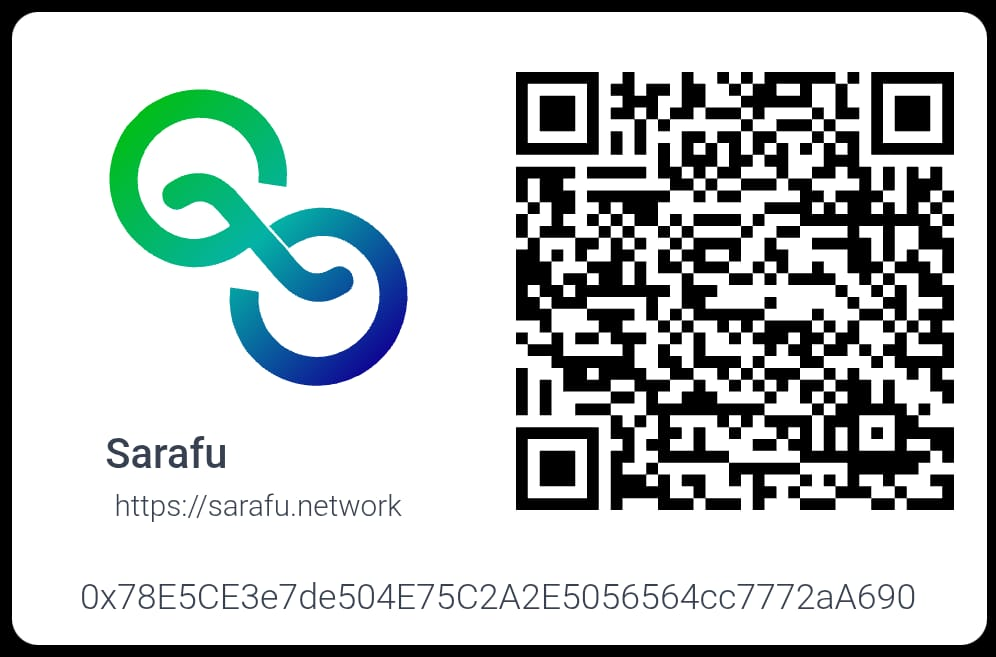
Concretely, a person will generate a paper crypto-asset wallet from a web address, sarafu.network sarafu.network, and print it, download it, or use it online, or connect an existing wallet. Everyone can then create a voucher to offer their goods and services, and exchange it for other vouchers. According to the report, "more than 1,200 acres of land have been restored, food security improved for more than 14,000 people and the construction of more than 30 houses and granaries funded by CAVs". Grassroots Economics has thus evolved from a local initiative in Kenya to a decentralized and technologically advanced economic ecosystem, demonstrating that it is possible to create resilient networks that retain liquidity within local economies while fostering sustainable development. An interdisciplinary team of researchers[65] conducted an economic analysis in 2023; these works reveal that implementing a Community Inclusion Currency is "a valuable, market-based channel for poverty alleviation, complementing humanitarian or government aid channels[66]" while noting that "substitutes for real money, such as CICs, are perceived as inferior, and therefore CIC systems can only be transitory[67]". It thus turns out that this academic study confirms the counter-cyclical nature of this model: the system is designed to switch communities to an alternative system during the occurrence of a liquidity crisis, since beneficiaries will tend to prioritize the local currency, the Kenyan shilling, when it circulates again.
Final example in Malawi, a landlocked East African country between Tanzania to the northeast, Mozambique to the east and south, and Zambia to the west. The joint initiative led by the international NGO Save the Children, via its SHIFT program, Coala Pay[68], and the Malawian youth organization Shift Power Organisation[69] (SPO) between January and May 2025, consisted of evaluating, within a pilot project framework, the use of stablecoins as a direct funding mechanism for initiatives on the ground, to address the mismatch between the very strict operational and compliance requirements of international NGOs and the often informal nature of community and local movements. An initial feasibility study[70] had indeed revealed that, even for modest funding, the SPO was subject to the same complex assessment and due diligence procedures as for grants up to $80,000—standards totally unsuited for a youth structure like SPO.
The project methodology relied on the allocation of total funding of 2,000 dollars, paid in two tranches of 1,000 dollars each. These payments, made in USDC stablecoin, were governed by a smart contract programmed to release funds to the SPO's MetaMask[71] crypto-asset wallet after manual validation of two key milestones: first, the submission of a campaign plan and budget, and second, the presentation of results accompanied by visual proofs, such as photos and videos. The process of converting funds into local currency, the Malawian kwacha (MWK), was carried out via the Yellow Card[72] platform.
The quantitative results of the pilot project were, according to Save the Children, "particularly convincing[73]". Money transfers, completed in less than two minutes, demonstrated speed incomparable to traditional banking systems. Furthermore, transaction costs proved minimal, with network fees, gas fees, not exceeding 0.80 USD. Moreover, the use of USDC stablecoins preserved the value of the funds against the devaluation of the local currency, offering the SPO a purchasing power gain estimated at over 80%. In terms of impact, this funding allowed SPO to deploy an environmental education program in four primary schools: Chidzingwe, Mgwerambavi, Mvunguti, and Kakule. The activities, focused on Reduction, Reuse, and Recycling principles, directly trained 160 students, who in turn shared their knowledge with over 4,000 of their peers.
According to the project leaders, participant feedback was also extremely positive, praising the platform's ease of use while affirming a desire to reuse stablecoins in the future. A member of the SPO summarized the general sentiment by stating: "The process was really easy! And fast! But it also gave us autonomy that we, young people in Malawi, normally do not get[74]". The project nevertheless highlighted a major challenge regarding the process of converting crypto-assets into fiat currency, off-ramping. Daily withdrawal limits imposed by the Yellow Card platform for accounts without KYC forced SPO to split its withdrawals over several days, complicating cash management and adding some 0.5% in fees to each transaction.
2.1.2 Optimization of financial and operational costs
The current global financial system, upon which non-profit organizations rely for their international operations, is a legacy of technologies and processes developed several decades ago. While robust, this system presents structural inefficiencies that directly impact the mission of humanitarian and development organizations. The pillar of this system is the correspondent banking network, which facilitates international transfers via platforms like SWIFT[75]. This model implies that funds pass through a chain of multiple intermediate financial institutions before reaching their final destination. Each intermediary adds delays and levies fees, resulting in settlement times that commonly extend from one to three business days, or even more in certain jurisdictions. This latency is particularly detrimental in emergency response contexts where speed is essential. Beyond delays, costs are a significant burden. The complexity of the existing infrastructure and the number of actors involved often obscure the path and status of payments, making tracking difficult and final fees unpredictable. For an organization, these fees are not merely an operational expense; they represent a direct reduction in the capital available for programs on the ground. Every dollar spent on transaction fees is a dollar that does not reach the beneficiaries.
All non-profit organizations that have implemented a pilot or experiments based on the use of stablecoins attest to a considerable reduction in operational costs, ranging from 70% to 95%. "In traditional models, operational costs typically absorb 10% to 35% of donated funds. DIVA Donate's model reduces operational expenses to just 2.5% of total distributed funds, representing a 75%[76] reduction," explains, for example, DIVA Donate[77], a decentralized conditional donation platform (see infra) working notably with Mercy Corps Ventures. Some non-profit organizations use stablecoins to pay the salaries of staff employed abroad, but also as a means of payment for service providers or local partners[78].
For example, the Union of Medical Care and Relief Organizations (UOSSM) is an international humanitarian and medical NGO. Founded by Syrian doctors from the diaspora as a medical humanitarian organization, it has offices in eight countries. During the war in Syria and until recently, the NGO managed its operations in Syria from the Turkish border, notably thanks to support from GIZ, the German international cooperation agency (Deutsche Gesellschaft für Internationale Zusammenarbeit), since 2018[79]. In response to the Syrian crisis, UOSSM's mission is to provide neutral and impartial medical assistance to populations affected by the conflict, primarily in northwestern Syria, in the Idlib and northern Aleppo regions. It manages a dense network of health infrastructures, including hospitals, primary health care centers, mental health units, and the largest dialysis center in Idlib, the latter supported by GIZ. The operational challenge was to pay the salaries of approximately one hundred employees—doctors, nurses, pharmacists, technicians, and administrative staff—in a secure, rapid, and traceable manner, bypassing the need to transport and distribute large amounts of cash, a logistically complex and high-risk operation.
GIZ and UOSSM International initiated a digital payment pilot project in October 2024 via the Stellar Disbursement Platform (SDP) built on the Stellar public blockchain, whose transaction fees are near zero, to ensure salary distribution to medical staff within seconds[80]. Results from this experiment indicate a reduction of at least 25% in administrative time allocated to payment processing and a saving of 400,000 euros per year in banking and informal fees. Furthermore, the hundred or so employees had no difficulty converting dollar stablecoins into cash via Digibank[81]. The deployment of this solution, widely acclaimed by beneficiaries, was extended to seven hospitals and serves to pay more than 900 employees in 2025[82].
This practice is particularly widespread in countries where access to banking services is limited, where the national currency is weak, or in situations of hyperinflation. Some organizations also use crypto-assets like bitcoin to distribute grants and bypass banking institutions. The "Bitcoin for NGOs" guide published by the Human Rights Foundation gives the example of an organization that made a direct donation in bitcoin to a university and Venezuelan researchers, "because it was the most effective method for cross-border fund transfers, requiring less bureaucracy and lower fees than fiat transfers[83]."
It thus turns out that financial flows in crypto-assets or stablecoins are not subject to any geographic restriction, operate 24/7 every day of the week, can be sent without any intermediary between the sender and the receiver, and cost a fraction of a cent when the transaction passes through the correct protocol.
Beyond simply optimizing financial and operational costs in traditional and hierarchical structures, some organizations are exploring new forms of governance and seeking to experiment with and modify existing vertical models. A particularly interesting initiative is called Big Green DAO, notably because it has been driven for five years by an American foundation that itself has existed for about fifteen years.
Founded by Kimbal Musk, the Big Green DAO was born from a radical vision: "to dismantle the traditional power structures of philanthropy to put grassroots organizations in the driver's seat[84]." In other words, the starting premise is that the people and groups working on the front lines within their communities are best placed to determine where resources should be allocated. Dedicated to food sovereignty[85], the Big Green Foundation was created in the United States in February 2011. Traditionally, a foundation allocates its funds via a restricted board of directors[86]. The Big Green DAO reversed this paradigm by transferring decision-making power to its community—that is, predominantly the leaders of the grassroots organizations funded by the Decentralized Autonomous Organization (DAO).
Since its inception, the Big Green DAO has distributed over $4.5 million to hundreds of organizations across the United States through regular grant cycles called Grant Rounds. For example, the GR3 cycle allocated $720,000 to 37 organizations, and GR4 distributed $595,000 to 45 organizations[87]. With over 171 organizations funded for a total exceeding $4 million since 2021, the Big Green DAO has proven the viability and effectiveness of its decentralized approach[88]. In June 2025 alone, during its eighth funding cycle, the DAO approved the distribution of nearly $500,000 for 34 new projects, with amounts ranging from $10,000 to $20,000 per initiative.
This DAO is characterized not only by community-operated governance but also relies on an innovative grant attribution system. Governance within the Big Green DAO is entirely in the hands of its community. Members can propose and vote on all aspects of the organization, from the selection of grant beneficiary organizations to modifications of the governance rules themselves[89]. This power is distributed and exercised via a governance token system, designed to align incentives and prevent the concentration of power[90]. The DAO uses three distinct types of tokens[91]:
- The $GARDEN token is awarded to non-profit organizations that become members of the DAO, generally after receiving a grant. This token is non-transferable to prevent any financial speculation. Its voting power is revoked ("burned") if not used during two consecutive grant cycles, ensuring that only active and engaged members retain their influence.
- The $GARDENDONOR token is awarded to donors who contribute above a certain threshold, for example, 1 Ether. This token is also non-transferable. Its voting power has a lifespan limited to one year, encouraging continuous engagement rather than perpetual influence stemming from a single donation.
- The $GARDENEXEC token is held by members of the DAO Committee and used for votes specific to this committee.
The DAO Committee plays a steering and facilitating role, rather than an authoritarian directive one. It is composed of representatives from member organizations of the community and is renewed through a community election process[92]. Its mission is to set broad annual guidelines and ensure that decisions are made in the best interest of the community and the cause[93]. In recognition of their commitment, organizations represented on the committee receive an annual grant[94].
As for the grant attribution process, it is the operational heart of the DAO. It is designed to be as simple and efficient as possible for applicants, thereby reducing the burden traditionally associated with fundraising[95]. The cycle proceeds in three stages: application, voting, and allocation[96].
The final decision is not based on a simple majority rule (50% + 1), but on an "optimized consensus" mechanism designed to "reflect the majority perspective of the community[97]." This sophisticated approach is made possible by the use of an advanced voting tool, Ethelo[98], which boasts of having managed the budget allocation of $100 million for over 250,000 stakeholders over ten years[99]. Unlike binary voting platforms, Ethelo is a consensus engine that explores a multitude of possible scenarios to identify the outcome that comes closest to the overall satisfaction of all participants, not just a simple majority[100]. Ethelo's philosophy, inspired by justice theorist John Rawls[101], aims to find fair outcomes that unite the community rather than polarize it[102]. The Big Green DAO has also used Ethelo in conjunction with quadratic voting[103], a funding allocation model that gives more weight to the number of donors than to the individual donation amounts[104]. Organizations that succeed in this process receive an unrestricted grant, community member status, and a $GARDEN governance token. This system creates a virtuous loop where today's beneficiaries become tomorrow's decision-makers, continuously strengthening power and expertise within the grassroots community[105].
According to Kimbal Musk, this model drastically reduces structural costs. Where a traditional foundation devotes up to 15% of its budget to operational and personnel costs, the Big Green DAO operates with less than 5% overhead. The impact is direct: out of a capital of $100 million, $95 million would go directly to projects, compared to $65 million in the classic model. The dual objective is to improve the social return on investment by entrusting decisions to field experts, and to establish transparent and quantifiable governance.
2.2 Innovations specific to Web3
Web3 offers structural innovations that redefine governance and institutional funding. The first part of this section examines inter-agency coordination and decentralized governance (2.2.1), illustrated by systems like the World Food Programme's Building Blocks and philanthropic DAOs, which aim to eliminate duplication and decentralize decision-making. The second part (2.2.2) highlights the emergence of crypto-philanthropic funds driven by NGOs, such as the UNICEF CryptoFund, which invest on-chain in impact start-ups to generate traceable digital public goods, as close as possible to the aided populations.
2.2.1 Between inter-agency coordination and decentralized governance
Modern humanitarian aid faces major structural challenges, notably high transaction costs that deplete already limited budgets, critical delays in the routing of funds, as well as a severe lack of inter-organizational coordination generating inefficiencies and redundancies.
Several financial optimization and coordination projects have been launched by traditional Organizations and institutions, such as Building Blocks, deployed by the World Food Programme (WFP), TruBudget[106], initiated by the German Development Bank[107], or FundsChain, launched more recently by the World Bank[108]. All share the specific feature of being built on private blockchains, justifying this approach by the desire "to ensure an increased level of security and control[109]".
The multiplication of intermediaries and the diversity of actors on the ground, particularly during severe humanitarian crises, simultaneously increase the risks of error, fraud, or misappropriation. Faced with this reality, the United Nations World Food Programme initiated the Building Blocks project in 2017 "to eliminate duplication in order to support organizations in preventing unintended overlaps, optimizing resources, and improving efficiency as well as equitable humanitarian aid outcomes, ultimately serving populations in a more secure and efficient manner[110]".
The project positions itself as an inter-organizational coordination meta-system whose role is to interconnect the internal systems of different agencies to coordinate collective assistance, thereby avoiding duplicates and fostering a holistic approach to the aid received by beneficiaries. Thus, Building Blocks does not replace the internal Enterprise Resource Planning (ERP), beneficiary registration, biometric management, or Monitoring & Evaluation (Measure & Evaluate) systems of member organizations, but integrates with them.
The architecture relies on an Ethereum-type private blockchain. This infrastructure is "permissioned", meaning that only approved humanitarian bodies can join the network, consult data, and validate transactions. Beneficiaries are identified via pseudonymous identifiers without any personal data such as name, date of birth, address, or any biometric data being recorded on the private blockchain, as this information remains in the centralized systems of each organization.
Since the first pilot, conducted in Pakistan in January 2017 by the World Food Programme, the project is now deployed in Bangladesh, Jordan, Lebanon, and Ukraine. From June 2019, UN Women used the Building Blocks platform in the Za'atari and Azraq refugee camps in Jordan[111], then extended its use to the Kakuma camp in Kenya in 2020[112]. In Jordan, the aid distributed by UN Women fell within the framework of "cash-for-work" programs, where participants received an allowance in exchange for their contribution to activities within the "Oasis" centers for the resilience and empowerment of women[113]. The project began with a pilot to support 200 women and progressively expanded to approximately 100,000 refugees in these camps.

Source image : Building Blocks https://innovation.wfp.org/project/building-blocks
In Ukraine, between 2022 and 2024, the system processed data for over 4.8 million unique households and identified and prevented 855,000 cases of duplication. These deduplication efforts reportedly led to savings of over 200 million dollars[114].
In 2024, it served as a coordination platform for 65 organizations, generating 67 million dollars in savings. The use of a Distributed Ledger Technology (DLT) provides an immutable record of transactions, which is a major draw for aid transparency and accountability[115]. Since 2023, Building Blocks has been an ecosystem open to other UN agencies, with free membership for eligible organizations. Each member pays 400 USD/month to operate its own validation nodes on the cloud, hosted by Amazon Web Services, but to date, only UN Women has joined the ecosystem. Since its implementation, approximately 300 million dollars of humanitarian aid have been distributed via the platform to over one million beneficiaries, with fees reduced by 98%—enough to allocate more resources to the benefit of aided individuals, and also providing the UN agency with a complete and internal history of every transaction[116].
However, Building Blocks is subject to significant structural criticism, mainly related to its technical architecture and its impact on beneficiary privacy. One of the main critical arguments is that, although Building Blocks is presented as a 'blockchain application', it operates on a private-permissioned blockchain[117] of the Ethereum type, developed with Accenture and Microsoft. in the early phases, particularly for the implementation in Jordan, the system operated on a single node on an Ethereum fork[118]. Critics note that this configuration made it technically equivalent to a centralized and proprietary database, thereby losing the fundamental advantages of decentralization[119].
The governance architecture poses a problem because, historically, the World Food Programme was the sole platform manager, holding the transaction records. Indeed, this unilateral control raises concerns regarding the impartiality and credibility of the system, and dissuades other operational partners from joining, for fear that the World Food Programme might exercise exclusive influence in favor of its own objectives. Debates also surround the project, particularly regarding the fact that its code is not open source, justified by a lack of resources and a desire not to discourage partners. The question of a transition to open source will be put to a member vote 'once a critical mass is reached', explain the project leaders[120].
Finally, the integration of Building Blocks with UNHCR's biometric identity systems (PRIMES/iris scan) is a source of major ethical controversy[121]. Researchers point out that this approach 'financializes'[122] refugee data, transforming information on displaced persons into digital footprints capable of being used by financial institutions. The absence of common data protection standards and the legal immunity of UN agencies create 'outsourcing loopholes'[123], allowing private technology companies, such as Accenture, Microsoft, or Cairo Amman Bank—which have received millions of dollars in contracts to develop these programs—to test new technologies on displaced populations without direct accountability.
This cyber-humanitarianism, through the use of biometrics without any safeguards, is at the heart of the critique—rightly so—of crypto-colonialism. Beneficiaries have no control over the data held by operators. Yet the biometric identity system used by the World Food Programme is the one implemented by the United Nations High Commissioner for Refugees (UNHCR) since 2013, which relies on an iris recognition solution developed by Irisguard, a private British company founded in 2001[124]. Its first major contract, in 2002, concerned border control with the United Arab Emirates (UAE) to allow them to distinguish citizens from 'deportees', namely foreign workers attempting to return to the UAE with new documents. Used by governments, NGOs, and a large number of retail banks in the Middle East, Irisguard has developed EyePay, an iris recognition system for the unbanked, deployed in various contexts including border control, cardless ATMs, and supermarket points of sale.
Today, this system allows for the verification of a person's identity in less than three seconds to authorize a transaction or aid distribution. To date, Irisguard claims to have processed over 18 billion dollars in transactions for more than 10 million people[125]. However, a report published[126] by Oxfam in 2018 concludes that the risks associated with holding large quantities of immutable biometric data (legal, security, reputational) outweigh the potential benefits in almost all cases. These data represent a high-value target, as tragically illustrated by the cyberattack against the International Committee of the Red Cross in 2022, which led to the theft of data from over 515,000 vulnerable people[127]. Although Building Blocks does not store beneficiary biometric data on its private blockchain, keeping it in the centralized systems of member agencies merely shifts the risk without eliminating it. The creation of proprietary and private IT systems, based on the collection of sensitive and immutable biometric data, held by commercial companies in a quasi-non-existent regulatory context, poses countless questions regarding refugee privacy and human dignity.
Traceability of funds in the context of development aid is also one of the major challenges of humanitarian aid and stems from the complexity of its ecosystem, fueled by the multiplicity of donors—whether states, international organizations, NGOs, or private foundations—each having its own priorities, mechanisms, and requirements, which often leads to a fragmentation of efforts and, frequently, a lack of coordination. Furthermore, funds may transit through banks, money transfer systems, online platforms, or even informal channels, making their traceability extremely difficult. This opacity also fosters redundancy in transaction costs, with each intermediary taking a cut, thereby reducing the efficiency of the allocated aid. A particularly concerning problem is the impossibility—sometimes disguised or intrinsic—for institutions in the aided country to track the precise use of funds. This lack of transparency may be due to inadequate financial management systems, a lack of technical capacity, or a deliberate desire to conceal certain expenditures. This situation prevents beneficiary countries from evaluating the actual impact of aid, planning their own budgets effectively, and being accountable to their citizens. It also opens the door to corruption and resource waste, diverting aid from its initial objectives of supporting development and improving populations' living conditions. According to an OECD report published in 2021, 'sometimes, the partner country's treasury may not even know the status of a disbursement or the money coming in, which compromises the national investment budget planning process'[128].
It is based on this observation that KfW Entwicklungsbank, the German development bank, has been developing TruBudget since 2018 (Trusted Budget Expenditure Regime), open-source software whose object is to 'increase the efficiency and traceability of funds by offering member states and donors greater transparency in resource allocation'[129]. TruBudget is an application that allows a consortium of actors to create their blockchain network in order to record funding and expenditure processes corresponding to the monitored project.
A pilot was funded by the German Federal Ministry for Economic Cooperation and Development (BMZ) in 2018 in Burkina Faso. The Burkinabé government thus configured TruBudget, renamed SIGFE (Information System for External Fund Management), and uses a permissioned blockchain shared between the various ministries, local IT systems—to automate data exchanges—and donors.
Today, some 25 development projects are managed via this platform, involving more than ten ministries and multiple international donors. In Ethiopia, TruBudget is used to jointly manage projects funded by KfW in the field of higher education. Other pilots are still in a preparatory stage: for example, Tunisia is developing the Loans and Support Fund for Local Communities (CPSCL) based on TruBudget, with Smart Africa and Gavi, the Vaccine Alliance, supported by the Bill and Melinda Gates Foundation. The Brazilian development bank BNDES also tested the device in 2018 to manage part of the Amazon Fund, notably from private individuals, then the project was suspended from 2019 to 2022 to resume in 2023.
Tech deep diveTruBudget is open-source software operating on a permissioned blockchain where each involved entity, such as a ministry or an administration, operates its own node on the blockchain network. Each action, each document validation, or each payment is a transaction recorded on the distributed ledger and visible to authorized persons within each of the other nodes. In April 2019, KfW published the source code of TruBudget, now accessible as open source on the GitHub[130] platform, allowing anyone to use, adapt, and develop it. It has also since been certified as a Digital Public Good[131], by the Digital Public Goods Alliance (DPGA), which facilitates its adoption by low- and middle-income countries without licensing fees
2.2.2 Crypto-philanthropic funds driven by NGOs
To overcome the structural obstacles of humanitarian aid, such as financial opacity and logistical inefficiencies, UNICEF has established itself as a major player in innovation. As early as 2014, the organization created a Venture Fund, an investment vehicle intended to provide seed capital to tech start-ups developing solutions for children in emerging markets. Five years later, in 2019, the fund took a decisive step by launching its CryptoFund, thus becoming the first United Nations entity to operate a fund capable of receiving, holding, and disbursing donations natively in crypto-assets like Bitcoin (BTC) and Ether (ETH). This initiative was not a simple experiment but the natural evolution of its strategy, aiming to exploit the potential of Distributed Ledger Technologies (DLTs) to reshape the mechanisms of philanthropy.
The CryptoFund model is an illustration of venture philanthropy. It makes equity-free investments in seed-stage companies, on the essential condition that their technologies be open source. This requirement ensures that the funded innovations become "digital public goods", freely accessible, adaptable, and reusable, thus creating a multiplied social impact. Transparency is the pillar of this system. The entire journey of a donation, from a contributor's wallet—like the Ethereum Foundation—to the beneficiary start-up, is recorded immutably on a public blockchain. Any observer can thus verify the "proof of transaction" of each investment, offering an unprecedented level of auditability and trust. By the end of 2024, the global portfolio of the Venture Fund, which encompasses the CryptoFund, counted 153 investments in 87 countries, having benefited more than 174 million people.
Atix Labs, for example, an Argentine company, benefited from one of the first CryptoFund investments to develop its open-source platform AGUA[132]. This solution tackles the challenge of financial opacity in the social sector by using a blockchain to ensure complete and verifiable traceability of funds. The technical principle is to link the disbursement of funding to tangible and predefined results. Concretely, a project is broken down into several stages, each associated with clear and measurable objectives. Funds are not paid out all at once but are locked in a secure smart contract on the Bitcoin blockchain[133].
The release of successive tranches occurs only when the funding recipient provides proof that the objectives of the previous stage have been met. This "proof of impact" can take various forms, such as validated reports, geolocated data, or third-party confirmations. This mechanism assures donors and public institutions that their funds are used efficiently, transforming project monitoring from a declarative process to a system based on proofs auditable by all.
Another example: in Bangladesh, despite progress in extending vaccination coverage since the 1980s, systemic challenges persist, leaving hundreds of thousands of children under-vaccinated or unvaccinated. The issue is particularly acute in densely populated urban slums and remote rural areas, where tracking children is complex. Traditional paper-based systems, prone to loss and errors, and fragmented digital systems hinder health workers' ability to identify and reach children. It is in this context that UNICEF, in collaboration with the Government of Bangladesh and Gavi, the Vaccine Alliance, uses a decentralized platform created by StaTwig[134], a startup from the UNICEF Venture Fund.
VaccineLedger, used in Bangladesh under the name eVLMIS (Electronic Vaccine and Logistics Management Information System) or VaxIN, is a digital system that ensures end-to-end traceability and transparency of vaccines. Rather than being limited to a simple digital registry, StaTwig's open-source solution uses a public blockchain to create an immutable and shared record for every child and every vaccine vial.
Concretely, when a child is brought in for their first vaccination, the health worker creates a digital file for them in the VaxIN application based on an identifier, linked to basic information (name, date of birth, parent information) collected from the family. In parallel, each vaccine batch has a digital identifier that is tracked in real time from national warehouses to local health centers. Field health workers, more than 20,000 of whom have been trained, use a mobile application—functioning online and offline to adapt to low-connectivity areas—to scan vaccines and update the child's record at the moment of administration.
This architecture ensures that the right vaccine is administered to the right child at the right time, but also monitors the cold chain thanks to temperature sensors whose data can be integrated into the registry. The immutability of the ledger guarantees the integrity of vaccination records, protecting them against any alteration or accidental or fraudulent deletion, a crucial advantage over paper systems or vulnerable centralized databases. The system's transparency and auditability allow public health supervisors and managers to track vaccine stocks in real time, identify bottlenecks in the supply chain, and reduce waste, thanks to real-time dashboards, predictive analytics, and automated alerts. The system's success was proven during the national typhoid campaign, where it managed the distribution of vaccines to millions of children[135]. Finally, this approach fosters interoperability with other national health information systems. By providing a secure and portable digital identity, the system ensures continuity of care for families who move, while laying the foundations for an ecosystem of "digital public goods" where essential data can be shared securely to improve access to other vital services.
By operating entirely on public blockchains to ensure investment traceability, UNICEF encourages its portfolio companies to become crypto-native themselves, which accelerates the adoption and development of blockchain solutions for social good. The donor therefore does not just fund an isolated project but catalyzes a whole ecosystem of sustainable and open innovation.
For non-profit organizations, the integration of crypto-assets and Distributed Ledger Technologies (DLTs) therefore goes far beyond the simple diversification of funding sources and represents new tools, both strategic and operational, which do not, however, replace the foundations of humanitarian work.
Chapter 3: From the beneficiary's perspective: direct and inclusive aid
The promise of Distributed Ledger Technologies (DLTs) is to offer more direct, rapid, and efficient aid to vulnerable populations, particularly the "invisibles" who do not have access to traditional financial systems and those who cannot provide proof of identity. However, this convergence raises significant ethical and structural challenges. The first section (3.1) will address this duality by detailing the financial inclusion mechanisms offered by projects built on Distributed Ledger Technologies (DLTs), while highlighting the peril of crypto-colonialism. This critique highlights the risk that the implementation of digital solutions, often private, reproduces or amplifies historical power dynamics, notably via the "financialization" of displaced populations' data. The second section (3.2) will examine the emergence of Decentralized Micro-finance (Micro-DeFi), which seeks to use Decentralized Finance tools to overcome the inherent limits of traditional microfinance.
3.1 Between better inclusion and the risk of crypto-colonialism
As a pharmakon, to borrow Stiegler's concept[136], Distributed Ledger Technologies (DLTs) reveal their ambivalent nature for beneficiary populations: both a remedy (3.1.1) representing immense transformative potential and a poison (3.1.2) introducing major new ethical and social risks.
3.1.1 Unprecedented inclusion
From the beneficiary's perspective, the advent of Distributed Ledger Technologies (DLTs) constitutes a profound break from traditional aid mechanisms. The main advantage lies in the capacity of these tools to effect a radical disintermediation, offering for the first time direct access to financial resources for the most marginalized populations of the global system: the unbanked. The classic philanthropic system indeed runs up against the systemic barrier of necessarily relying on a fiduciary and banking infrastructure to which billions of individuals do not have access. This exclusion forces aid to pass through multiple intermediaries, causing fees, delays, and security risks for the final beneficiary, often forced to collect cash at centralized distribution points.
It is important to specify that DLTs must not be presented as the sole answer to the lack of banking access. Many regions of the world already possess high-performing financial inclusion systems via mobile money (M-Pesa, MTN Mobile Money, Orange Money, Wave, etc.), often more accessible and robust than current crypto solutions. Web3 does not necessarily bring a "first inclusion", but structurally different functionalities: programmability, transparency, global interoperability, and resilience in contexts where conventional financial systems fail. These mechanisms do not replace existing systems but allow for the creation of new financial layers, capable of operating even in the event of a local banking freeze, as in Afghanistan, Myanmar, or Sudan, which constitutes an advantage rarely accessible via traditional mobile money systems.
How are hospital employees in the northwest region of Syria paid?
In the context of the Syrian conflict, which began in 2011 and led to the collapse of state and financial infrastructures, the northwest region of Syria is particularly isolated. Due to this war situation and the near-total absence of a formal banking system, most hospital employees were paid through a complex and high-risk cash-based process, involving multiple intermediaries. GIZ, the German international cooperation agency (Deutsche Gesellschaft für Internationale Zusammenarbeit), first sent the funds to the accounts of the international NGO UOSSM in Turkey, the Union of Medical Care and Relief Organizations (Union of Medical Care and Relief Organization, UOSSM). From this border country, which had become the main rear base for humanitarian aid, UOSSM transferred the monthly salary funds to Syria using the Turkish National Post and Telegraph Directorate, a national service offering financial and logistical services such as fund transfers. An authorized member of the UOSSM staff then had to withdraw the funds, in cash, at a Turkish Post branch located in northwest Syria. They then handed them over to a local exchange agent, an authorized representative operating as a liquidity point. The representative of this liquidity point then had to transport the funds—a logistically burdensome and perilous operation in a conflict zone—to the health facilities, where salaries were finally distributed to staff using physical cards, which also served as proof of payment. To ensure supervision of this manual payment chain, distributions were carried out in the presence of the facility's accountant and a representative of Innovation Consulting & Solutions, a third-party organization that helps facilitate equity in humanitarian and development efforts in the Middle East and North Africa[137].
Crypto-assets, whether stablecoins or cryptocurrencies, provide an alternative, resilient, and universal financial infrastructure. For the beneficiary, the only requirement to access these funds is access to a crypto-asset wallet, most often via a simple mobile phone. This technological simplicity bypasses the need for formal civil identity—a major obstacle for refugees, internally displaced persons, or populations without civil registration.
For the beneficiary of this new kind of aid, the advantages are numerous. Aid can be transferred almost instantly from donor to individual, eliminating the delays inherent in international bank transfers and complex disbursement processes, especially in emergency situations. Transaction fees are significantly reduced compared to traditional remittance services, meaning a greater proportion of donations reaches the beneficiary directly. Although transaction privacy is a key aspect, the immutability and transparency of distributed ledgers allow, under certain conditions, for the tracking of the origin and destination of funds, reinforcing donor confidence and reducing the risks of misappropriation. By receiving funds directly into a crypto-asset wallet, beneficiaries have the freedom and capacity to decide how and when to spend their money, without being constrained by in-kind aid programs or imposed supplier lists; this autonomy reinforces their dignity and power to act on their own situation. Storing funds in a crypto-asset wallet eliminates the need to transport large sums of cash, thereby reducing the risks of theft or extortion, which are frequent in conflict zones or areas of extreme poverty.
Finally, for billions of people who were excluded from the formal financial system, crypto-assets offer a gateway to financial inclusion.
Beyond direct financial inclusion, Distributed Ledger Technologies (DLTs) offer a novel solution to a fundamental problem of social exclusion for persons without legal identity—whom the UN agency ecosystem calls the 'invisibles'. For instance, the United Nations High Commissioner for Refugees (UNHCR), working directly with stateless populations and refugees, notes they are often devoid of identity documents and thus 'legally invisible'[138]. Similarly, UNICEF focuses on identity from birth, on the grounds that a 'child who is not registered at birth is invisible to the government. Without proof of identity, children are often excluded from health care, education, and other vital services, and are more vulnerable to exploitation and abuse'[139]. This invisibility affects at least 850 million people worldwide[140]—refugees, stateless persons, displaced populations—who, deprived of state-recognized proof of identity, are prevented not only from accessing banking services but also essential health services, education, and even civil registration, thus perpetuating a cycle of vulnerability and marginalization.
It is in this context that the potential of Decentralized Identifiers (DIDs) and Verifiable Credentials becomes truly transformative[141]. These technologies allow for the establishment of self-sovereign digital identity. Identifiers are created and managed by the user, who retains total control over them. Different identity property providers can then issue Verifiable Credentials, the proof of source and integrity of which are anchored on a blockchain. Unlike traditional identification systems that depend on a single central authority, this decentralized identity can be built from multiple Verifiable Credentials that contribute to forging a robust digital identity, without any single entity having a monopoly on its validation or revocation. Credential data is not directly stored and exposed on a blockchain (which contains only the traces allowing for their verification) but is ideally recorded locally and directly by the user themselves on their decentralized identity wallet, thus limiting massive centralized data leaks.
By holding ownership and control of their own digital identity, the beneficiary emerges from invisibility and acquires the capacity to prove who they are, in a portable and secure manner, without being subject to the constraints of a single centralized system, which is often inaccessible or failing in crisis zones or for vulnerable populations. This identity autonomy opens access to financial inclusion but can also unlock access to health care, by enabling a secure and shareable medical history; to education, by authenticating diplomas and academic records; and even to forms of civic and economic participation, by enabling proof of digital citizenship or professional skills.
3.1.2 The peril of crypto-colonialism
The rapid development of Distributed Ledger Technologies (DLTs) and crypto-assets in the aid and philanthropy sector, while promising better financial inclusion, also raises serious concerns regarding the reproduction of historical power dynamics, a phenomenon referred to by critics as crypto-colonialism[142].
The critique of digital colonialism targets a social system where a restricted number of influential actors, often technology companies, operate globally and exercise an unequal concentration of power[143]. This system is characterized by the extraction of profits, data, labor, and natural resources, while imposing cultural norms and ensuring dependence on products, all justified by a discourse of progress and benevolence[144].
The term 'crypto-colonialism' specifically describes neo-colonial processes where blockchain technology facilitates new forms of appropriation of resources from the Global South to catalyze economic growth elsewhere. The Global South refers to regions still suffering the effects of past colonial expansion[145].
Although presented as solutions for aid and the improvement of living conditions, digital technologies, including the use of crypto-assets, risk amplifying historical forms of colonization and maintaining power inequalities[146].
One of the most frequently cited illustrations of crypto-colonialism is that of Puerto Rico, studied following Hurricane Maria[147] which struck the island in September 2017, notably by Naomi Klein. The promise of blockchain decentralization was instrumentalized by wealthy investors to test the technology there on a state scale, according to objectives they had defined themselves. This phenomenon is motivated by tax optimization and the promise of transforming the region, which tends to relativize the stated philanthropic objective. The discourses held by investors construe the local population as a colonial and underdeveloped 'other'[148], naturally in need, whose economy must be assisted by outside 'great minds'[149] to transition from an agrarian economy to an information economy. This dynamic maintains and reproduces the existing relationship of colonial domination.
The use of private blockchains in humanitarian aid fits into a pattern not unlike the pitfalls of traditional aid. Researchers[150] point out that the absence of common data protection standards and the legal immunity of UN institutions create 'outsourcing loopholes'[151]. These loopholes allow technology companies to test new solutions, such as biometrics or Distributed Ledger Technologies (DLTs)—often private ones—on displaced populations without incurring direct liability.
In certain humanitarian programs using blockchain, such as those involving the UNHCR and the World Food Programme with private companies, there is a risk of 'financialization'[152] of information on displaced persons, their data being converted into digital footprints used for verification and transactions.
The biometric crypto-asset project Worldcoin is another representative example of this issue[153]. The company targets fragile populations and unregulated territories in the Global South through aggressive promotional strategies, offering money either in local currency or in crypto-assets in exchange for the collection of biometric data, consisting of an iris scan as well as a facial scan[154]. This process aims to capture markets and extract valuable data by presenting itself as a form of 'social aid'."
Worldcoin: biometric data for a handful of crypto
Worldcoin, the project co-founded in 2019 by Sam Altman, CEO of OpenAI, aims to create a global digital identity based on iris recognition. Worldcoin has deployed "Orbs", a proprietary technology used to scan the iris and other biometric data in numerous countries, meeting particular enthusiasm in Latin America, notably in Argentina. However, the massive collection of biometric data has raised significant concerns regarding privacy protection, leading to investigations, suspensions, or bans of its activities by several national authorities—notably in Spain, via its Data Protection Agency (AEPD), which ordered in March 2024 the temporary cessation of data collection and processing on its territory. The notion of informed consent surrounding the possible storage and transmission of biometric data (though unnecessary by default) has been severely challenged, as the user was encouraged to grant these permissions by the "Orbs" operators. Portugal has also taken similar measures to limit data collection, while the Office of the Privacy Commissioner in Hong Kong has launched an investigation. Kenya had already suspended the project as early as the summer of 2023 for security and data protection reasons, and in May 2025, the Indonesian Ministry of Communication froze Worldcoin's activity, citing the absence of a license for biometric data collection. Investigations and questions have also been raised in Germany, which supervises the project at the European level.
The number of individuals having scanned their iris in exchange for a "World ID" and WLD crypto-assets has seen significant growth, although the most recent figures vary according to sources and the progress of deployment. According to Worldcoin's response to a question addressed to the European Parliament in March 2024[155], more than 4.5 million people in 120 countries had already provided their biometric data. In Argentina, the success was particularly notable with registration spikes, such as in August 2023 when 9,500 people had their irises scanned in a single day in the capital, Buenos Aires. In Chile, in September 2023, the project had attracted 200,000 people, representing 1% of the country's population.
In September 2025, the World App application, which serves as a wallet for the World ID and WLD tokens, counted approximately 33 million users. Of this total, seven million reportedly have a verified "World ID", a figure difficult to confirm.
The peril of crypto-colonialism lies in the fact that, without a thoughtful and locally grounded approach, technological aid solutions can not only fail to correct inequalities but also reproduce a model of development imposed from the top down, keeping beneficiaries in a state of "permanent assistance" and dependence, rather than fostering the empowerment and sovereignty of local populations, while also, through the use of biometric data with virtually no safeguards, permanently jeopardizing the personal data of millions of people around the world—among those who might still be able to defend themselves.
The paradigm of decentralized identity and Verifiable Credentials is also subject to criticism from academics, such as Margie Cheesman of the University of Oxford, who views these self-sovereign identity systems as "simultaneously the potential catalyst for new modes of empowerment, autonomy, and data security for refugees, and a means of maintaining and extending bureaucratic and commercial power"[156] and for whom, "if self-sovereign identity continues to be routinely depoliticized in the aid sector, the particular ways in which identities are configured, the social biases they instill, and the harmful consequences of this social sorting will be overlooked"[157].
3.2 Towards the emergence of Decentralized Micro-finance (Micro-DeFi)?
Microfinance was designed to include those excluded from the traditional banking system, but it faces significant structural limitations. This chapter examines the inherent limits of traditional microfinance (3.2.1), such as high transaction costs and lack of liquidity, before presenting the opportunities offered by the emergence of Micro-DeFi (3.2.2), which seeks to overcome these obstacles by using Decentralized Finance tools, notably on-chain credit history and access to global liquidity for more transparent funding.
3.2.1 The inherent limits of microfinance
If so-called inclusive finance exists, it is indeed because traditional finance excludes—perhaps because the risk is not worth the cost. It is from this observation that microfinance, a concept born in 1976 within traditional finance and awarded a Nobel Prize in 2006, came into being.
The modern history of microfinance is inseparable from that of Muhammad Yunus, a Bangladeshi economist. In the 1970s, while Bangladesh was struck by famine, Yunus was a professor of economics at the University of Chittagong. Struck by the discrepancy between the grand economic theories he taught and the misery he observed, he realized that poor craftswomen could not buy their raw materials for lack of a few dollars and were exploited by pawnbrokers. In 1976, he decided to personally lend the equivalent of 27 dollars to a group of 42 women. All of them repaid him. This experience led him to create the Grameen Bank in 1983—the "village bank"—whose model relies on trust and solidarity. Loans are granted without material collateral, often to groups of women who act as guarantors for one another, in the form of a joint liability group. This approach not only ensures very high repayment rates, often exceeding 95%, but also strengthens social bonds and the empowerment of women, who constitute the vast majority of borrowers. For this innovation, Muhammad Yunus and the Grameen Bank received the Nobel Peace Prize in 2006, enshrining microfinance as a major tool in the fight against poverty.
Microfinance thus refers to the range of financial services—micro-credit, micro-savings, micro-insurance—intended for low-income individuals, generally in the Global South, who do not have access to traditional banks. The fundamental idea is that even very small sums can enable individuals to start or develop an income-generating activity, and thus improve their living conditions. Since its inception, microfinance has experienced exponential growth and has widely spread beyond the Grameen Bank, through NGOs but also commercial banks, cooperatives, microfinance institutions (MFIs), and for-profit crowdfunding platforms.
The impact of microfinance can be measured on several levels. In 2019, the number of microfinance clients worldwide was estimated at over 140 million, with a global loan portfolio of nearly 124 billion dollars. For many "micro-entrepreneurs", access to credit, however modest, is the starting point for an activity such as buying livestock, a sewing machine, goods for a small business, or seeds for a farmer. This micro-capital allows them to generate income, smooth their consumption, and cope with unforeseen events. Beyond the purely economic aspect, microfinance also has profound social impacts. It contributes to the empowerment of individuals, particularly women, who, by managing their own activity, gain independence, confidence, and status within their families and communities. Additional income is often invested in children's education and the improvement of household health and nutrition. Microfinance played a pioneering role in financial inclusion and demonstrated that it was possible and profitable to provide financial services to the poorest, paving the way for other innovations like "mobile banking", which is experiencing resounding success in Africa and Asia.
But this optimistic vision must not obscure a certain number of limitations and pitfalls observed on the ground and widely documented. One of the main criticisms leveled at microfinance today is the often very high level of interest rates. While microfinance institutions justify these rates by significant operational costs, such as managing numerous small loans or monitoring clients in rural areas, they can reach levels of 30%, 50%, or even over 77% per year in some cases[158]. Such rates transform a tool of emancipation into a trap, and many borrowers, struggling to generate sufficient profits to repay their loan, find themselves forced to take out a new credit to repay the previous one, thus entering a spiral of over-indebtedness. This phenomenon was particularly visible during the Andhra Pradesh crisis in India in 2010, where aggressive lending practices and usurious rates led to a wave of suicides among over-indebted farmers, casting lasting discredit on the sector.
"Added to this are forms of social pressure, sometimes excessive, in joint liability mechanisms such as daily visits, community stigma in case of delay, the exclusion of women's groups, or even coercive collection practices. These dynamics, documented by the World Bank[159] and the Abdul Latif Jameel Poverty Action Lab (J-PAL)[160], show that microfinance can reinforce certain vulnerabilities instead of alleviating them,"[161] explains Inès d'Haultfoeuille.
Furthermore, microfinance struggles to reach the poorest of the poor. Microfinance institutions, concerned with their financial viability, tend to lend to those who already have a small activity and a certain repayment capacity. The most destitute, marginalized, and vulnerable populations, such as the homeless and the sick, are excluded from these programs because they are deemed too risky[162]. Moreover, numerous impact studies[163] have shown that while microcredit helps smooth consumption and cope with shocks, it has a much more modest effect on sustainably escaping poverty[164].
Most funded activities remain very low value-added subsistence activities, which do not allow for real capital accumulation or job creation[165]. Microcredit helps manage poverty, but it is not always sufficient to escape it.
At the macroeconomic level, several analyses, notably from CGAP[166]—a global partnership housed within the World Bank—and the Overseas Development Institute[167] (ODI), highlight that the positive effects of microfinance are largely neutralized as soon as contexts become unstable: inflation, local currency depreciation, climate risks, political crises. This discrepancy between punctual micro-economic impacts and the absence of sustainable structuring effects constitutes a major limitation.
The entry of commercial actors and investors with a profit motive into the microfinance sector has led to what is called "mission drift". Attracted by the potential profitability of the "market of the poor", some institutions have applied the same principles to microfinance as in speculative finance, prioritizing maximum profitability and profit optimization to the detriment of social impact. This drift results in a concentration of loans on the "least poor and most profitable" clients, sometimes brutal collection practices, and the abandonment of non-financial services—notably training, literacy, and health awareness programs—which were nevertheless at the heart of the initial Grameen Bank model. A part of microfinance is now simply a banking activity targeted at the poor, and no longer a social development tool.
That said, microfinance cannot solve everything on its own. As a financial tool, it will never be able to solve the structural problems that trap some in poverty, such as the lack of infrastructure, roads, electricity, access to water, deficiencies in health and education systems, political instability or corruption, or deep inequalities, whether of gender, caste, or ethnicity. Without a favorable environment and strong public policies in these areas, the impact of microfinance will remain intrinsically limited. A micro-entrepreneur may have access to credit, but if no road allows them to transport their products to market, their activity will never be able to prosper. Microfinance is a powerful tool that has changed the lives of millions of people by giving them access to financial services and fostering their autonomy. Muhammad Yunus's legacy is immense. But nearly fifty years after his first experiments, microfinance is hitting its own boundaries: market saturation, rising climate risks affecting repayment capacity, increased dependence on costly capital, and an inability to reach the most precarious households.
The question arising in 2025 is the following: Could Decentralized Finance (DeFi) tools simply optimize the profitability of a traditional finance that has now integrated microfinance as a profit center, or would they allow for a reconnection with the genesis of the values upheld by the Grameen Bank? More broadly, can they correct certain systemic failures of the sector—lack of transparency, opaque risk management, high transaction costs, dependence on local institutions—or do they risk, on the contrary, reproducing the same biases in another form?
Moving beyond the myth of the miracle solution, what is the impact of crypto-assets on microfinance, and how do they provide an answer to specific issues—notably over-indebtedness and commercial drift? are we witnessing the emergence of a Decentralized Micro Finance, and if so, what is it?
3.2.2 The emergence of a Micro-DeFi?
Micro-DeFi uses Decentralized Finance (DeFi) tools to attempt to overcome certain obstacles of traditional microfinance. It proposes not only a new financial infrastructure but also an experimental model, still immature, whose promises must be analyzed with caution regarding technical, governance, and regulatory risks.
These advantages can include reducing transaction costs, accessing better global liquidity, recording an on-chain credit history for the micro-borrower, and ensuring total transparency of funds linked to digital wallets and public crypto-asset addresses—that is, as long as they remain in the form of tokens. Smart contracts automate loan management, notably disbursement, interest calculation, and repayment tracking, making very small loans economically viable, which would be too costly for a classic bank to manage. Liquidity pools, fed by investors from around the world, can fund local micro-entrepreneurs without borders. Transaction after transaction, a farmer builds a verifiable financial reputation on a public blockchain. This on-chain credit history will serve to prove their reliability to obtain another micro-loan, even without a traditional bank account. Lenders, whether individuals or organizations, can see exactly where their money is going and track repayment rates in real time, thereby reinforcing trust. However, the quality of this information depends on how external data interacts with data recorded in a distributed ledger. Without reliable verification mechanisms, this on-chain transparency does not necessarily guarantee reality, which can create new risks of information asymmetry.
For hundreds of millions of people living in the informal economy worldwide, access to microcredit is impossible because interest rates are often prohibitive. Micro-DeFi does not eliminate this risk but can contribute to reducing it by lowering the cost of capital, provided that liquidity reserves remain sufficiently supplied and that the volatility of mobilized assets is controlled—two conditions far from guaranteed in current Decentralized Finance (DeFi) environments.
Mercy Corps Ventures piloted a project aimed at making loans more accessible, in collaboration with Quipu, a Colombian player connecting DeFi liquidity to traditional microfinance institutions, and Anzi Finance, a blockchain platform managing guarantee funds and credit risk[168]. The capital, provided in the form of USDC stablecoins by DeFi lenders, was routed via the Nudo protocol to a local microfinance institution, Bancuadra[169], dependent on the Colombian administration. The latter was then responsible for distributing loans in local currency to entrepreneurs. The true innovation lies in risk management. To encourage traditional lenders to participate, Mercy Corps Ventures provided so-called "first-loss" capital.
Concretely, this tranche of capital, placed in a smart contract, acts as a shield absorbing the first payment defaults. This safety net significantly reduced the risk for other investors, making lending to micro-entrepreneurs much more attractive. Thanks to this structure, the project was able to lower the cost of capital for the partner microfinance institution, which in turn could offer loans at interest rates much lower than those of the market. Thus, more than 80% of entrepreneurs who benefited from a loan stated that it would have been impossible for them to obtain similar financing from other sources. This injection of capital had a direct impact, with 75% of them reporting an increase in their income.
This model actually illustrates the impact of Decentralized Finance on micro-credit organizations, and the role of indirect financial aid provided by Mercy Corps Ventures. By creating a system where capital is both productive for the borrower and secured for the lender, this approach opens new perspectives for experiments whose object would be broader financial inclusion than the current one. However, this type of financial architecture relies on Decentralized Finance (DeFi) protocols whose security is both critical and a major stake: a bug in a smart contract, a loss of a stablecoin's peg to a fiat currency, or an attack on the computer protocol could jeopardize the system's liquidity, reminding us that these innovations remain dependent on technical infrastructures that are still young and sometimes immature.
Tech deep diveAnzi Finance is built on an EVM sidechain of the XRP Ledger blockchain. Quipu is a credit protocol for Real-World Assets (RWA). It is a decentralized platform that connects, via a protocol called Nudo, DeFi liquidity pools to real-world microfinance institutions and serves as a bridge so that capital denominated in stablecoins can be used to grant loans in local currency to micro-entrepreneurs.
There are several companies and experiments that could be described as Micro-DeFi, such as Ethichub[170], a Spanish company that has distributed more than 600 loans totaling 5 million dollars to more than 10,000 small farmers in six countries, especially in Mexico, or Hiveonline[171], a platform operating in several African countries, like Mozambique and Zambia, which uses the Stellar public blockchain to create verifiable financial identities and credit histories for thousands of small farmers—mainly women—from community savings and credit groups.
These projects nevertheless remain on a still limited scale and raise a central question: can Micro-DeFi be deployed massively without reproducing the commercial or speculative drifts that have weakened traditional microfinance, particularly when investors seek high returns rather than social impact?
Thus, Micro-DeFi does not position itself as a simplistic alternative to classic microcredit or mobile money, but as a complementary infrastructure capable of reducing certain systemic biases: cost of capital, lack of reliable data, dependence on local banks, opacity of risk, or even commercial drift. It opens up real opportunities but also introduces new risks—technological, financial, and social alike—which must be evaluated rigorously to avoid substituting one fragile system for another.
Comment sont payés les employés des hôpitaux de la région du nord-ouest de la Syrie.?
Dans le contexte du conflit syrien, qui a débuté en 2011 et a entraîné l'effondrement des infrastructures étatiques et financières, la région du nord-ouest de la Syrie est particulièrement isolée. En raison de cette situation de guerre et de l'absence quasi totale d'un système bancaire formel, la plupart des employés des hôpitaux étaient payés par le biais d'un processus complexe et à haut risque basé sur des espèces, impliquant de multiples intermédiaires. La GIZ, l'agence de coopération internationale allemande (Deutsche Gesellschaft für Internationale Zusammenarbeit) envoyait d'abord les fonds sur les comptes de l'ONG internationale UOSSM en Turquie, l'Union des Organisations de Secours et Soins Médicaux (Union of Medical Care and Relief Organization, UOSSM). Depuis ce pays frontalier, devenu la principale base arrière de l'aide humanitaire, l'UOSSM transférait les fonds salariaux mensuels vers la Syrie en utilisant la Direction Nationale Turque de la Poste et du Télégraphe, un service national qui propose des services financiers et logistiques tels que les transferts de fonds. Un membre autorisé du personnel de l'UOSSM devait alors retirer les fonds, en espèces, dans une agence de la Poste turque située dans le nord-ouest de la Syrie. Il les remettait ensuite à un un agent de change local, un représentant agréé opérant comme point de liquidité. Le représentant de ce point de liquidité devait à son tour transporter les fonds — une opération logistiquement lourde et périlleuse en zone de conflit — jusqu'aux établissements de santé, où les salaires étaient finalement distribués au personnel au moyen de cartes physiques, qui servaient également d'attestation de paiement. Pour assurer la supervision de cette chaîne de paiement manuelle, les distributions étaient effectuées en présence du comptable de l'établissement et d'un représentant d'Innovation Consulting & Solutions, une organisation tierce qui aide à faciliter l'équité dans les efforts humanitaires et de développement au Moyen-Orient et en Afrique du Nord [139] .
Les crypto-actifs, que ce soit les stablecoins ou les cryptomonnaies, fournissent une infrastructure financière alternative, résiliente et universelle. Pour le bénéficiaire, la seule condition requise pour accéder à ces fonds est l'accès à un portefeuille de crypto-actifs, le plus souvent via un simple téléphone mobile. Cette simplicité technologique permet de contourner la nécessité d'une identité civile formelle – un obstacle majeur pour les réfugiés, les déplacés internes ou les populations sans état civil.
Pour le bénéficiaire de cette aide d'un nouveau genre, les avantages sont nombreux. L'aide peut être transférée quasi instantanément du donateur à l'individu, éliminant les délais inhérents aux virements bancaires internationaux et aux processus de décaissement complexes, qui plus est dans les situations d'urgence. Les frais de transaction sont considérablement réduits par rapport aux services de transfert de fonds traditionnels, ce qui signifie qu'une plus grande proportion des dons atteint directement le bénéficiaire. Bien que la confidentialité des transactions soit un aspect clé, l'immutabilité et la transparence des registres distribués permettent, sous certaines conditions, de tracer l'origine et la destination des fonds, renforçant la confiance des donateurs et réduisant les risques de détournement. En recevant les fonds directement dans un portefeuille de crypto-actifs, les bénéficiaires ont la liberté et la capacité de décider comment et quand dépenser leur argent, sans être contraints par des programmes d'aide en nature ou des listes de fournisseurs imposées, cette autonomie renforçant leur dignité et leur pouvoir d'agir sur leur propre situation. Le stockage des fonds dans un portefeuille de crypto-actifs élimine le besoin de transporter de grandes sommes d'argent liquide, réduisant ainsi les risques de vol ou d'extorsion, fréquents dans les zones de conflit ou de grande pauvreté.
Enfin, pour des milliards de personnes qui étaient exclues du système financier formel, les crypto-actifs offrent une passerelle vers l'inclusion financière.
Au-delà de l'inclusion financière directe, les Technologies de registre distribué (DLTs) offrent une solution novatrice à un problème fondamental de l'exclusion sociale des personnes sans identité légale, que l'écosystème des agences des Nations Unies appelle les « invisibles » comme le Haut Commissariat des Nations Unies pour les Réfugiés (HCR) qui travaille directement avec des populations apatrides et des réfugiés, sont souvent dépourvus de documents d'identité et donc « juridiquement invisibles [140] » ou encore l'UNICEF, qui se concentre sur l'identité dès la naissance, au motif qu'un « enfant qui n'est pas enregistré à la naissance est invisible pour le gouvernement. Sans preuve d'identité, les enfants sont souvent exclus des soins de santé, de l'éducation et d'autres services vitaux, et sont plus vulnérables à l'exploitation et aux abus [141] ». Cette invisibilité touche au moins 850 millions de personnes [142] à travers le monde – réfugiés, apatrides, populations déplacées – qui, privées d'une preuve d'identité reconnue par un État, les empêche non seulement d'accéder aux services bancaires, mais aussi aux services de santé essentiels, à l'éducation, et même à l'enregistrement de faits d'état civil, perpétuant ainsi un cycle de vulnérabilité et de marginalisation.
C'est dans ce contexte que le potentiel des identifiants décentralisés (Decentralised IDentifiers) et des attestations vérifiables (Verifiable Credentials) devient véritablement transformateur [143] . Ces technologies permettent l'instauration d'une identité numérique auto-souveraine. Les identifiants sont créés et gérés par l’utilisateur, qui en détient le contrôle total. Différents fournisseurs de propriétés d’identité peuvent ensuite fournir des attestations vérifiables dont la preuve de la source et de l’intégrité sont ancrés sur une blockchain. Contrairement aux systèmes d'identification traditionnels qui dépendent d'une autorité centrale unique, cette identité décentralisée peut être construite à partir de multiples attestations vérifiables qui contribuent à forger une identité numérique robuste, sans qu'aucune entité unique n'ait le monopole de sa validation ou de sa révocation. Les données des attestations ne sont pas directement stockées et exposées sur une blockchain (qui ne contient que les traces permettant leur vérification) mais idéalement enregistrées localement et directement par l’utilisateur lui-même sur son wallet d’identité décentralisée, limitant ainsi les fuites massives de données centralisées.
En détenant la propriété et le contrôle de sa propre identité numérique, le bénéficiaire sort de l'invisibilité et acquiert la capacité de prouver qui il est, de manière portable et sécurisée, sans être assujetti aux contraintes d'un système centralisé unique, souvent inaccessible ou défaillant dans les zones de crise ou pour les populations vulnérables. Cette autonomie identitaire ouvre l'accès à l'inclusion financière mais peut également déverrouiller l'accès aux soins de santé, en permettant un historique médical sécurisé et partageable ; à l'éducation, en authentifiant les diplômes et les parcours scolaires ; et même à des formes de participation civique et économique, en permettant la preuve de citoyenneté numérique ou de compétences professionnelles.
3.1.2 Le péril du crypto-colonialisme
Le développement rapide des technologies de registre distribué (DLTs) et des crypto-actifs dans le secteur de l'aide et de la philanthropie, s'il promet une meilleure inclusion financière, soulève également de sérieuses préoccupations quant à la reproduction des dynamiques de pouvoir historiques, un phénomène désigné par la critique comme le crypto-colonialisme [144] .
La critique du colonialisme numérique cible un système social où un nombre restreint d'acteurs influents, souvent des entreprises technologiques, opèrent à l'échelle mondiale et exercent une concentration inégale du pouvoir [145] . Ce système se caractérise par l'extraction de profits, de données, de travail et de ressources naturelles, tout en imposant des normes culturelles et en assurant une dépendance aux produits, le tout justifié par un discours de progrès et de bienveillance [146] .
Le terme « crypto-colonialisme » décrit spécifiquement les processus néo-coloniaux où la technologie blockchain facilite de nouvelles formes d'appropriation des ressources des pays du Sud global pour catalyser la croissance économique ailleurs. Le Sud global se réfère aux régions qui subissent toujours les effets de l’expansion coloniale passée [147] .
Bien que présentées comme des solutions pour l'aide et l'amélioration des conditions de vie, les technologies numériques, y compris l'usage de crypto-actifs, risquent d'amplifier les formes historiques de colonisation et de maintenir les inégalités de pouvoir [148] .
L'une des illustrations les plus souvent citées du crypto-colonialisme est celle de Porto Rico, étudiée [149] à la suite de l'ouragan Maria ayant frappé l'île en septembre 2017, notamment par Naomie Klein. La promesse de décentralisation de la blockchain a été instrumentalisée par de riches investisseurs pour y tester la technologie à l'échelle d'un État, selon des objectifs qu'ils avaient eux-mêmes définis. Ce phénomène est motivé par l'optimisation fiscale et la promesse de transformer la région, ce qui tend à relativiser l'objectif philanthropique affiché. Les discours tenus par les investisseurs construisent la population locale comme un « autre [150] » colonial et sous-développé, par nature dans le besoin, dont l'économie doit être assistée par des « grands esprits [151] » extérieurs pour passer d'une économie agraire à une économie de l'information. Cette dynamique maintient et reproduit la relation de domination coloniale existante.
L'utilisation de blockchains privées dans l'aide humanitaire s'inscrit dans un schéma qui n'est pas sans rappeler les écueils de l'aide traditionnelle. Des chercheurs [152] soulignent que l'absence de normes communes de protection des données et l'immunité juridique des institutions de l'ONU créent des « failles d’externalisation [153] », outsourcing loopholes. Ces failles permettent aux entreprises technologiques de tester de nouvelles solutions, comme la biométrie ou encore les Technologies de registre distribué (DLTs), souvent privés, sur les populations déplacées sans encourir de responsabilité directe.
Dans certains programmes humanitaires utilisant la blockchain, tels que ceux impliquant le Haut Commissariat aux Réfugiés et le Programme alimentaire mondial avec des entreprises privées, il y a un risque de « financiarisation [154] » des informations sur les personnes déplacées, leurs données étant converties en empreintes numériques utilisées pour la vérification et les transactions.
Le projet de crypto-actifs biométriques Worldcoin est un autre exemple représentatif de cette problématique [155] . L'entreprise cible les populations fragiles et les territoires non réglementés du Sud global par des stratégies promotionnelles agressives, offrant de l'argent soit en monnaie locale, soit en crypto-actifs en échange de la collecte de données biométriques qui consiste en un scan de l'iris, mais également du visage [156] . Ce processus vise à capter des marchés et à extraire des données précieuses en se présentant comme une forme d’« aide sociale..».
Part 2: How are crypto-assets deployed for philanthropic purposes?
After exploring the reasons why Distributed Ledger Technologies (DLTs) are redefining philanthropy, this chapter focuses on examining the concrete mechanisms by which crypto-assets are employed in the service of philanthropy and charity. We will address the practical transformations induced by these new tools on donation modalities by distinguishing two fundamental approaches. The first, which we will term direct philanthropy, concerns transactional value transfers, whether peer-to-peer or via intermediated platforms. The second, termed indirect philanthropy, relies on more innovative models where it is no longer the capital that is donated, but the yield it generates. Analyzing these different modalities will highlight how Distributed Ledger Technologies (DLTs) are reconfiguring traditional donation channels and paving the way for new forms of solidarity.
Chapter 4: Crypto-asset donation mechanisms
Distinguishing between direct transfers and indirect financing mechanisms, how are crypto-assets deployed for philanthropic purposes? The first section (4.1) is devoted to direct or transactional philanthropy. We will describe the functioning of crypto-asset donations, highlighting why the majority of non-profit organizations favor intermediated donations via specialized platforms. The second section (4.2) will analyze indirect philanthropy, which uses Web3-specific financial mechanisms to generate funds without requiring capital divestment by the donor or through other innovative modalities.
4.1 Direct philanthropy: Transactional donations and micro-donations
Direct donation of crypto-assets is the most common method in the realm of crypto-philanthropy and accounts for the majority of funds collected. But since the nature of a crypto-asset is to be self-held via a crypto-asset wallet, a non-profit organization must choose to accept donations directly and manage this wallet itself, or go through an intermediary's wallet. This section clarifies these two main transactional models: the custodial route, i.e., an intermediated donation channel handled by a third party (4.1.1); and the non-custodial route, i.e., without an intermediary, peer-to-peer (4.1.2), which would realize the ideal of direct aid and financial sovereignty between donor and beneficiary.
4.1.1 Intermediated donations, the custodial route
In 2013, the first crypto-asset donation campaign led by Save the Children operated towards a wallet address managed by a crypto payment processor, which handled the immediate conversion of crypto donations into US dollars and their subsequent transfer to Save the Children's bank accounts, while taking a commission in the process. Today in 2026, Save the Children has formalized this process and works with platforms like The Giving Block and the centralized exchange (CEX) Gemini to manage donations in around one hundred different cryptocurrencies, but the principle of using a third party to simplify the process, avoid volatility, and comply with financial flow regulations remains the same as in 2013.
Today, the vast majority of major non-profit organizations—whether based in France, like UNICEF France, CCFD-Terre Solidaire, or Association Sœur Emmanuelle; or American, like the American Cancer Society, CARE, WWF, Save The Children, Earthjustice, UNICEF, or The Water Project—prefer outsourcing donation management to specialized payment processors such as, in the US, The Giving Block, JustGiving, or Endaoment (see infra), or in France, Lyzi / Vadato or Cryptodephi.
This approach of automatic conversion by a qualified third party offers technical simplicity: a simple button on a website, a mobile application, or a link in a message or email suffices without having to worry about the technical complexity related to securing private keys or managing wallets. generally, the provider instantly converts each donation into fiat currency, thereby guaranteeing a stable and predictable amount for budget planning purposes. Another advantage for the organization lies in the simplification of accounting, tax, and regulatory compliance, handled by the provider, ensuring that all operations respect current standards, including fund traceability, which considerably lightens the enterprise's administrative burden. In some cases, as with the solution carried by Lyzi / Vadato, a tax ruling from the regulator validates the flow scheme and grants a "moment of reason"[172] to the crypto donation, allowing for the consideration that the beneficiary has not received crypto-assets (see supra). This process resolves the issue of crypto-asset custody, calculation of capital gains or losses related to their conversion, and crypto accounting for non-profit organizations.
Initially designed as simple payment processors for crypto-asset donations, these platforms have progressively evolved and now offer a range of integrated services including automatic conversion into fiat currency, regulatory compliance management (KYC/AML), issuance of tax receipts, and even marketing tools to reach the crypto donor community. The acquisition in March 2022 of The Giving Block, the sector leader, by Shift4[173], a payment solutions giant processing over 200 billion dollars annually, marks a turning point in the professionalization and consolidation of the intermediated crypto donation management market, and is now integrated into the traditional, centralized financial infrastructure.
4.1.2 Donation without intermediary, peer-to-peer, the non-custodial route
This approach allows an Organization to hold its own private keys and use its own wallets, often via solutions such as hardware wallets like Ledger or Trezor, or self-hosted software like BTCPay Server[174].
This approach allows an NGO to hold its own private keys and use its own wallets, often via solutions such as hardware wallets or open-source and self-hosted software like BTCPay Server. This offers several major advantages: ideological alignment and censorship resistance, particularly crucial for human rights or freedom of expression organizations, because the absence of a financial intermediary guarantees the impossibility of freezing or seizing donations. The organization can theoretically receive donations from all over the world.
Furthermore, this method can decrease transaction fees, if those required for a transfer on the selected blockchain are lower than those of a payment provider, maximizing the impact of each donation. Direct management also promotes increased transparency; the NGO can choose to publish its wallet addresses, allowing donors to publicly track financial flows on the blockchain used. Finally, this method ensures operational autonomy, offering unequaled agility and speed of action to transfer funds directly to the field in crisis contexts where traditional banking systems are failing.
A few actors, such as the Human Rights Foundation (HRF) or UNICEF, have chosen to manage these crypto-assets without an intermediary. A figurehead of this movement, the Human Rights Foundation does not just accept Bitcoin but is a fervent promoter of it as a tool for financial freedom for dissidents and activists. The organization uses its own instance of BTCPay Server, an open-source and self-hosted payment processor. This approach allows it to receive donations directly into its crypto-asset wallets, without an intermediary, without fees, and while protecting donor privacy. For the Human Rights Foundation, resorting to a centralized third-party service would go against its mission, and self-determinism and financial sovereignty are principles it defends and applies, going so far as to manage a development fund, the Bitcoin Development Fund[175], which finances open-source projects.
This direct approach falls within the legacy of other organizations motivated by the cypherpunk[176] spirit and the fundamental right to privacy. WikiLeaks was one of the first and most famous examples, having adopted Bitcoin out of necessity as early as 2011 following a financial blockade orchestrated by traditional banking institutions and credit card operators. As early as 2011, this early adoption highlighted Bitcoin's potential as a tool for circumventing financial restrictions and strengthened its legitimacy as an alternative to conventional payment systems.
WikiLeaks' experience demonstrated the resilience and capacity of crypto-assets to support controversial causes, thus laying the groundwork for its future use in philanthropy and international aid contexts, even if, subsequently, Bitcoin suffered for a long time from a sulfurous image.
The Human Rights Foundation
and Bitcoin donations
In order to guarantee total sovereignty over its financial flows and maximum privacy for its donors, the Human Rights Foundation uses BTCPay Server, an open-source and self-hosted crypto-asset payment processor. This solution, recognized for its security, its absence of fees, and its resistance to any form of censorship, allows for receiving Bitcoin donations directly, including via the Lightning Network for instant and low-cost transactions. The Lightning Network is a peer-to-peer payment protocol, a layer-two application built on the Bitcoin blockchain. Described in 2015 by Joseph Poon and Thaddeus Dryja, it allows for direct off-chain exchanges of bitcoins, without transaction confirmations. These transactions are fast, near-free, and handle very small sums. Users can perform numerous transactions and, upon closing the channel, the final balance is recorded on the Bitcoin blockchain.
The organization also offers the option to donate via PayJoin[177], a protocol that merges the donor's and recipient's transactions, thereby making the exact payment amount and the origin of funds much more difficult to trace on the blockchain, offering a superior level of discretion.
4.2 Indirect philanthropy: Yield donation or capital donation
Indirect crypto-philanthropy relies on sophisticated Web3 financial mechanisms that transform the very act of giving and whose philosophy is articulated between yield donation (4.2.1) and deferred capital donation (4.2.2). In the first case, donors generate revenue for philanthropy while retaining their crypto-assets through Impact Liquid Staking, Automatic Public Goods Funding (AutoPGF), and crypto-asset sharing funds. In the second case, a financial vehicle receives the crypto-asset capital to manage, grow, and distribute it later. This refers to Donor-Advised Funds (DAF).
4.2.1 Yield donation, financial support without depleting capital
Impact Liquid Staking, Automatic Public Goods Funding (AutoPGF), and crypto-asset underlying Sharing Funds are three mechanisms that allow crypto-asset holders to direct revenue or interest toward solidarity actors.
At the heart of the decentralized digital economy emerges a new kind of financial mechanism: "Impact Liquid Staking". This innovation, specific to Web3, inaugurates a new type of philanthropic donation by allowing for the generation of continuous financial support for causes of general interest, without depleting the donor's capital. To grasp the scope of this model, it is necessary to break down its three components: staking, its liquid version, and finally its application to social impact.
Staking is the cornerstone of the security of certain public blockchains, notably Ethereum. In these decentralized digital ledgers, devoid of a central authority to validate transactions, trust must be established collectively. This is the role of the consensus mechanism. The most widespread, "Proof-of-Stake", invites users to become guardians of the network. To do this, a participant must "stake"—that is, immobilize or more precisely "put at stake"—capital locked in a smart contract. This immobilized capital acts as a deposit because, in exchange for their honest work validating transactions, the user is remunerated with rewards paid in the network's native crypto-asset. But if they were to act maliciously, they would lose their staked funds. This system guarantees the network's integrity but presents the constraint of freezing the user's capital, which can no longer be used elsewhere. It is to address this immobilization that "liquid staking" was designed. Specialized protocols, such as Lido[178] or Rocket Pool[179], act as staking cooperatives. They allow users to deposit any amount of crypto-assets, pooling funds to reach required thresholds. In return, the user receives a liquid staking token (LST), such as stETH. This new token is a sort of digital receipt representing the claim on the asset initially staked. It continues to accumulate staking rewards, but crucially, it remains "liquid"—meaning it can be sold, exchanged, or used as collateral in other Decentralized Finance (DeFi) applications, thus unlocking the value of the locked capital.
"Impact Liquid Staking", finally, constitutes the last step of this architecture. The principle is elegantly simple. It involves automatically redirecting the rewards generated by liquid staking to the crypto-asset wallet of a non-profit organization. The donor's capital remains intact and available, while the continuous flow of interest becomes a perpetual donation. The most emblematic application of Impact Liquid Staking is the "Stake2Care"[180] initiative launched by the Swiss branch of Médecins Sans Frontières (MSF) to diversify its funding sources and reach a new generation of donors. Through a dedicated interface[181], supporters—indirect donors—can stake their ETH and direct the yields to MSF's humanitarian actions, ensuring the NGO a regular and predictable source of income while strengthening its financial independence. As Mario Stephan, Head of Diversification and Impact within the philanthropy unit of Médecins Sans Frontières Switzerland, explains, "Stake2Care marks a departure from traditional philanthropy; instead of donations, Médecins Sans Frontières offers wealth co-creation to its new supporters: a paradigm shift for the organization, conscious of new generational realities."
This model was quickly adopted by other major organizations, including Giga[182], a UNICEF initiative, GiveDirectly[183], Mercy Corps Ventures[184], and the United Nations High Commissioner for Refugees[185] (UNHCR). They benefit from the interest generated by the 10 to 80 ETH staked to date on their respective crypto-asset wallets[186]. By transforming the security of a computer network into a funding engine for the common good, Impact Liquid Staking inaugurates a form of "regenerative philanthropy". It allows any digital asset holder to become an actor in this regenerative philanthropy, transforming a technical act—securing a network—into a sustainable source of funding for general interest causes.
Another innovative indirect donation mechanism is AutoPGF. Automatic Public Goods Funding (AutoPGF) is another form of indirect donation pioneered by Glo Dollar[187].
The Glo Dollar is a stablecoin, meaning a crypto-asset whose value is designed to be stable and track the US dollar. Like other popular stablecoins such as Tether's USDT or Circle's USDC, each USDGLO (Glo Dollar) in circulation is backed by an equivalent reserve in US dollars and/or US Treasury bills. This means that for every Glo Dollar issued, there is at least one dollar in reserve, and holders can always redeem it at par. The unique feature of the Glo Dollar, which claims to "give more than 3,000 dollars a month to organizations driving real change,"[188] is its "embedded philanthropic mission." While companies issuing traditional stablecoins generate billions of dollars in revenue from interest earned on their reserves, the Glo Dollar donates 100% of the profits generated by its US Treasury bills to charities and to fund charitable organizations, many of which belong to the Web3 ecosystem.
In other words, simply by holding or using Glo Dollars, users passively contribute to funding general interest causes without having to make a direct donation. This is what the project calls "Automatic Public Goods Funding" (AutoPGF). Concretely, a user converts dollars into Glo Dollars (USDGLO), increasing the reserves invested by Brale, the issuing company of the Glo Dollar, in US Treasury bills. The interest generated, after deduction of fees[189], is donated to the Glo Foundation. Glo Dollar holders vote (1 USDGLO = 1 vote) to allocate these funds to organizations like Celo Public Goods[190], which in turn redistributes to GoodDollar[191] (Universal Basic Income), Ubeswap[192] (Decentralized Exchange), GainForest[193] (Forest Conservation via AI), Regen Coordination[194] & ReFi Medellin[195], or GiveDirectly[196], an NGO specializing in direct cash transfers to people living in poverty.
Finally, the emergence of crypto-asset underlying Sharing Funds inaugurates a new type of philanthropic funding inspired by a model that has existed in France for four decades. In 1983, Crédit Coopératif launched the "Faim et Développement" (Hunger and Development) Sharing Fund, which relied on a voluntary assignment of a portion of the profits generated to a partner NGO, such as CCFD-Terre Solidaire, without the investor having to deplete their initial capital. Having become one of the pillars of solidarity finance and framed as early as 1997 by the Finansol label[197], this historic mechanism finds today, through crypto-asset underlying sharing funds, a new variation adapted to digital assets.
In this configuration, the investor, driven by an impact strategy, allocates capital to a Sharing Fund—such as the Empreinte Fund, structured by Tilvest[198] and co-managed by BoGe Partners[199] and Vadato[200]. Like its equivalent in traditional finance, this mechanism relies on a revenue assignment clause indicating that, upon subscription, the investor contractually consents to redistribute a fraction of the performance generated to a general interest cause. By way of illustration, the Empreinte Fund applies a distribution key where 30% of gains are retroceded to the eponymous endowment fund, working notably for biodiversity and civic awakening, while the remaining 70% ensures the investor's remuneration and will be integrated into their taxable income base.
The economic viability and impact of this model rely intrinsically on the performance of the underlying crypto-asset management, which will allow, in the event of a gain, the generation of philanthropic flows—sometimes recurrent, comparable to the yield structure of an evergreen fund—while preserving financial attractiveness for subscribers.
4.2.2 Capital donation for deferred and amplified impact
The On-chain Crypto Donor-Advised Fund (DAF), for its part, is a financial vehicle allowing crypto-asset holders to donate capital in order to benefit from immediate tax advantages and plan the distribution of impact over the long term.
In the United States, a Donor-Advised Fund (DAF) is a personal philanthropic savings account hosted by a large charitable organization. A donor irrevocably pays funds into it to obtain an immediate tax benefit, then these funds are invested to grow. Subsequently, the donor recommends grants from this account to qualified non-profits of their choice, at a time that suits them. The closest concept in France until 2025 was that of the "sheltered foundation" (Fondation abritée), also called "fund under aegis" (Fonds sous égide), within a host foundation (Fondation abritante). For example, an individual, a family, or a company makes a significant donation—often starting from a few tens of thousands of euros—to a large host foundation, such as the Fondation de France. This donation is irrevocable and entitles the donor to an immediate tax reduction. This donation allows for the creation of a sheltered foundation bearing the name chosen by the donor. The host foundation takes charge of the entire administrative, accounting, legal, and financial management, and invests the capital. The donor (or their family) is a member of the executive committee of their sheltered foundation. This committee is the decision-making body for choosing projects to support and associations to fund, in accordance with the philanthropic object defined at its constitution. The donor's role is therefore that of a true decision-maker, far beyond a simple advisory opinion.
Endaoment's value proposition, created in the United States in 2019 by Robbie Heeger, is to offer this same service for crypto-asset holders, in order to dissociate the timing of the donation's taxation from the moment it is paid to an association. Endaoment, a US 501(c)(3) non-profit organization, acts as a sort of simplified personal foundation that links it to the realm of indirect philanthropy. The mechanism is as follows: a donor creates their personal fund on the platform by depositing crypto-assets, such as Bitcoin or Ether. This transaction, recorded on a public blockchain, is considered an irrevocable gift to Endaoment, allowing the donor to immediately benefit from tax advantages on the full value of the asset, without incurring capital gains tax. The platform then handles the conversion of these assets into dollars.
The donor can then, from their dollar balance, recommend grants to one of the 1.8 million charitable organizations registered in the United States. Crypto-asset donations are immediately converted into USDC stablecoins to preserve their value at the time the tax receipt is issued, and the donation capital is then secured in a "charitable savings account," separate from the donor's personal finances, but not yet allocated to a final cause.
The figures attest to the fit of this model with market needs. In October 2025, Endaoment facilitated over 250 million dollars in donations since its launch. This sum was channeled via more than 3,000 personalized funds, created by individuals or companies in the Web3 ecosystem. In total, over 4,000 distinct charitable organizations received funding, ranging from large international NGOs to small local associations that would never have had the technical means to accept crypto-asset donations directly.
In addition to these Donor-Advised Funds, Endaoment launched in June 2023, in partnership with Gitcoin, another notable innovation: the Universal Impact Pool (UIP)[201]. It is a "common pot," or matching fund, intended to support all non-profit organizations on the platform. Its originality lies not in the collection of this fund, but in its distribution method, which relies on quadratic funding[202]. This method uses direct community donations, regardless of their size, as a signal to determine how to allocate the common pot. Concretely, the mathematical formula employed gives more weight to the number of unique donors than to the total amount they contributed. Thus, a project benefiting from broad popular support—for example, 100 donors giving €1 each—will receive a much larger share of the matching fund than a project having collected the same sum, €100, from a single donor. This approach aims to democratize resource allocation by prioritizing the breadth of community consensus over the financial weight of a few individuals.
Beyond its role as a financial intermediary, Endaoment itself operates as a DAO. The platform's governance is not ensured by a traditional board of directors, but by a community of token holders who vote on strategic directions, the fee structure—which is minimal, around 0.5%—and new features. This decentralized governance aims to ensure that the organization remains aligned with the interests of its user community. In the US, the platform has become an essential wealth transmission tool between the digital economy and the non-profit sector, demonstrating the integration of crypto-assets into the field of philanthropy.
While Endaoment was the precursor in the United States of crypto Donor-Advised Funds, and particularly those built on a public blockchain, on-chain, other organizations have followed suit, such as The Giving Block, which is, however, a technology service provider for associations, enabling them notably to accept crypto-asset donations, sometimes integrating Donor-Advised Fund features. Every.org[203], a US 501(c)(3) association, is also a sort of intermediary whose platform handles converting donations into dollars and sending them to the association chosen by the donor. Traditional Donor-Advised Funds, like Fidelity Charitable[204] or Schwab Charitable[205], are starting to integrate solutions to accept crypto-assets, often in partnership with specialized companies. However, Endaoment stands out for its crypto-first and decentralized approach, where the entire donation lifecycle can remain on a public blockchain.
Indirect crypto-philanthropy thus relies on financial mechanisms inherent to Web3 and profoundly transforms the very act of giving and receiving.
Comparative table of Impact Liquid Staking
AutoPGF / Crypto Donor-Advised Funds / Sharing Funds
Impact Liquid Staking | AutoPGF | Sharing Funds | Donor-Advised Fund | |
Underlying Asset | PoS Crypto-assets (e.g., ETH) | Fiat currency reserves (USD) | Share of management yield on crypto-assets | Cash, stocks, Cryptocurrency, etc. (crypto and traditional assets) |
Nature | Philanthropic | Philanthropic | Investment + Philanthropic | Philanthropic |
Source of Funds | Staking rewards (blockchain security) | Interest on | Shared investment yields | Investment yields (DeFi) |
Beneficiary | A charitable organization (MSF) or a chosen cause | Public goods and charities (voted by the community) | Endowment funds or other non-profit organizations | Charities (chosen by the donor) |
Capital Status | User retains initial capital (yield is donated) | User retains capital (stable stablecoin value) | User retains capital and donates a fraction of the yield | Capital is donated irrevocably |
Example / Action | Stake ETH via "Stake2Care"; rewards are sent to MSF. | Hold USDGLO. Reserve profits fund causes. | Ongoing. | Contribute 1 BTC to a crypto DAF, convert it, grow it, then distribute it to NGOs. |
Chapter 5: Towards programmable, verifiable, and measurable aid?
This chapter explores how the programmable and verifiable nature of crypto-assets, whose transaction ledger is anchored in a public blockchain, transforms not only funding but also the structure and distribution of humanitarian and development aid. The first section (5.1) focuses on programmable and verifiable aid that uses smart contracts and external data, Oracles, to automatically trigger payments. We will also analyze the importance of Verifiable Credentials and Decentralized Identifiers as tools for secure identification and rapid aid deployment. The second section (5.2) focuses on impact measurement and describes retrospective (ex-post) funding models and impact tokenization, which aims to create a new class of tradable digital assets representing verified social impacts or "outcomes."
5.1 Programmable and verifiable aid
One of the most transformative characteristics of Distributed Ledger Technologies (DLTs) is their ability to make aid programmable via smart contracts, allowing for automated and conditional distribution. We illustrate this concept with anticipatory and conditional aid (5.1.1), which triggers funds automatically based on verified external thresholds, such as climate shocks, drastically reducing payment times. We then analyze the role of Verifiable Credentials and Decentralized Identifiers (5.1.2) as secure identification tools.
5.1.1 Anticipatory and conditional aid
The humanitarian sector is closely looking at new intervention models, known as Anticipatory Action (AA), particularly in the face of intensifying climate crises and shrinking funding. The value proposition of the Anticipatory Action model is to provide assistance and aid before a disaster occurs, in order to strengthen community resilience and reduce overall intervention costs; pilots have already taken place in Nepal and Kenya. For Sandra Uwantege Hart, Humanitarian Lab Lead at Mercy Corps Ventures, "innovation is something the humanitarian sector has been notoriously bad at; it is very slow to adapt, like any big bureaucracy."[206] Yet, the very functioning of Anticipatory Action relies on three interdependent components: a financial fund, dynamic data, and a triggering algorithm, the orchestration of which must happen as far upstream of a crisis as possible.
In Nepal, one of the countries most exposed to natural disasters, the startup Rumsan has developed an innovative solution, Rahat, currently built on a private network derived from Ethereum. Financially supported by the GSM Association[207] Innovation Fund, this project involves deploying an early warning and automated financial aid distribution system in the Terai region, an area particularly vulnerable to floods. It turns out that during sudden crises, traditional aid mechanisms are often slow and complex, struggling to reach populations in time. The Rahat platform was designed to address this issue by linking flood forecasting data to smart contracts. When sensors and data analytics signal a high risk, the system triggers automatically, sending warning messages via SMS and voice messaging to threatened households, while simultaneously distributing pre-allocated crypto-assets representing direct financial aid.
This approach is a game-changer. During an activation in September 2024, the system allowed for the distribution of 85,000 dollars to 774 households and the sending of 4,500 warning messages in just a few hours, right before the floods arrived. By shifting from a reactive model to anticipatory action, Rumsan aims to offer communities the means to prepare, secure their assets, and meet their immediate needs, thereby considerably reducing the human and material impact of the disaster. The success of this initiative does not rely solely on technology. From the start, the project adopted a user-centered design, directly involving local communities, municipalities, and humanitarian partners like the Danish and Nepal Red Cross. Collaborative workshops helped refine the solution to precisely meet field challenges. Aware of digital risks, Rumsan also conducted a vast financial literacy training program for over 800 people, strengthening beneficiary confidence and autonomy regarding these innovative tools.
Tech deep diveRahat operates on a permissioned private blockchain, a private Ethereum network, EVM compatible. The infrastructure recently evolved towards a microservices architecture with a monorepo backend to improve scalability and maintenance. For users, Rahat provides a wallet accessible via basic mobile phones thanks to QR codes or One-Time Passwords (OTP), ensuring inclusivity. When a beneficiary wants to access their wallet or validate a payment, the Rahat system sends them an OTP via SMS—for example, 482159—to their phone, which they communicate to the humanitarian agent or merchant to prove their identity and authorize the transaction. To improve security and fund management for humanitarian agencies, a recent update funded by UNICEF integrates multi-signature wallets of the SAFE type.
Another example of Anticipatory Action (AA) is in the Horn of Africa—Kenya, Somalia, Ethiopia—where pastoralist communities are bearing the full brunt of climate change effects and experiencing extreme weather phenomena, alternating between prolonged droughts, sometimes lasting over three years, and erratic rains causing floods[208]. This environmental instability has devastating consequences. Pasture degradation leads to massive livestock loss—the main source of income and subsistence for these communities—and triggers a domino effect impacting food security, health, and livelihoods. This inevitably exacerbates tensions and can lead to conflicts between different communities, such as the Maasai, Samburu, and Turkana, explain Benson (Njuguna) Mbuthia[209], Chief Product Manager at Fortune Credit, Kennedy Ng’an’ga, CEO and founder of Shamba Network, and Wladimir Weinbender, co-founder of DIVA Protocol and founding member of the DIVA Donate initiative.
All three are behind a pilot project, conducted in collaboration with Mercy Corps Ventures, to evaluate a program titled "Anticipatory Cash Transfers for Climate Shocks." This program was intended for vulnerable livestock farming communities in Kenya and consisted of paying them financial aid programmatically, thus transforming the traditional humanitarian aid model by moving from a reactive approach to a proactive, or "anticipatory," one. For Wladimir Weinbender, anticipatory aid is a form of aid that "uses predictive analytics to reduce the negative impacts of humanitarian shocks."[210] Unlike the traditional model which intervenes after the catastrophe, when losses have already been suffered, this project aimed to provide financial aid before the disaster occurred. The goal was to give livestock farmers the means to act preventively—for example, by buying fodder for their livestock—in order to survive the crisis period. Concretely, funds in the form of the RLUSD[211] dollar stablecoin are deposited into a smart contract, acting as a programmable escrow, at the start of the rainy season. If an imminent drought risk is detected, based on data provided by an Oracle, the smart contract automatically triggers a money transfer to beneficiaries—selected because they have few animals and cannot afford traditional insurance—managed on the ground by a local micro-finance organization called Fortune Credit[212] and community leaders.
Shamba Network, an Oracle dedicated to ecological and climate data
A blockchain Oracle is a mechanism that allows smart contracts to access data external to a blockchain, originating from the real world. This data can come from physical sensors used, for example, along a supply chain; this is referred to as a hardware Oracle. Or it can come from third-party software programs such as airline flight status, weather data, or election results; this is referred to as a software Oracle.
They are necessary in that they translate real-world events (non-deterministic data) into digital values recognized by smart contracts (deterministic data). This makes it easier to understand the importance of decentralized Oracles and their data, which sometimes have immense power over the functioning of smart contracts. If a centralized Oracle is hacked and indicates that freezing has occurred, all parametric insurance compensation contracts against frost will be triggered automatically. If an exchange rate is hacked, stock market orders
will be executed automatically. Hence the development of so-called decentralized Oracles, which align with the decentralized nature of blockchains and smart contracts. This type of decentralized application aggregates and verifies data coming from different providers in order to reduce the risks of manipulation and ensure the reliability of information.
The Shamba Network Oracle specializes in ecological and climate data. It collects data from space agencies, notably NASA in the United States and the European Space Agency (ESA), processes it using geospatial algorithms and machine learning, and then records this key information on a blockchain so that it can be called by a smart contract.
For this project in Kenya, the key parameter was the NDVI (Normalized Difference Vegetation Index), an indicator of vegetation health and density. The Oracle monitors NDVI in target zones, following a calibration phase conducted upstream. By analyzing historical NDVI data and correlating it with government drought reports, the team was able to define precise NDVI thresholds which, once reached, are associated with drought conditions and must trigger a payment.
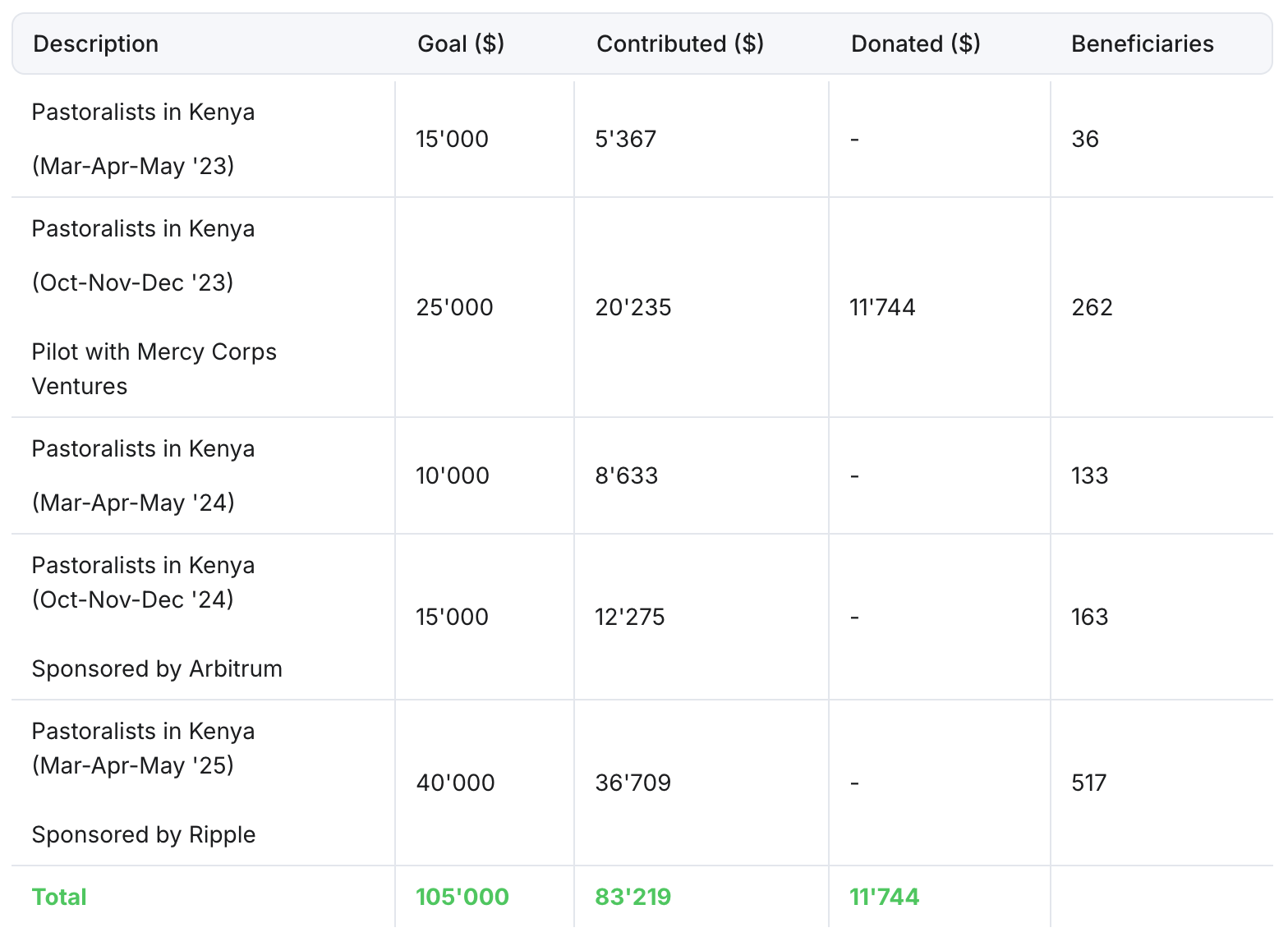
Source image : DIVA Donate https://docs.divadonate.xyz
Since its inception, DIVA Donate has launched six campaigns, five of which were completed (by October 2025), and secured $83,219 in contributions from Mercy Corps Ventures, Arbitrum, Ripple, and members of the DIVA protocol community. Diva has already distributed $11,744 (14%) in financial aid to livestock farmers to combat drought. Ripple Launches its RLUSD Stablecoin, Pegged to the US Dollar.
Even though the project did not go exactly as planned[213], the program demonstrated "a drastic reduction in costs, lowered to 2.5% of disbursed funds—a 75% drop compared to traditional systems—and a significant acceleration of payments, with funds released in 14 hours, representing a 90% reduction in payment time, with optimization potential to reach just a few minutes,"[214] explained Wladimir Weinbender at the program's conclusion.
5.1.2 Verifiable credentials and decentralized identifiers
Beneficiary identification stands at the critical crossroads of operational efficiency, donor accountability, and, above all, respect for the dignity of populations affected by crises. How can one ensure aid reaches the right hands? How can the identification of these individuals be tracked, particularly those whom the United Nations calls the "invisibles"[215] because they lack proof of identity?[216] The ability to prove one's identity is not a simple administrative formality but the prerequisite for access to essential services, legal protection, and the exercise of fundamental rights. This reality is indeed enshrined in the United Nations Sustainable Development Goals (SDGs), notably target 16.9, which aims to "provide legal identity for all, including birth registration, by 2030."[217]
Historically, humanitarian organizations relied on paper-based systems, then progressively adopted centralized digital solutions, increasingly based on biometrics. While this transition allowed for efficiency gains, it also generated new challenges regarding data security, system fragmentation, and individual autonomy over their own information.
Faced with this systemic exclusion, decentralized digital identity, or Self-Sovereign Identity (SSI), emerges as an alternative paradigm aiming to restore individual dignity and autonomy. Founded on open standards developed by entities like the W3C and the Decentralized Identity Foundation[218] (DIF), the decentralized digital identity paradigm allows an individual to control their own data. The model relies on three actors: (1) an issuer, for example, an NGO or a UN agency, who attests to a fact; (2) a holder, an individual or organization, who stores this attestation in an identity wallet; and (3) a verifier, for example, a healthcare provider or an employer, who can verify its authenticity without having to contact the issuer. This system uses Decentralized Identifiers (DIDs) to identify individuals locally and specifically, but above all to publicly identify issuers and the validity of Verifiable Credentials (VCs) that users can present as portable and secure digital proofs.
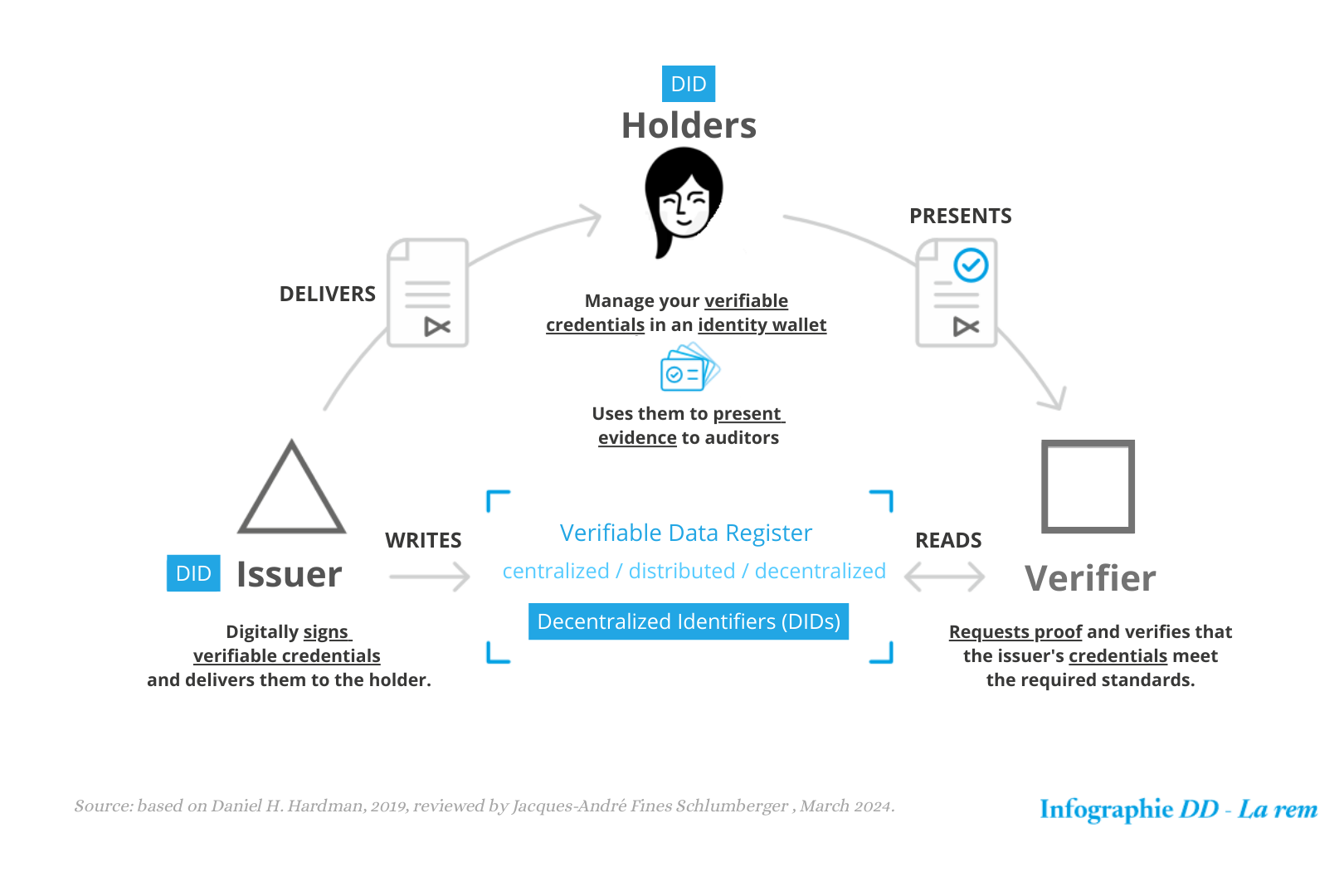
Decentralized identity and Verifiable Credentials
The true innovation of this model lies not only in "decentralization" as an abstract concept, but in a fundamental architectural decoupling. It separates three elements that are traditionally fused in centralized systems: (1) a person's identifier (the Decentralized IDentifier), (2) the attributes or attestations regarding that person (the Verifiable Credentials), both stored in an identity wallet, and (3) the authority or registry that makes the whole system work by guaranteeing the authenticity of the source and optionally its traceability over time (timestamping).
In a state system or in a centralized system managed by an NGO, the identity number, civil registry data, and the database itself are controlled by a single entity. The DID/VC model breaks this fusion. The Decentralized Identifier is controlled by the user. Verifiable Credentials are distinct personal information, issued by a multitude of actors and held by the user. The underlying registry, which may be centralized or distributed, where the DID Document is anchored, is merely a public utility for cryptographic key discovery, and not a registry where personal data is recorded. It is this decoupling that allows the user to collect credentials from multiple sources and present them in any context without the involvement of the issuer of a Verifiable Credential, thus making real portability and control possible. This architectural rupture is the very source of the transformative potential of the decentralized identity paradigm, also known as self-sovereign identity.
Humanitarian organizations have initiated pilot projects to explore the potential of this technology. The Dignified Identities in Cash Assistance Consortium (DIGID)[219], led by the International Federation of Red Cross and Red Crescent Societies (IFRC) and including the Norwegian Red Cross, the Norwegian Refugee Council, and Save the Children, tested the issuance of "humanitarian verifiable credentials" during a pilot project in Kenya in 2021 and a second one in Uganda in 2022, during which 300 households without official papers received these digital certificates to attest to their eligibility for financial aid[220].
How to share
aid beneficiaries' personal data
Interoperability is the ability of different organizations and systems to collaborate in the field, by sharing and analyzing data and resources to facilitate operational processes and meet the needs of affected populations. It involves interdependent legal, organizational, semantic, and technical aspects that require alignment and coordination among stakeholders.
It turns out that the humanitarian sector presents an extremely diverse technical landscape. A research project conducted by the Dignified Identities in Cash Assistance (DIGID) consortium and funded by European funds from European Civil Protection and Humanitarian Aid Operations (ECHO) specifically investigated this subject—"Investigating safe data sharing and systems interoperability in humanitarian cash assistance"—and its conclusions are as follows[221].
On one hand, the simplest and most common method for sharing data between organizations remains sending personal data by email. This approach, although inexpensive and universal, is inherently insecure. On the other hand, the largest humanitarian organizations, such as UN agencies or large international NGOs, possess sophisticated software systems using global databases, robust APIs, and sometimes Distributed Ledger Technologies (DLTs/blockchain) or even biometrics. The challenge of interoperability consists of reconciling these disparate systems to improve coordination, efficiency, and data security, particularly for beneficiary deduplication and individual referrals.
Deduplication is the comparison of lists of target persons to eliminate unintentional duplicates. The most common approach is a single registry managed by a "host" organization, which collects and reconciles data from all participating organizations. However, this approach can pose problems regarding security, protection, quality, and data governance. The project also explored alternative approaches such as a jointly managed registry or a data management model where a neutral third party facilitates the data sharing process. Individual referrals are used when an organization cannot provide the services an individual or household needs and directs them to another organization that can. The simplest and most common method for sharing data for referrals consists of sending a spreadsheet by email. This approach is simple and inexpensive, but also insecure and inefficient. The project also explored other approaches, such as the use of APIs to enable automated and secure data exchange, or the use of case management systems to enable more transparent and coordinated service delivery.
The most significant obstacle to improving interoperability lies in non-technical issues and the structure of humanitarian aid. The report notably points to power and resource asymmetries between large UN agencies or international NGOs and small organizations. The superior technical capabilities of large entities act as a competitive differentiator for obtaining funds, which creates incentives not to share systems or data, running counter to interoperability. Furthermore, donors tend not to support technical initiatives that do not have a direct impact on targeted populations, and often impose strict conditions on the type of data to be collected, which limits flexibility and fosters vendor lock-in. Finally, there is an absence of widely accepted data standards for the exchange of information on beneficiaries, forcing each national context to define its own ad hoc standards.
The report concludes that, rather than looking for a magic bullet at the technological application level, long-term success lies in data standardization at the semantic level.
Tadamon[222] is a community platform supporting some 5,200 Civil Society Organizations (CSOs) spread across 57 member countries of the Organization of Islamic Cooperation (OIC)[223]. In partnership with key institutions including the Islamic Development Bank (IsDB)[224] and the United Nations Development Programme (UNDP)[225], Tadamon pilots acceleration programs such as the "Food Security Accelerator"[226], which offers training, mentoring, and grants.
However, the success of the Tadamon platform revealed that its validation process for Civil Society Organizations, being entirely manual, was slow and complex. While the program can attract up to 1,200 applicants, each application required successive verifications by Tadamon, the UNDP, the IsDB, and national governments—a process that could drag on for months. Tadamon initiated a collaboration with the Cardano Foundation to implement a solution based on an identity wallet (see the graphic Decentralized identity and Verifiable Credentials) with the objective of replacing manual verifications with a decentralized system of tamper-proof attestations, cryptographically signed and quick to verify. A call for projects was launched in June 2025, at the end of which 50 Organizations were selected to join the Food Security Accelerator.
The adoption of a decentralized digital identity system[227] is now required for Civil Society Organizations wishing to interact within the Tadamon ecosystem. This process relies on the use of the identity wallet called Tadamon ID, a software application derived from the open-source Veridian[228] technology developed by the Cardano Foundation[229] and accessible to all stakeholders. Initially, the organization creates a decentralized identifier in the identity wallet and submits the required information and supporting documents. This identifier acts as a unique and permanent digital address, of which the organization retains ownership and control. Once initial verifications are complete, Tadamon (the issuer) cryptographically signs and sends a Verifiable Credential, kept by the organization (the holder), which can present it to various partner entities (the Verifiers) with whom it interacts, and who can easily verify the authenticity of the attestation.
This mechanism eliminates the need to exchange and verify the same information multiple times, thus optimizing interaction efficiency. The entire certificate lifecycle—from its issuance to its use for approval or grant distribution—is recorded on the Cardano blockchain, ensuring traceability of operations, simplifying application validation, audits, project monitoring, and fund distribution.
From a more global standardization perspective, the vLEI[230] (verifiable Legal Entity Identifier) is progressively establishing itself as the international reference standard for digital identification of organizations. Led by the Global Legal Entity Identifier Foundation (GLEIF), this system constitutes the cryptographic transposition of the LEI code (ISO 17442 standard), the unique global identifier for legal entities. By encapsulating an organization's legal identity and the official roles of its representatives within Verifiable Credentials, the vLEI establishes an automatable and interoperable chain of trust. It thus allows for instant verification, without manual intervention, of the authenticity of a legal entity (NGO, donor, supplier) and the validity of actions undertaken by its authorized signatories, directly addressing the fragmentation and security challenges inherent in humanitarian ecosystems.
5.2 What measurement? Which impact?
The desire to link funding to concrete results is not new, and institutional structures are actively exploring this path, like the OECD, which formalized the concept of "Outcomes-based financing" (OBF)[231]. The OECD broadly defines this as approaches where payments are conditioned on the achievement of specific and verifiable results, a method that already involves established actors such as companies or impact investors.
While this concept of pay-for-performance exists outside the crypto ecosystem, philanthropy and impact investing both face a fundamental problem: how to capture, measure, and more transformatively, monetize social impact in a standardized and incentivized way[232].
The aid and impact investing sector faces a persistent challenge: standardized measurement and accountability for social results. This section focuses on the use of Distributed Ledger Technologies (DLTs) as well as Monitoring, Reporting, and Verification (MRV) processes to monetize impact. We differentiate between ex-post and ex-ante impact-proof funding (5.2.1), detailing the retrospective (ex-post) model of Hypercerts, which rewards real, already-produced impact. We also examine the transition from NFT proof of impact to NFT proof of donation (5.2.2), where tokens represent a completed service or a philanthropic commitment, as in the Amply experiment.
5.2.1 Ex-post and ex-ante impact-proof funding
Social impact funding is structured around a temporal dichotomy: should intentions be funded—i.e., prospective or ex-ante funding—or should results be rewarded—i.e., retrospective or ex-post funding? Today, traditional philanthropic models, based on grant-making, are predominantly ex-ante, funding project promises based on written proposals. Distributed Ledger Technologies (DLTs) now allow not only for formalizing and scaling ex-post models but also for sophisticating ex-ante approaches by making them more dynamic and reactive.
The retrospective funding model - ex-post consists of rewarding proven impact and fundamentally shifts the incentive paradigm. It is no longer about rewarding the ability to write convincing grant proposals, but rather the ability to generate real, observable, and verifiable impact.
The Hypercerts[233] protocol represents one of the most advanced implementations of this model. Its lifecycle breaks down into three distinct stages: (1) A project led by an organization or individual performs an action or work, generates an impact, and creates an "hypercert" to digitally represent this impact. This digital certificate transparently documents the contributors, the scope of work accomplished, and the timeframe. (2) Credible and independent evaluators, such as experts from third-party organizations, examine the work and add their assessments to the hypercert. These attestations confirm the scope, quality, and veracity of the claimed impact. (3) Funders—donors, foundations, impact investors—buy fractions of this hypercert. By doing so, they acquire the right to "claim" a portion of the generated impact for their own offsetting, reporting, or communication goals. The proceeds from this sale constitute the retrospective financial reward for the project that initially created the impact.
Tech deep diveTechnically, a hypercert is a semi-fungible token, compliant with the ERC-1155 standard on the Ethereum blockchain. The associated metadata—containing work details, evaluations, and claims—is stored on a decentralized file system like IPFS (InterPlanetary File System), ensuring persistence and immutability. The whole system functions as an open, interoperable, and decentralized database designed to track impact work and its evaluations, thus facilitating experimentation with various funding mechanisms beyond just the retrospective model.
This mechanism transforms the interaction between innovation and funding. The traditional (ex-ante) grant model favors "safe" and established projects to the detriment of radical innovation. Hypercerts break this link, allowing innovators to act without prior permission. In case of success, a market rewards them. Philanthropic funding shifts from a "push" system to a "pull" system, where capital is attracted by proven project results. This results in a shift to a system directly correlated with demonstrated impact rather than the promise of impact.
As for the traditional funding model operated ex-ante, it is crucial to note that while this model can be transposed or adapted to a new decentralized infrastructure, it does not merely replicate traditional grants on a new medium. This migration to a decentralized infrastructure can, for example, enable greater transparency in fund allocation and commitment tracking.
The IXO protocol, which is developing an "Internet of Impact"[234], is representative of this approach. This infrastructure aims to fund, implement, and verify impact globally. One of its flagship instruments is the "Alpha Bond"[235]. This is a programmable financing instrument based on token bonding curves, a mechanism where a token's price is determined algorithmically by its circulating supply. In the case of Alpha Bonds, capital is released progressively, and the cost of this capital (the bond price) evolves according to an "Alpha Risk Signal". This signal can be generated by an internal prediction market where stakeholders (experts, community, investors) bet on the probability of the project achieving its goals. If confidence in the project increases, the risk signal decreases, making capital cheaper and more accessible, and vice versa. This mechanism fits perfectly into Outcomes-based Financing frameworks, where payments are automatically triggered by smart contracts when predefined and independently verified milestones are reached.
This approach radically transforms the nature of the funding contract. Traditional ex-ante funding is a static, one-time event: a sum is allocated at the start of the project, and monitoring occurs via periodic reports often disconnected from the initial funding mechanism. The IXO model, conversely, integrates a continuous feedback loop. Data on project performance, or predictions about its future performance, directly and in real-time influence its funding conditions. Capital thus becomes "smart": it is allocated and adjusts. This allows for much more efficient resource allocation, reducing losses on projects showing signs of failure and reinforcing those demonstrating success—during their lifecycle, not just after.
A final example is the Karma protocol[236], which functions as an on-chain reputation platform for project leaders. It allows them to create a unified profile aggregating their contributions and progress via the "Karma's GAP protocol" and their impact metrics, often linked to GitHub repositories or smart contracts. This verifiable reputation is then used by ecosystems and funds, such as Gitcoin or Arbitrum, to allocate funding transparently, notably in the form of retrospective funding (retrofunding), based on the project's proven results and impact.
While these impact funding models like Hypercerts, IXO, or Karma aim for increased efficiency and transparency, they nevertheless present structural limitations and raise questions. The main pitfall lies in the definition, measurement, and verification of "impact" itself. The system does not eliminate the need for trust; it shifts it to new intermediaries: "credible evaluators" or data Oracles. This raises the question of their independence, funding, and objectivity, and the risk of inducing "measurement bias" according to Goodhart's Law, which states that when a measure becomes a target, it ceases to be a good measure. Indeed, projects might be incentivized to optimize easily quantifiable and "tokenizable" metrics, like code updates on GitHub tracked by Karma, to the detriment of more complex and long-term social objectives.
Furthermore, the retrospective (ex-post) funding model, like Hypercerts, although innovative, eludes the need for seed capital. By rewarding impact after its creation, it favors projects already funded or possessing venture capital, capable of "acting without prior permission", while potentially excluding grassroots organizations or those from the Global South that precisely lack the liquidity to front costs. Finally, the technical complexity of certain protocols like bonding curves or prediction markets on IXO could create a new barrier to entry, strengthening the power of technical experts to the detriment of field actors. Lastly, the introduction of market mechanisms, like IXO's speculative "risk signals", poses the risk of excessive financialization of social action, where the general interest mission would be subject to incentives and volatility inherent to financial markets.
5.2.2 From NFT proof of impact to NFT proof of donation
Beyond funding mechanisms, blockchain technology allows for representing impact itself as unique and verifiable digital assets. This "tokenization of social impact" aims to create a new asset class, Impact Tokens[237], which encapsulate a verified proof of impact and make it liquid, programmable, and tradable.
An Impact Token is a digital representation of a unit of social or environmental impact that has been quantified, measured, and verified, often in alignment with recognized frameworks like the UN Sustainable Development Goals (SDGs). Each token is recorded on a public blockchain, offering immutable and auditable proof that a positive impact has been realized and can be unequivocally attributed to a specific activity or investment.
On the IXO platform, an Impact Token, called "Impact Credits", can represent "any verified social, environmental, economic, or climate outcome state that people and organizations care about, are willing to pay for, invest in, or work towards."[238] A real-world action generates data submitted to a public blockchain as a verifiable claim; a verifier validates it, a Verifiable Credential is generated, and an impact NFT is created based on this Verifiable Credential.
For example, the Amply project was initiated in South Africa in partnership with the UNICEF Innovation Fund and Innovation Edge to address the inefficient, paper-based management of a government grant program for early childhood education. In South Africa, the government offers a subsidy (about 15 rand per day per child) to encourage attendance at Early Childhood Development centers[239] (preschool equivalents). To receive these funds, teachers had to manually record attendance on paper forms—a time-consuming, costly, and error-prone process. The Amply project provided teachers with a simple mobile app. Each day, instead of filling out paper logs, they used the app to record each child's attendance. Each attendance record was transformed into a "verifiable claim" and securely and immutably recorded on the Ethereum blockchain. This created a transparent and tamper-proof digital registry of educational services actually provided. This process digitized tens of thousands of attendance records, saving over 4,000 hours of administrative work per month[240]. Once attendance data is verified at the end of the month, the system aggregates these records to create an Impact Token—a digital certificate representing a verified quantity of services rendered, for example, "20 days of attendance for child X in May". The final goal was to fully digitize the subsidy process. The school or teacher transfers this impact token to the government as irrefutable digital proof of service completion, and in return, the government transfers the corresponding grant funds to the school.
NFTs can also serve as proof of donation. For example, a Non-Profit Organization issues an NFT to a donor to certify their donation. For the donor, this NFT serves as public recognition, a socially valuable "badge"[241] they can display on social networks. It can be part of a collection and fit into a logic of "gamification" of philanthropy, with tiers, rewards for recurring donations, or special badges. For a Non-Profit Organization, the benefits are multiple: increased donor engagement, strengthened trust thanks to a transparent and immutable receipt, and a powerful viral marketing tool.
The evolution of the philanthropic NFT reveals a profound transformation of the relationship between the donor, the act of giving, and the resulting impact. A "Proof of Donation" type NFT is a collectible attesting to a past transaction—a certificate on the input (the donation). Its value is primarily social and memorial. In contrast, a "Proof of Impact" type NFT, like Amply's, is a certificate on the output (the result). It is a digital container for a real environmental asset. Possession of the NFT becomes synonymous with the claim to this impact.
This fusion of the digital asset and tangible impact creates a much stronger psychological and economic connection. The digital asset is no longer a simple souvenir of the act of giving; it is the result of that act. The donor is no longer just a financial contributor; they become the guardian or symbolic owner of the generated impact. This establishes a deeper incentive for engagement and creates a new form of value that is both financial (the NFT can be traded on a secondary market) and ethical (it represents a tangible good for the planet or society). The NFT shifts from the status of a receipt to that of the incarnation of impact.
Chapter 6: Crypto philanthropy through engagement
Digital technologies stemming from Web3—notably NFTs, video games, charitable trading, and metaverses—although still largely experimental for the philanthropic sector, offer unprecedented perspectives regarding fundraising and donor engagement. In addition to being (6.1) fundraising tools through the sale of unique digital assets, NFTs, by virtue of their programmable nature, allow not only for the generation of continuous revenue upon each resale but also serve as proofs of engagement or governance, transforming the donor into an active member of the community. Philanthropy through interaction (6.2), whether within video games, called Play-to-Give ("playing to give"), or during charitable events organized around trading, which could be called Trade-to-give ("trading to give"), testifies to the potential of gamification and virtual worlds for raising awareness and engaging a new generation in humanitarian action.
6.1 NFTs as tools for community engagement…
NFTs are versatile tools for philanthropy, going beyond speculation, whether to mobilize communities and fund projects—notably via event-based fundraising and the sale of digital assets (6.1.1)—or to serve as governance tools and proof of donation, offering automatic royalties to organizations and transforming donors into active members of DAOs (6.1.2).
What is an NFT and what was the NFT hype of 2021?
A Non-Fungible Token (NFT) can be defined as a unique certificate of digital authenticity and ownership, recorded in a tamper-proof manner on a blockchain. To exist, much like national currency minted by a state, an NFT is first "minted" on a public blockchain, and then, subsequently, potentially "burnt"—that is, destroyed. "Minting an NFT" involves using a crypto-asset wallet and a smart contract to record the token and its identification data on a public blockchain so that it becomes immutable, tradable, but also viewable and verifiable by anyone[242].
This certificate of digital authenticity and ownership, materialized by the NFT, represents a major advance in the way ownership and traceability of digital goods are conceived. The NFT is associated with any type of digital asset, whether it be a high-resolution image, a video, a significant tweet, or even a piece of music. Contrary to popular belief, this association does not require the digital asset itself to be stored directly on a blockchain. Indeed, one must distinguish between the unique digital asset, which can be hosted on classic servers, decentralized storage platforms, or any other digital medium, while the NFT itself, minted on a secure and transparent blockchain (like Ethereum, Solana, or Tezos), acts as a unique and tamper-proof pointer to this asset. This inseparable link between the NFT and the underlying digital work confers upon the NFT owner rights and irrefutable proof of its authenticity and ownership.
It allows for effectively fighting digital counterfeiting, guaranteeing the provenance of a work, and establishing a clear history of its transactions. For creators, this opens new avenues for monetization and protection of their works, while for collectors and buyers, it offers unprecedented confidence and security in the digital art and virtual asset market. The NFT thus becomes the digital guarantor of the originality and value of the work to which it is attached.
The hype surrounding NFTs peaked on March 11, 2021, when Michael Joseph Winkelmann, known by the pseudonym Beeple, sold an NFT despite never having sold a work at auction before. He then joined David Hockney and Jeff Koons, ranking among the top three living artists to have reached a record sale price. Beeple's multimedia mosaic, titled Everydays: the First 5000 Days, was auctioned for 69.3 million dollars during a sale organized by Christie's[243]. This digital patchwork is composed of 5,000 images and animations, each representing a day in the life of the man now called the "crypto-artist," between May 1, 2007, and January 7, 2021. This unprecedented sale illustrates the art world's enthusiasm for NFTs issued on a public blockchain.
According to the report by the analysis firm NonFungible[244], the global NFT market exploded, and the art segment alone reached a transaction volume of nearly 2.9 billion dollars in 2021. However, between the 2021 peak and the end of 2024, the volume of NFT art sales contracted by more than 95%. The average sale price of an artistic NFT, which could reach thousands of dollars, plummeted to a few tens of dollars. Speculators have given way to a more restricted community of passionate collectors and institutions exploring the technology for its intrinsic utility: certification of authenticity, traceability of provenance, and new forms of digital storytelling. Leading museums, like the Centre Pompidou in Paris or MoMA in New York, have acquired NFTs, not for their speculative value, but for their historical and artistic relevance[245].
6.1.1 ... for fundraising
The unique character of an NFT and its traceability make it a particularly innovative fundraising mechanism, capable of attracting a new generation of philanthropists. In March 2021, the sale of Jack Dorsey's first tweet, the founder of the social network Twitter, in the form of an NFT, allowed him to raise 2.9 million dollars for the organization GiveDirectly's Africa Response[246]. Later that same year, an anonymous donor contributed the equivalent of 3.5 million dollars in ETH to Médecins Sans Frontières, a sum derived from the sale of an NFT art collection[247]. In March 2022, the brand Stella Artois, in collaboration with VaynerNFT[248] and the art platform Art Blocks, launched a project of 1,024 water-themed NFTs called "The Drop Artois"[249] on the occasion of World Water Day[250]. The entirety of the 200,000 dollars in proceeds from the NFT sale[251], which sold out in 2 hours, was donated to the association Water.org, an organization working for access to drinking water in the Global South. The charity event "Punks vs. Apes"[252], which pitted two famous NFT collections—Bored Ape Yacht Club (Apes) and CryptoPunks (Punks)—against each other, raised over 55,000 dollars in donations for the Riley Children's Hospital in Indianapolis. Organized in September 2022 at the <imnot/Art> gallery[253] in Chicago via the platform The Giving Block, this two-day event showed the capacity of these Web3 communities to mobilize for a charitable cause.
The singularity and traceability of NFTs make them an innovative fundraising tool, as evidenced by these few charitable initiatives that have raised millions of dollars for various causes.
The "Leap of Faith" initiative: From a personal story to donate.gg
The "Leap of Faith" operation benefiting St. Jude Children’s Research Hospital in Memphis, USA, is a textbook case[254] of this next-generation philanthropy, born from the initiative of a Web3 community figure known by the pseudonym "@Leap". Combining personal motivation, community mobilization, and professional structuring, this project illustrates the community potential of Web3 to generate social impact.
At the origin of the project lies @Leap's personal story, whose father was suffering from terminal cancer. Driven by emotion and the desire to act, he published a crypto-asset wallet address on social networks to collect donations to fund the fight against cancer for St. Jude Children’s Research Hospital. The Web3 community's response was immediate and massive, and over 100,000 dollars were collected in just 24 hours. This spontaneous success attracted the hospital's attention, which contacted @Leap. To transform this momentum into a legitimate and ambitious campaign, the latter invested his own funds to build a team and professionalize the approach.
The project culminated in October 2024 at the prestigious Art Basel art fair in Miami through a live auction, dubbed "Leap of Faith Auction", selling artworks in the form of NFTs created by over 30 ecosystem artists. The operation aimed to donate 100% of the profits to St. Jude Hospital and accept direct crypto-asset donations. At the time, the auction raised 115,000 dollars, to which were added donations received after the event, reaching a total amount of 350,000 dollars donated for cancer research.
Asked about his vision, @Leap does not define Web3 as a simple technology, but as a true culture. According to him, "it's a way of thinking, a lifestyle."[255] The most significant impact of Web3 will not come from a new application, but from individuals from this culture who "are ready to break barriers established by the traditional system and take massive financial risks to achieve it."[256] Building on this success, @Leap evolved his initiative into a sustainable and scalable solution and founded the platform donate.gg. Initially designed for St. Jude, it has since opened up to other international charitable organizations like UNICEF or the WWF. The platform stands out for features optimized for crypto-asset donations fully remitted to organizations. The platform automatically converts crypto-assets into the organization's preferred currency and issues tax receipts for donors. In October 2025, it had collected over 1 million dollars in donations[257].
The use of NFTs in philanthropy presents two financial advantages that address key sector issues. Total transparency, since every transaction linked to an NFT is recorded immutably and publicly on a public blockchain. This allows donors to track the journey of their contributions with unprecedented precision, reinforcing trust, even if this radical transparency can sometimes raise complex questions regarding donor privacy and GDPR compliance[258], as pseudonymous transactions on a public blockchain can sometimes be traced back to real identities—an issue organizations must master. Additionally, it is possible to program automatic royalties in the NFT's smart contract and generate recurring revenue. This mechanism guarantees that a certain percentage of every future sale of the token on the secondary market will be automatically remitted to the organization inscribed in the smart contract.
For example, Boss Beauties is a collection of 10,000 PFP (Profile Picture) NFTs[259] designed by women to celebrate female diversity. From its inception, the project integrated a philanthropic mission at the heart of its economic model. During the initial sale in September 2021, the millions of dollars generated were partially donated to the Boss Beauties Foundation[260]. This foundation aims to fund scholarships and mentorship programs for women and girls around the world. Furthermore, the smart contract of each Boss Beauties NFT provides for a 5% royalty on every resale. A portion of these 5% is systematically allocated to the foundation, ensuring continuous funding for its operations. Thanks to this recurring revenue mechanism, the foundation has been able to grant scholarships to thousands of women. It has also established a historic five-year partnership with the UN[261] to promote gender equality via global educational initiatives and launched mentorship programs in collaboration with major brands and institutions. This economic model ensures that the digital art collection, as long as it is actively traded, functions as a sustainable funding engine for the cause it supports.
However, the utility of NFTs is not limited to simple fundraising; they also prove to be governance tools and proofs of engagement, strengthening the very nature of participation and the relationship of donors with Organizations.
6.1.2 ... for governance and proof of donation
Beyond their financial function, NFTs have the potential to become true tools for encouraging active donor participation. An NFT can function as a digital badge, conferring upon its holder specific rights and recognized status within a community. This approach transforms the traditionally passive donor into an engaged and influential member.
The concept of NFT as proof of donation or participation is gaining popularity, with a notable application being the POAP (Proof of Attendance Protocol). Technically, "the POAP is an NFT that is generally awarded for free [...] and has no intrinsic value, other than demonstrating that the holding address is controlled by a person who attended the event subject of the POAP."[262] Awarded to participants of an event, physical or virtual, it serves as a "digital souvenir" attesting to their presence and support[263]. For example, donors contributing to Diva Donate campaigns supporting drought-stricken livestock farming communities in Kenya "receive a digital POAP certificate to commemorate their donation." The POAP thus reinforces the sense of belonging to a community and allows an organization to value its members' engagement in a tangible and verifiable way.
NFTs also play a central role in decentralized governance models, notably within Decentralized Autonomous Organizations (DAOs). The case of NounsDAO[264] is particularly emblematic. Its functioning is as follows: every day, a new unique NFT, a "Noun", is created and auctioned. The profits feed a collective treasury—3,660 ETH in October 2025, equivalent to 13,800,000 dollars—and possession of a "Noun" grants voting rights on spending proposals. To submit a proposal, a minimum of three Nouns is required, and any idea can be funded if there are enough community votes. This "one NFT, one vote" model establishes a form of direct governance where contributors decide on fund allocation. Thus, Proposal 42[265] was voted to send 100 ETH intended for emergency humanitarian aid in Ukraine, in partnership with UNICEF.
Source image [271]
Tech deep diveFrom a technical standpoint, the Nouns DAO uses a fork of Compound's governance[267] and constitutes the main governing body of the Nouns ecosystem. The Nouns DAO treasury receives 100% of the ETH revenue from the daily Nouns auctions. Each Noun is an irrevocable member of the Nouns DAO and entitles the holder to one vote for all governance matters. Nouns voting rights are non-transferable (if you sell your Noun, the voting right is ceded with it) but they are delegatable, meaning you can assign your voting right to someone else as long as you own your Noun. Nouns are stored directly on Ethereum and do not use pointers to other networks such as IPFS, because the components of the Nouns are compressed and stored on-chain using custom Run-Length Encoding (RLE), which is a form of lossless compression.
This model is only one of the possible incarnations of a philanthropic DAO. The report by the Haut Comité Juridique de la Place Financière de Paris notes that DAOs can be "charitable or humanitarian", and other structures are emerging. For example, the Big Green DAO (see supra), initiated by the Big Green Foundation, uses the governance structure of a DAO to facilitate the management and allocation of grants in the field of food sovereignty, aiming to subvert the traditional relationship between donors and beneficiaries by giving voting power to practitioners on the ground. While NounsDAO represents a direct governance model linked to the possession of a unique asset, other DAOs explore systems based on vote weighting by fungible tokens or reputation, opening a vast field of experimentation for a more democratic philanthropy.
From digital assets like NFTs to immersive virtual worlds, the transition is natural. Video games and metaverses, built on similar logics of digital ownership and community interaction, constitute the next frontier to explore for philanthropy.
6.2 Philanthropy through interaction: Gaming, Trading, and Metaverses
Virtual worlds, gaming, and charitable trading constitute innovative approaches to engage and raise awareness among new generations thanks to interactive and immersive experiences fostering a strong sense of community.
6.2.1 Play-to-Give and Trade-to-Give
The concept of "playing to give", or Play-to-give in Web3 video games, where gameplay directly and automatically generates funds for charitable causes, is still emerging and rarely implemented as a passive game mechanic. However, this model illustrates one of the ways crypto philanthropy is inviting itself into the heart of communities whose audience is very far from traditional methods of appealing to generosity but obviously just as receptive to humanitarian crises.
The most documented example of Play-to-give is the strong mobilization of a community of gamers within the Web3 video game Axie Infinity[268], following the passage of Typhoon Rai in the Philippines in December 2021. Axie Infinity is a video game whose concept is akin to that of Pokémon. Players collect small creatures named Axies, engage them in battles, and can breed them to generate new ones. The major distinction lies in the fact that each creature is a unique digital object truly owned by the player, comparable to a collectible card, and can thus be bought and sold for real money to other players.
Several teams, called guilds, gathering individual players and NFT artists from the ecosystem, mobilized to collect funds for the typhoon victims[269]. The largest game guild, named the Yield Guild Games (YGG), first launched a donation campaign named "crypto-ayuda" (crypto aid), with an initial donation of 2.5 ETH, worth nearly 500,000 Philippine pesos at the time, to fund a medical mission on the devastated island of Siargao. Then an influential Filipino player, named Nix Eniego, declared donating all his game earnings to help the victims. Charity streams were organized, collecting several tens of thousands of Philippine pesos transferred to the management of the Yield Guild Games (YGG). Artists from the community sold NFT works, pledging to donate all profits to organizations on the ground. In parallel, a major charity tournament, the "United Gamers Guild (UGG) All-Stars Tournament", was organized and broadcast live to amplify the collection. Thanks to the convergence of all these initiatives—direct donations, charity streamings, tournaments, and NFT sales—the Axie Infinity community raised over 28.6 million Philippine pesos, the equivalent of 572,000 US dollars at the time, to help the typhoon victims.
While this example remains anecdotal, the philanthropic potential of Web3 video games seems as significant as it is uncertain. It is also hindered by the same challenges that characterize broader Web3 adoption: technical complexity, regulatory uncertainty, and the need to create fluid user experiences for an uninitiated audience.
Another initiative at the crossroads of trading and streaming for charitable fundraising purposes is charitable trading. While charitable trading is a philanthropy model widely deployed in the United States, consisting of dedicating all or part of the profits generated by financial speculation activities to one or more charities, the model has been developed in the crypto-asset universe. In June 2021, a pioneering initiative in France, led by Alexandre Chkirate, with the support of Binance Charity[270] and Paymium[271], transposed the concept of charitable trading into the Web3 universe. The first trading marathon was organized by the association Crypto4Good, in partnership with the platform Kryll.io[272], during which, for 24 hours without interruption, the event, broadcast live on Twitch, gathered 3,200 viewers, creating a "crypto" version of traditional telethons or the Z Event[273]. The objective was to mobilize a community around a streaming that was both educational and supportive, where several teams of traders competed to generate maximum profits, with all earnings generated, as well as donations collected from the audience during the event, distributed to charities. Thus, the associations Restos du Cœur and Entraide et Partage were able to share the 36,000 € raised across five cities in France: Paris, Lyon, Marseille, Lille, and Bordeaux. The event not only allowed for innovative fundraising but also played a role in popularization, inviting well-known figures from the French-speaking crypto community like Hasheur[274], Sébastien Borget of The Sandbox, or Thibaut de Meria, to comment on and analyze the traders' strategies in real-time[275].
6.2.2 Metaverses
A metaverse designates a persistent and shared virtual space where users, via avatars, can interact with each other and with digital objects[276]. These immersive 3D environments aim to simulate or extend aspects of the real world, offering new types of social interactions across various registers, ranging from entertainment to professional, educational, or commercial applications. Persistence means the metaverse continues to exist and evolve even when users are not logged in, maintaining the state of interactions and objects. Sharing implies that many users can connect simultaneously and interact within the same space. Avatars are the digital representations of users, allowing them to immerse themselves and act in this virtual world, with virtual reality headsets being the fetish devices. Beyond video games, which are often the precursors, the concept of metaverse encompasses a broader vision of an embodied and decentralized internet, where ownership of digital assets and new forms of governance play a growing role. The promise of metaverses is to offer other ways of working, learning, socializing, and consuming, by blurring the boundaries between the physical and digital worlds.
For the philanthropic sector, it represents a new channel to run awareness campaigns, organize fundraising events, and engage committed communities without the geographic constraints of the physical world. Here are some of the experiments tested by the Red Cross, the RadicalxChange Foundation, or the WWF in Germany.
In December 2023, a Parisian communication agency approached the French Red Cross and The Sandbox to explore an original use case of crypto-philanthropy experimentation via gamification and NFTs within a metaverse. Born in 2011, The Sandbox was first a 2D online video game allowing the creation of Pixel Art-type maps, then a metaverse running on the Ethereum blockchain, where users can create, customize, and trade digital elements like land, objects, and avatars. This virtual world is a decentralized and community platform, allowing everyone to design their own game experiences and interactive content using tools. In The Sandbox, everything is tokenized[277], notably land parcels (called LAND), land assemblies (ESTATE), as well as other digital objects, which are NFTs, certifying their ownership and authenticity. The internal currency of the metaverse is the SAND token, a crypto-asset used for all transactions in The Sandbox, such as buying land, objects, or services. This token can also be earned by playing and participating in activities, making The Sandbox a "play-to-earn" game. Furthermore, SAND holders participate in the project's governance via a Decentralized Organization, a DAO, allowing them to vote on decisions and evolutions of the metaverse.
The main objective of this Red Cross foray into The Sandbox metaverse was to raise awareness among younger generations, Gen Z and Gen Alpha, about the Red Cross missions, using the Play-to-Give mechanic. Indeed, the challenge today is "to know how associations can attract the new generation, how to capture their attention, when usual communication channels like newsletters, postal mail, websites, and mobile apps no longer really engage. People also want to better understand what the association's mission is, how the money will be spent, and what the impact will be. And video games are an excellent medium for that,"[278] explains Sébastien Borget, founder of The Sandbox.
The experience was structured around a gamification of the volunteer journey. The operational model relied on players purchasing digital assets in the form of NFTs linked to the project within The Sandbox's virtual environment. To maximize the multiplier effect of the crypto donation and encourage players to buy NFTs, The Sandbox pledged to match the funds collected through this initiative. Specifically, for every SAND token spent by players to acquire project-linked NFTs, The Sandbox committed to donating an equivalent amount to the Red Cross.
Within the framework of implementing new Web3-specific voting, funding, and governance models, the RadicalxChange Foundation, a US non-profit organization, initiated a collaboration with the platform The Sandbox. This pilot project aimed to collaborate with the crypto-native community of players on The Sandbox metaverse and test these virtual environments as vectors for raising awareness about the United Nations Sustainable Development Goals (SDGs) and also as funding channels for civil society organizations in the Global South. For The Sandbox, "it was about increasing the visibility of social impact games, experimenting with a Web3 donation model for NGOs, and aligning The Sandbox with global causes such as education and health in disadvantaged regions."[279] The project was structured in two distinct phases: a first phase dedicated to creation by developers, followed by a charitable engagement phase called "play-to-give". The initial phase of the program began in April 2024 with a virtual hackathon[280], the Impact Game Jam[281], whose objective was to mobilize the creativity of software developers to design playful experiences while integrating the Sustainable Development Goals (SDGs) into their game mechanics. This initiative gathered 425 participants from 17 countries, resulting in the creation of 36 original games and the nomination of 10 winners.
An innovative aspect of the project lies in the selection method of the winners. In accordance with models promoted and experimented by the RadicalxChange Foundation, the community did not proceed with a simple majority vote, but used Quadratic Voting (akin to quadratic funding - see 1.2) to "elect" the game experiences that were then deployed during the second phase.
What is quadratic voting (or plural voting[282])?
What is Plural Voting (PV)? Plural Voting is a voting system that allows people to express not only their choices, but also the intensity of their convictions. Each participant has a budget of "voice credits" to distribute among different issues. However, concentrating one's votes on a single subject quickly becomes expensive; participants must therefore find a balance between the intensity of their support and the diversity of subjects.
What problem does this solve? Plural Voting helps groups define their priorities fairly. Unlike yes/no votes or simple rankings, it reveals the strength of preferences. Unlike polls, it prevents participants from exaggerating their opinions for free, because gaining extra influence incurs a higher cost.
How does it work? Voters distribute a budget of "voice credits" across several subjects. Allocating multiple votes to a single subject costs credits according to a quadratic rate: 1 vote is worth 1 credit, 2 votes are worth 4 credits, 3 votes are worth 9 credits, etc. This allows for the expression of strong opinions while preventing the domination of the ballot by a few loud voices.
The second phase, financial and oriented "play-to-give", began in June 2025 by leveraging the three winning games from the first phase vote. The Decentralized Autonomous Organization (DAO) of The Sandbox voted to allocate 30,000 SAND tokens, the platform's native crypto-asset, to constitute the Prize Pool. A fundraiser was organized among metaverse players, who bought NFTs, acquiring items usable in the game. They also had the opportunity to donate directly to the associations. The two winners, and beneficiaries of the donation campaign, the associations Clinic+[283] in Guinea and Puerta18[284] in Argentina, received specific support, revealing in the process the necessary education of beneficiary structures in crypto-asset treasury management, and notably, the creation of wallets, their security, and the conversion of crypto-assets into local currencies. This initiative constitutes less an immediate massive funding solution than an experimental laboratory for new, unprecedented models of governance and value distribution.
The final example is that of the German branch of the WWF, in partnership with the organization Savespecies and the metaverse platform Journee. Together, they launched an immersive and award-winning virtual exhibition named #OceanDetox[285]. Launched on the occasion of World Cleanup Day on September 17, 2022, this experience aimed to raise awareness among the public, and particularly younger generations, about ocean plastic pollution in an innovative and engaging way. Accessible for free from any browser, the exhibition transported users into a virtual world where they could explore a digital marine environment. The centerpiece of this experience was an animated whale, designed realistically and made up of 50 floating plastic waste objects. This strong artistic representation, created by artist Etienne Kiefer of Savespecies, strikingly illustrated the scale of the crisis.

The initiative integrated a "Play-to-Donate" mechanism (see supra) through which visitors had the possibility to buy these waste objects in the form of Trash NFTs on the Polygon blockchain, with each purchase representing a direct donation. The funds collected served to finance real plastic removal projects from the oceans, notably on the island of Phu Quoc in Vietnam, a region particularly affected by tourism-related plastic pollution. While the operation initially communicated a result of 2,453 kg of plastic removed, more recent sources report a much larger total, reaching over 8,200 kg of waste collected thanks to this campaign. The #OceanDetox operation can be seen as an example of how the metaverse and NFTs are used to create real-impact experiences, generating both awareness and funds for conservation actions.
Risks, Challenges, and Future Prospects
The adoption of Distributed Ledger Technologies (DLTs) in the solidarity sector, while promising in terms of efficiency and transparency, faces ethical risks and regulatory challenges that require a didactic and rigorous approach to ensure that innovation serves the autonomy and sovereignty of beneficiaries.
The introduction of Distributed Ledger Technologies (DLTs) in the humanitarian aid sector acts as a pharmakon, a potential remedy and poison, posing major ethical risks, particularly for the most vulnerable populations. The risk of crypto-colonialism relies on the reproduction of historical power dynamics, where technological solutions are imposed from the top down, notably by private technology companies and humanitarian agencies from the Global North. This phenomenon manifests through the financialization of data, potential outsourcing loopholes, and major risks related to the use of beneficiary biometric data.
The adoption of these technologies also generates risks of exclusion and loss of sovereignty for beneficiaries, notably due to the digital divide specific to these new technologies, and risks of immutability and stigmatization due to the immutable nature of these distributed ledgers, should beneficiary identities be divulged.
The regulatory environment around crypto-assets and DLTs also remains uncertain and constantly evolving, posing major challenges for solidarity actors. The status of Decentralized Autonomous Organizations (DAOs), particularly charitable or humanitarian ones, is surrounded by legal uncertainties stemming from the absence of legal personality. Since the very nature of a DAO is not to have legal personality in the traditional sense and because they are not registered in any public registry, this raises issues of law enforcement, tax regime, and capacity to contract, own assets, and take legal action. Furthermore, the absence of legal personality makes determining civil, criminal, or regulatory liability complex, as prosecutions could focus on identifiable persons associated with the DAO, such as de facto leaders, founders, developers, or even governance token holders.
Non-profit organizations must also navigate a strict regulatory landscape, particularly in Europe and France. Laws on Anti-Money Laundering and Combating the Financing of Terrorism (AML/CFT) require donor verification (Know Your Customer, KYC), which introduces friction into the donation journey. NGOs must avoid anonymous donations and ensure protocols are in place by their service providers. The provision of crypto-asset services also requires Digital Asset Service Provider (DASP) registration in France. The MiCA (Markets in Crypto-Assets) regulation introduces new obligations regarding the issuance of Electronic Money Tokens (EMT), such as stablecoins. Finally, crypto-asset volatility demands clear treasury policies, while risks of smart contract flaws or private key theft necessitate the use of multi-signature wallets and external audits.
Beyond these limits inherent to a still largely immature sector, the report "Aides, Charité & Philanthropie 2025/2026" published by the association Blockchain for Good reveals that the impact of Distributed Ledger Technologies (DLTs) transcends the simple creation of a new fundraising channel for Non-profit organizations.
"Crypto philanthropy" inaugurates the emergence of new "realms of possibility", aiming for a new type of transparency, increased efficiency in fund transfers, and a redefinition of international aid governance. This transformation operates on three structural levels: that of the donor, that of solidarity actors, and finally, that of the beneficiary.
From the donor's perspective, trust—the pillar of traditional philanthropy based on reputation—is redefined by crypto-philanthropy to be founded on verifiable proof. Distributed Ledger Technologies (DLTs) provide an immutable and publicly verifiable ledger allowing donors to track the use of their contributions "end-to-end". Furthermore, new forms of engagement are emerging, driven by technologically savvy communities capable of rapid and massive mobilization, as illustrated by the collection of over 100 million dollars following the 2022 Russian invasion. These communities initiate Decentralized Autonomous Organizations (DAOs) that sometimes amplify the voice of the many. For example, the Quadratic Funding mechanism, proposed by platforms like Gitcoin, prioritizes the signal sent by the number of donors rather than the amount of individual donations, thus reinforcing democracy in patronage allocation.
From the solidarity actors' perspective, Distributed Ledger Technologies (DLTs) offer new digital infrastructures allowing global operational optimization. By bypassing traditional financial systems, crypto-assets enable faster and cheaper cross-border transfers. The use of smart contracts and external data (Oracles) allows for the deployment of new types of aid, anticipatory or conditional.
This programmability can automatically trigger the sending of funds as soon as a predictive disaster threshold is reached, drastically reducing payment times. Philanthropic DAOs, such as the Big Green DAO, have demonstrated the capacity to reduce overhead costs (less than 5% versus about 15% for a traditional foundation) by transferring decision-making power to stakeholders directly on the ground.
From the beneficiary's perspective, Distributed Ledger Technologies (DLTs) present a double potential, acting as a pharmakon. On one hand, they are a remedy offering unprecedented inclusion to unbanked populations or those without formal proof of identity, the only prerequisite being access to a crypto-asset wallet via a simple mobile phone. Aid can be transferred directly, reinforcing beneficiary autonomy and security. For example, the partnership between the United Nations Development Programme (UNDP, via Tadamon) and the Cardano Foundation uses Verifiable Credentials to grant digital identity to Civil Society Organizations (CSOs), reducing their validation time from several weeks to a few minutes.
On the other hand, these innovations introduce the peril of crypto-colonialism. This critique highlights the risk of reproducing historical power dynamics, particularly when private technology companies and humanitarian agencies collaborate using refugee biometrics. The integration of biometric identity systems raises major ethical controversies, a risk of financialization of displaced populations' personal data, and the risk that the absence of regulatory safeguards allows private actors to test new technologies without direct accountability.
Crypto-philanthropy is oriented towards a profound transformation of how social results are funded and measured. The future likely lies in the alignment of economic incentives and measurable social results. New forms of aid are evolving towards impact-proof funding (ex-post), a model that rewards real, already-produced impact, as opposed to prospective funding (ex-ante) which relies on project promises. Protocols like Hypercerts illustrate this approach by allowing funders to buy digital certificates representing proven impacts, thus ensuring funds are allocated solely to proven results.
The final challenge facing the solidarity sector is therefore twofold: technical and ethical. It is no longer a question of whether Distributed Ledger Technology (DLT) will persist, but whether the sector will be capable of integrating it responsibly, ensuring that innovations, potentially reinforced by Artificial Intelligence (AI), serve operational efficiency, social and environmental impact, as well as the autonomy and sovereignty of stakeholders, including beneficiaries. This implies prioritizing open-source solutions and genuinely decentralized governance mechanisms, to ensure that technocratic efficiency does not override human dignity and the protection of the most vulnerable populations.
notes & references
[2] OECD (2024), Development Co-operation Report 2024: Tackling Poverty and Inequalities through the Green Transition, OECD Publishing, Paris, doi.org
[3] Followed by Germany ($36.7 billion), Japan ($19.6 billion), the United Kingdom ($19.1 billion), and France ($15.4 billion) (Source: Ibid.).
[4] Understanding development aid (an overview). Focus 2030, 14 May 2021 focus2030.org
[6] OECD (2025), “Cuts in official development assistance: OECD projections for 2025 and the near term”, OECD Policy Briefs, No. 26, OECD Publishing, Paris, doi.org
[7] Center for Global Development, "USAID Cuts: New Estimates at the Country Level", Justin Sandefur, Charles Kenny March 26, 2025. cgdev.org
[8] Interview with Guillaume Soto-Mayor and Inès Haultfoeuille. Egregor x Blockchain for Good, November 2025.
[9] Ibid.
[11] In 2024, remittance flows to low-and middle-income countries are expected to reach $685 billion, larger than FDI and ODA combined Dilip RathaSonia PlazaEung Ju Kim December 18, 2024. blogs.worldbank.org
[12] The Giving Institute. (2024). Giving USA 2024: The Annual Report on Philanthropy for the Year 2023. Giving USA Foundation. givingusa.org
[13] France Générosités, Baromètre de la générosité 2024 (FR). francegenerosites.org
[14] France Générosités, & Fondation de France. (2024). Panorama national des générosités (3e éd.). France Générosités (FR). francegenerosites.org
[15] Charities Aid Foundation. (2024). UK Giving Report 2024. CAF. cafonline.org
[16] Schuyt, T. N. M. (Ed.). (2022). Giving in the Netherlands 2022. Springer library.oapen.org
[17] 2025 Annual Report On Crypto Philanthropy, thegivingblock.com
[18] Interview with Guillaume Soto-Mayor and Inès Haultfoeuille. Egregor x Blockchain for Good, November 2025.
[20] 2025 Annual Report On Crypto Philanthropy, thegivingblock.com
[21] Ethereum co-founder Vitalik Buterin is liquidating millions of dollars worth of memecoins to fund his Kanro charity By Daniel Kuhn People • January 6, 2025, 10:58AM EST theblock.co
[23] Interview between the RadicalxChange Foundation and Blockchain for Good, Aouatef Khelloqi, November 2025.
[25] Bitcoin explorer : btc4.trezor.io
[26] Ethereum explorer : etherscan.io
[27] See infra
[28] Interview between the RadicalxChange Foundation and Blockchain for Good, Aouatef Khelloqi, November 2025.
[31] “We spoke to the vigilante hackers who stole $85 million in ether to save it”, Jack Morse, Mashable, Jul 26 2017, mashable.com
[32] “Giveth”, LinkedIn, retrieved May 10 2022, linkedin.com
[34] “Welcome to the GIVeconomy”, Lauren, Dec 24, 2021, medium.com Retrieved May 23, 2022.
[35] Consensys, founded by Joseph Lubin, a co-founder of Ethereum, is a leading software development and Web3 company, primarily known for creating flagship tools for the ecosystem, notably the MetaMask wallet. consensys.io
[36] "We propose a design for philanthropic or publicly-funded matching funds to allow for the (quasi) optimal provision of a decentralized, self-organizing ecosystem of public goods. This concept extends ideas from quadratic voting to a funding mechanism for endogenous community formation. Citizens make contributions to public goods projects of value to them. The amount received by the project is proportional to the square of the sum of the square roots of contributions received. Under the 'standard model', this yields optimal provision of public goods. Variations of the mechanism can limit the cost, protect against collusion, and aid coordination. We discuss applications to campaign finance, open source software ecosystems, news media finance, and urban public projects. Broadly, we seek to situate our mechanism in a political theory of how to solve the problem of public goods with neutral and non-authoritarian rules for society while supporting collective organization."
Buterin, Vitalik and Hitzig, Zoë and Weyl, Eric Glen, Liberal Radicalism: A Flexible Design For Philanthropic Matching Funds (December 2018). dx.doi.org
[37] Interview between the RadicalxChange Foundation and Blockchain for Good, Aouatef Khelloqi, November 2025.
[38] More information: wtfisqf.com
[39] Gitcoin Grants is a crowdfunding platform relying on a fund allocation mechanism based on Quadratic Funding. grants.gitcoin.co
[40] Gitcoin <> UNICEF: A powerful Quadratic Funding collaboration pilot, November 21, 2022. gitcoin.co
[41] The Oakland Fund for Public Innovation oaklandfund.org
[42] Plurality: Technology for Collaborative Diversity and Democracy Audrey Tang, E. Glen Weyl September 15, 2022 radicalxchange.org
[43] « Downtown Stimulus Program », Katie Johnson, Aug 7, 2020. Review medium.com
[44] Gitcoin Grant #6, gitcoin.co
[45] Novak, M. (2023). Crypto altruism: Applying blockchain to charitable and humanitarian activities. Chinese Public Administration Review, 15(1), 11-23. doi.org (Original work published 2024)
[47] Ibid.
[48] Reimagined Philanthropy: A Roadmap to a More Just World, Rockfeller, Philanthropy Advisors rockpa.org
[49] Aping into Progress: A Report on Crypto Philanthropy Authors Bryan Lehrer, July 06 2022. otherinter.net
[50] The State of the World's Cash 2023 calpnetwork.org
[51] Interview with Guillaume Soto-Mayor and Inès Haultfoeuille. Egregor x Blockchain for Good, November 2025.
[52] Pilot Insights | How Stablecoins Transformed Aid in Syria—96% Faster, 60% Cheaper Oct 16, 2025 mercycorpsventures.com
[53] Ibid.
[54] Ibid.
[55] Digital Humanitarian Payments to Vulnerable Afghans By Michael Callen (LSE), Miguel Fajardo-Steinhäuser (LSE), Michael Findley (UT Austin), Tarek Ghani (WUSTL) and Shahim Kabuli 1 povertyactionlab.org
[56] Pilot Insights | How Stablecoins Transformed Aid in Syria—96% Faster, 60% Cheaper Oct 16, 2025 mercycorpsventures.com
[57] « How HesabPay became the first and only interoperable digital payments platform in Afghanistan », Algorand Foundation, December 16, 2023. algorand.co
[58] The USSD code, standing for Unstructured Supplementary Service Data, is a telephony communication protocol that enables instant interaction with a service via short codes (such as 123#). Operating without an internet connection and compatible with the most basic mobile phones, it constitutes the standard technology for accessing essential services—such as mobile money, crypto-assets, or balance inquiries—in areas with limited network coverage.
[59] According to Mercy Corps, "the inability of local mobile networks to send PIN codes proved to be the 'biggest surprise', necessitating a workaround that allowed verification codes to be transmitted via WhatsApp. Furthermore, although all participants possessed a smartphone, some older participants found learning the digital wallet difficult, which required additional support and training. Internet connectivity issues were resolved through mobile hotspots installed in central public areas".
Source : «Pilot Insights | How Stablecoins Transformed Aid in Syria—96% Faster, 60% Cheaper», Oct 16, 2025, mercycorpsventures.com
[60] Chainalysis is an American company specializing in the analysis of data derived from public blockchains and crypto-assets. It develops software tools for governments and financial institutions to track and analyze transactions, particularly for the purposes of regulatory compliance and financial crime investigation. chainalysis.com
[61] « How HesabPay became the first and only interoperable digital payments platform in Afghanistan », Algorand Foundation, December 16, 2023. algorand.co
[63] Clark, A., Mihailov, A. & Zargham, M. Complex Systems Modeling of Community Inclusion Currencies. Comput Econ 64, 1259–1294 (2024). doi.org
[64] One Year of Impacts 2024 Thu 31 October 2024 By Njambi Njoroge grassrootseconomics.org
[65] Clark, A., Mihailov, A. & Zargham, M. Complex Systems Modeling of Community Inclusion Currencies. Comput Econ 64, 1259–1294 (2024). doi.org
[66] Ibid.
[67] Ibid.
[69] Shift is a campaign accelerator designed by Save the Children that supports young activists (aged 15-25 years) to design and deliver public campaigns for social or environmental change. resourcecentre.savethechildren.net
[70] « How Stablecoins Can Accelerate Localisation », Kourtney Rusow, Andy Nilsen, Chrispine Botha, Rigsar Wangchuk, Coala Pay, Save the Children, Shift Power Organisation, September 2025.
[71] MetaMask est un portefeuille numérique de cryptomonnaie metamask.io
[73] « How Stablecoins Can Accelerate Localisation », Kourtney Rusow, Andy Nilsen, Chrispine Botha, Rigsar Wangchuk, Coala Pay, Save the Children, Shift Power Organisation, September 2025.
[74] Ibid.
[76] DIVA Donate Cost reporting docs.divadonate.xyz
[78] Crypto Donations: The State of Play, Opportunities, Regulations, and Tax Treatment in the EU and France July 10, 2025 morganlewis.com
[80] ID ASSIST Regional Humanitarian Partnership Week, Bangkok Transforming Humanitarian Aid Delivery Through Blockchain icvanetwork.org
[82] How GIZ and UOSSM used Stellar to transform payroll delivery in a conflict zone stellar.org
[83] The Bitcoin NGO Guide, Leigh Cuen, Human Rights Foundation, Bitcoin Policy Institute, btcfornonprofits.org
[84] Grants | Big Green DAO, consulted october 31, 2025, dao.biggreen.org
[85] « We've spent the last 12 years helping people grow their own food—through garden-based education, modular and scalable gardening products and systems, and a supportive, collaborative community. We've built a network of over 700 vibrant, edible learning gardens in schools across the country and are now advancing home, school, and community gardens nationwide. ». biggreen.org
[86] BIG GREEN DAO disrupting philanthropic hierarchies The first non-profit led philanthropic DAO theouterhaven.org
[87] Big Green DAO: Home, dao.biggreen.org
[88] Grantmaking - Big Green, biggreen.org
[89] Big Green DAO: Home, consulted october 31, 2025, dao.biggreen.org
[90] Proposal | Big Green DAO, consulted october 31, 2025, dao.biggreen.org
[91] Ibid.
[92] Big Green DAO: Home, consulted october 31, 2025, dao.biggreen.org
[93] Grantmaking - Big Green, consulted october 31, 2025, biggreen.org
[94] DAO Election - Big Green, consulted october 31, 2025, biggreen.org
[95] Dao | Outer Haven, theouterhaven.org
[96] Grants | Big Green DAO, dao.biggreen.org
[97] Grantmaking - Big Green, biggreen.org
[99] Ibid.
[100] Introducing Ethelo - How can we make better decisions in web3 ..., consulted october 31, 2025, gov.gitcoin.co
[101] John Rawls fr.wikipedia.org
[102] Introducing Ethelo - How can we make better decisions in web3 ..., consulted october 31, 2025, gov.gitcoin.co
[103]See section: 1.2. Decentralized organizations and applications > 1.2.1 Supported by a crypto community
[104] Ibid.
[105] Grantmaking - Big Green, consulted october 31, 2025, biggreen.org
[106] Trusted Budget Expenditure Regime
[107] “A blockchain-based workflow tool for an efficient and transparent project management”, TruBudget, retrieved May 10 2022, openkfw.github.io
[108] World Bank Group Tracks Project Funds with New Blockchain Tool worldbank.org
[109] World Bank FundsChain Blockchain for Disbursement Traceability Frequently Asked Questions (FAQ), September 30,2025 ebizprd.worldbank.org
[110] Building Blocks Blockchain network for humanitarian assistance - innovation.wfp.org
[111] Building Blocks Blockchain network for humanitarian assistance - Graduated Project innovation.wfp.org
[112] Ibid.
[113] Building Blocks innovation.wfp.org
[114] Ibid.
[115] « Governing Blocks: Building Interagency Consensus to Coordinate Humanitarian » Aid Farah Awan, Soheib Nunhuck, Journal of Science Policy & Governance, University College London Department of Science, Technology, Engineering and Public Policy, Vol. 16, Issue 2, May 2020, doi.org
[116] « Charitable Giving — Blockchain Case Studies », Denise Tambanis, Blockchain Philanthropy Foundation, medium.com. February 3, 2019
[117] « Governing Blocks: Building Interagency Consensus to Coordinate Humanitarian » Aid Farah Awan, Soheib Nunhuck, Journal of Science Policy & Governance, University College London Department of Science, Technology, Engineering and Public Policy, Vol. 16, Issue 2, May 2020, doi.org
[118] Building Blocks Frequently Asked Questions (FAQs), wfp.orgv20230201
[119] The Next Generation Humanitarian Distributed Platform, Sofie Blakstad and Charlotte Melkun (hiveonline), Ric Shreves (Mercy Corps), Danish Red Cross, Mercy Corps and hiveonline, November 2020 researchgate.net
[120] Building Blocks Blockchain network for humanitarian assistance - innovation.wfp.org
[121] Martin Lemberg-Pedersen & Eman Haioty (2020) Re-assembling the surveillable refugee body in the era of data-craving, Citizenship Studies, 24:5, 607-624, DOI: 10.1080/13621025.2020.1784641
[122] Ibid.
[123] Ibid.
[125] IrisGuard, Industry Reports irisguard.com
[126] The Engine Room. (2018). Biometrics in the humanitarian sector. Oxfam International. policy-practice.oxfam.org
[127] International Committee of the Red Cross (ICRC), Sophisticated cyber-attack targets Red Cross Red Crescent data on 500,000 people, 19-01-2022. icrc.org
[128] Boiardi, P. et E. Stout (2021), « To what extent can blockchain help development co-operation actors meet the 2030 Agenda? », OECD Development Co-operation Working Papers, n° 95, Éditions OCDE, Paris, doi.org.
[129] “A blockchain-based workflow tool for an efficient and transparent project management”, TruBudget, retrieved May 10 2022, openkfw.github.io
[131] News from 2022-09-12 / KfW Development Bank Double upgrade for TruBudget software kfw-entwicklungsbank.de
[132] AGUA: Revolutionizing Global Collaboration for Funding Transparency (with Growth Graduate Atix Labs) unicefventurefund.org
[133] Atix Labs uses Rootstock which allows the creation of EVM-compatible smart contracts on the Bitcoin network. rootstock.io
[134] statwig.com VaccineLedger is a blockchain-powered platform that tracks vaccines from manufacturing to delivery, ensuring transparency, reducing wastage, and improving efficiency.
[135] Bangladesh launches nationwide typhoid conjugate vaccine campaign to protect 50 million children, 12 October 2025 gavi.org
[136] Stiegler, B. (2010). What makes life worth living: Pharmacology. Flammarion.
[137] How GIZ and UOSSM used Stellar to transform payroll delivery in a conflict zone stellar.org
[139] UNICEF, Birth registration unicef.org
[140] According to the World Bank, 850 million people worldwide lack official identification; at least 1.1 billion people lack a digital record of their identity; at least 1.25 billion people lack a digitally verifiable identity; and at least 3.3 billion people lack access to a government-recognized digital identity to securely conduct online transactions. Source: World Bank, ID4D Initiative : id4d.worldbank.org
[141] See Chapter 5.1.2 Verifiable attestations and decentralized identifiers
[142] « Blockchain Island A critical discourse analysis of the colonial construction of a Puerto Rican crypto utopia », María De Los Milagros Colón Cruz, N°264 Media@LSE, London School of Economics and Political Science, 2022. lse.ac.uk
[143] Toussaint Nothias, « An intellectual history of digital colonialism », Journal of Communication, 2025, doi.org
[144] Ibid.
[145] « Blockchain Island A critical discourse analysis of the colonial construction of a Puerto Rican crypto utopia », María De Los Milagros Colón Cruz, N°264 Media@LSE, London School of Economics and Political Science, 2022. lse.ac.uk
[146] Ibid.
[147] Naomi Klein recounts the struggle of Puerto Ricans who, in the aftermath of Hurricane Maria, are opposing a model of sustainable, community-based reconstruction to private interests—the “disaster capitalists”—seeking to profit from the catastrophe to privatize the island’s resources. She describes the massive influx of blockchain entrepreneurs and cryptocurrency investors, whom she dubs the “Puertopians,” who arrive on the island to take advantage of highly favorable tax laws. Their goal is to transform Puerto Rico into a “Crypto Island” or a libertarian paradise, exploiting the vacuum left by the disaster to impose their vision, which the author calls “crypto-colonialism.” Klein, N. (2018). The battle for paradise: Puerto Rico takes on the disaster capitalists. Chicago, Illinois: Haymarket Books. catalog.freelibrary.org
[148] « Blockchain Island A critical discourse analysis of the colonial construction of a Puerto Rican crypto utopia », María De Los Milagros Colón Cruz, N°264 Media@LSE, London School of Economics and Political Science, 2022. lse.ac.uk
[149] Ibid.
[150] Lemberg-Pedersen, M., & Haioty, E. (2020). Re-assembling the surveillable refugee body in the era of data-craving. Citizenship Studies, 24(5), 607–624. doi.org
[151] Ibid.
[152] Ibid.
[153] Toussaint Nothias, « An intellectual history of digital colonialism », Journal of Communication, 2025, doi.org
[154] « Contrary to what one might think, it is not just a simple photo of one iris, but of both irises and also photos of the entire face, in 2D and 3D, in visible light and under two types of infrared” in “Worldcoin (World ID): Useless, ineffective and dangerous”, Frédéric Martin, August 9, 2023. linkedin.com
[155] Worldcoin collecting biometric data, Parliamentary question - E-000961/2024 European Parliament europarl.europa.eu
[156] Cheesman, M. (2020). Self-Sovereignty for Refugees? The Contested Horizons of Digital Identity. Geopolitics, 27(1), 134-159. doi.org
[157] Ibid.
[158] Acclassato, D.-H. (2008). Do interest rate caps in microfinance actually benefit the poor and small economic actors? Mondes en développement, 141(1), 93-109. doi.org.
[159] Beck, Thorsten. 2015. Microfinance: A Critical Literature Survey. IEG working paper,2015/No.4;. © Independent Evaluation Group, World Bank Group. hdl.handle.net License: CC BY 3.0 IGO
[160] Abdul Latif Jameel Poverty Action Lab (J-PAL). 2023. "Microcredit: impacts and promising innovations." J-PAL Policy Insights. Last modified May 2023 povertyactionlab.org
[161] Entretien avec Guillaume Soto-Mayor et Inès Haultfoeuille. Egrogor x Blockchain for Good, novembre 2025.
[162] « Evidence on Microcredit: Rethinking Financial Tools for the Poor », Abhijit Banerjee Massachusetts Institute of Technology Dean Karlan Northwestern University Jonathan Zinman Dartmouth College, Innovations for Poverty Action (IPA), 2015. poverty-action.org
[163] Ibid.
[164] Banerjee, Abhijit, Esther Duflo, Rachel Glennerster, and Cynthia Kinnan. 2015. "The Miracle of Microfinance? Evidence from a Randomized Evaluation." American Economic Journal: Applied Economics 7 (1): 22–53. DOI: 10.1257/app.20130533
[165] Servet, J.-M. (2015). Chapter 6. Why is the impact of microcredit on poverty reduction in sub-Saharan Africa limited?. In B. Paranque & R. Pérez (éds.), La finance autrement ? (1‑). University presses of Septentrion. doi.org
[166]Hosted within the World Bank, CGAP is a global partnership of more than 35 leading development organizations working to improve the lives of people living in poverty, particularly women, through financial inclusion. See in particular : Fragility and inclusive finance cgap.org
[167] Duvendack, Maren & Palmer-Jones, Richard & Copestake, James & Hooper, Lee & Loke, Yoon & Rao, Nitya. (2011). What is the Evidence of the Impact of Microfinance on the Well-Being of Poor People? EPPI-Centre.
[168] Pilot Insights | Unlocking DeFi-powered Credit for Microentrepreneurs in Colombia, October 8, 2025. mercycorpsventures.com
[169] Alcaldía de Medellín Secretaría de Desarrollo Económico, Banco Distrital de Medellín, medellin.gov.co
[172] The "moment of reason" is a legal fiction (a very short period of time) granted between the moment the cryptocurrency is transferred by the donor and the moment it is converted into fiat currency (euros, dollars, etc.) by the specialized service provider. This fiction allows it to be treated as if the beneficiary, the non-profit organization, had never held the cryptocurrency in its own wallet.
[174] BTCPay Server is an open-source, self-hosted software that allows merchants and individuals to accept Bitcoin payments without intermediaries or fees other than those charged by the Bitcoin network. It offers a secure, private, and free solution for managing Bitcoin payments directly to one's own wallet, whether online or in-store. This makes it a democratic, user-controlled alternative to centralized payment processors.. btcpayserver.org
[175] «The Bitcoin Development Fund (BDF) is dedicated to supporting individuals and projects that make Bitcoin and related freedom technologies more powerful tools for human rights defenders operating in challenging political environments. ». hrf.org
[176] Born in the protest-driven California of the 1990s, the Cypherpunk movement is a fusion of the terms "cipher" and "cyberpunk." It brings together cryptographers, programmers, and activists united by a fundamental conviction: cryptography is a political tool for liberation. Their thinking is crystallized in Eric Hughes's seminal work, "A Cypherpunk's Manifesto," published in 1993. This text sets forth principles that still resonate today at the heart of the decentralized ecosystem. The manifesto asserts that "privacy is necessary for an open society in the electronic age." In a world where communications and transactions are becoming increasingly digital, the ability of individuals to protect their personal information from government and corporate surveillance becomes a fundamental issue of freedom. Cypherpunks don't just advocate for privacy; they act. A key phrase in the manifesto underscores this pragmatic approach: "Cypherpunks write code." They don't trust institutions to grant them privacy out of benevolence, but instead build the systems that guarantee it through the power of mathematics. This proactive approach, which consists of building tools to change society, is the very DNA of Web3 development.
[178] « Lido is a suite of open-source software that runs on the Ethereum blockchain. Through this protocol, users can create transferable utility tokens. These tokens generate rewards from transaction validation on the blockchain and can also be used in other applications within the ecosystem.» The total value locked in the Lido protocol as of November 2025 is $33 billion. Source : lido.fi
[180] MSF launches "Stake2Care" to allow cryptocurrency users to support humanitarian action. 26/09/2024. msf.ch
[188] Ibid.
[189] Brale retains all returns generated on the first two million dollars. With an average short-term US Treasury bond or cash equivalent interest rate of 4.5%, this represents $90,000 per year. Since Glo Dollar's market capitalization has fluctuated between $3.5 million and $3.1 million since May 2023 (Source: coinmarketcap.com), the portion of cash income received by the Glo Foundation that it then donates in full ranges from $3,000 to $4,000 per month, amounting to $49,000 per year, which represents 35% of total income. The Glo Foundation donates all of its income to projects, a list of which can be found here: glodollar.org. To achieve a 50/50 split between Brale and the Glo Foundation, the Glo Dollar would need to reach a capitalization of $4 million. At a capitalization of $50 million, if the share of Brale's income does not change; 96% of the income is redistributed.
[197] Connaître le label Finansol finance-fair.org
[201] Endaoment and Gitcoin Unveil New Universal Impact Pool to Kindle Philanthropic Giving, June 29th, 2023. endaoment.mirror.xyz
[202] See 1.2. Decentralized organizations and applications > 1.2.1 Driven by crypto community docs.google.com
[206] «The future of humanitarian aid: Anticipatory Action, Blockchain and AI », Podcast, Crypto Altruists Episode 192, Drew Simon, 18 février 2025, cryptoaltruists.com
[208] Benson (Njuguna) Mbuthia, Chief Product Manager
[209] « Blockchain-Powered Anticipatory Cash Transfers for Climate Shocks, ft. Shamba Network, Fortune Credit, and DIVA Donate », Podcast, Crypto Altruists Episode 177, Drew Simon, 22 octobre 2024, cryptoaltruists.com
[210] Ibid.
[211] Ripple Impact Pilot: RLUSD for Drought Relief in Kenya, April 4, 2025 ripple.com
[212] Fortune Credit Limited is a microfinance institution in Kenya that provides credit, insurance, and other non-financial services to over 50,000 clients nationwide. Fortune Credit's clients range from smallholder farmers and herders to micro-retailers and young people in the mobility sector. mercycorps.org
[213]It turns out that cloud cover created outliers in the data, skewing the average vegetation index and triggering a payment that, according to the project's initiators, "probably shouldn't have happened." Furthermore, the majority of the funds were not used to purchase fodder, but rather to buy more livestock, as farmers perceived the money as an investment in rebuilding their herds rather than preserving their existing ones.
[214] Ibid.
[215]See in particular "Invisible Children", Educational Dossier on Citizenship, Solidarity and Children's Rights Education, Middle/High School Levels, October 2009, With the sponsorship of the Ministry of National
Education unicef.fr
[216] 1 milliard de personnes ne peuvent pas prouver leur identité dans le monde.
[220] Dignified identities in cash programming – DIGID 2 hip.innovationnorway.com
[221] « Investigating safe data sharing and systems interoperability in humanitarian cash assistance », Bryan Pon, Alphoncina Lyamuya, Emrys Schoemaker, and Horacio Nunez - Caribou Digital, Dignified Identities in Cash Assistance consortium (DIGID), the Norwegian Refugee Council, the Norwegian Red Cross and Save the Children Norway, calpnetwork.org
[223]The Organization of Islamic Cooperation (OIC), which has a permanent delegation within the United Nations, is an intergovernmental organization created on September 25, 1969 in Rabat and whose headquarters are located in Jeddah, Saudi Arabia, and whose mission is to promote cooperation in the economic, social, cultural and scientific fields.
[224] The Islamic Development Bank or IDB, established in 1973 in Saudi Arabia, aims to be a global bank for Muslim-majority countries.
[225] The United Nations Development Programme (UNDP), located in New York, USA, is one of the UN programmes and funds whose role is to provide assistance to countries of the Global South.
[226] Tadamon Accelerator - Food Security tadamon.community
[227] See Graph “Decentralized Identity and Verifiable Credentials” in Chapter 5.1.2 Verifiable Credentials and Decentralized Identifiers.
[229] « Veridian: A Next-Generation Digital Identity Platform », Thomas A. Mayfield, April 2, 2025 cardanofoundation.org
[231] « Outcomes-based financing (OBF) is defined by the OECD as approaches that link financing to the achievement of predefined objectives and are based on three essential characteristics: (1) The outcomes are defined collectively beforehand. (2) Payments are linked to the achievement of these outcomes, either partially or fully. (3) The outcomes are independently verified. Source : Guerrero-Ruiz, A. (2025). Outcomes-Based Financing in the New Financing for Development Architecture: Lessons and opportunities for governments, development partners, and multilateral organisations. OECD Development Co-operation Working Papers, DCD(2025)9. Paris. June 2025, one.oecd.org
[232] « Impact tokens: A blockchain-based solution for impact investing », David Uzsoki, Patrick Guerdat, International Institute for Sustainable Development, IISD, April 2019. altiorem.org
[234] The Internet of Impact Dr Shaun Conway 1 , Dr Michael Zargham 2 , Dr Tat Lam 3 and Joe Andrieu 4 1 ixo Foundation , 2 BlockScience , 3 Shanzhai City , 4 Legendary Requirements May 2021 fr.scribd.com
[235] IXO Token Design 2.0 ixo-world.notion.site
[237] « Impact tokens: A blockchain-based solution for impact investing », David Uzsoki, Patrick Guerdat, International Institute for Sustainable Development, IISD, April 2019. altiorem.org
[239] ixo Foundation: A Blockchain-Based Response to the UN’s Call for a Data Revolution Rebecca Campbell By Rebecca Campbell December 1, 2017 bitcoinmagazine.com
[240] Blockchain for education in South Africa: Q&A with Joyce Zhang from ixo and Amply, Aaron Fernando|May 15, 2018 shareable.net
[243] Beeple (b. 1981) EVERYDAYS: THE FIRST 5000 DAYS, Christie's onlineonly.christies.com
[244] Yearly NFT Market Report 2021 HOW NFTS AFFECT THE WORLD, 2022 NonFungible Corporation, nonfungible.com
[245] The Centre Pompidou in the age of NFTs, 10 Feb 2023 centrepompidou.fr
[246] « Twitter CEO Jack Dorsey’s first tweet NFT sells for $2.9 million », Todd Haselton, Mar 22, 2021. cnbc.com
[247] Art Blocks artist donates $3.5m in Eth to Médecins Sans Frontières via Australian branch Coinhead 12 Oct 2021 Derek Rose stockhead.com.au
[251] Annual Industry Report on the State of Crypto Philanthropy, go.thegivingblock.com
[252] Case Study: Punks vs. Apes thegivingblock.com
[254] Leap of Faith: Auction to Benefit Children's Cancer Research Attracts Major Crypto Artists, Erika Lee Dec 6, 2024 decrypt.co
[255] « In Conversation With Leap », Megan DeMatteo, July 28, 2025. opensea.io
[256] Ibid.
[258] Javogues, J. (n.d.). The Silent Revolution: How Cryptocurrencies Could Transform Humanitarian Aid. France Générosités.
[259] Boss Beauties, A collection inspired by the women & girls of MySocialCanvas, dappradar.com
[260] « The Diversity, Equity And Inclusion Potential Of NFTs », Rebekah Bastian, Oct 24, 2021. forbes.com
[261] « United Nations to Go NFT on International Women’s Day », Bob Mason, February 9, 2022. finance.yahoo.com
[262] in « La réception des organisations autonomes décentralisées (ou « DAO ») en droit français », High Legal Committee of the Paris Financial Center, Working Group chaired by Hubert de Vauplane, 31 may 2024.
[263] Empowering pastoralists in Kenya - The 6th DIVA Donate campaign, Wladimir Weinbender at September 30, 2025 divadonate.xyz
[265] 100 Eth for Emergency Humanitarian Assistance in Ukraine with UNICEF Proposed by max-power.eth Delegated Nouns: max-power.eth nouns.wtf
[267] Compound is a decentralized finance (DeFi) protocol that allows users to lend cryptocurrencies to generate interest or borrow them by depositing other assets as collateral. compound.finance
[269] List of PH Axie Infinity, Crypto, and Crypto Art Community Donation Drives Typhoon Odette Victims By BitPinas 2021-12-19 bitpinas.com
[270] Binance Charity is the philanthropic arm of the world's largest cryptocurrency exchange platform.. binance.charity
[271] Founded in 2011, Paymium is one of the first French cryptocurrency exchange platforms. paymium.com
[272] Founded in France in 2018, Kryll is a web3 crypto-asset portfolio tracking and management software. kryll.io
[273] ZEvent is a charity streaming marathon organized on the Twitch platform, the 9th edition of which in 2025 raised 16 million euros shared by 5 associations.
[274] Hasheur youtube.com
[275] Kryll.io's First Charity Trading Marathon June 22, 2021 blog.kryll.io
[277] See Tokenization in Glossary
[278] Cannes, EthCC 2025
[279] The SandBox, SIP-29: Live Event with Top Winners of Impact Game Jam forum.sandboxdao.com
[280] The term is a portmanteau of "hack," in the sense of creative tinkering or exploratory programming, and "marathon," for endurance. A hackathon is an event, often competitive, where groups of people—developers, designers, project managers, subject matter experts, etc.—come together to work intensively on IT or digital projects for a limited time.
[281] GAME JAM: Impact, The Sandbox, Apr 24, 2024. medium.com
[282] Plural Voting radicalxchange.org
Bibliography
- Masmoudi, M. (1979). The new world information order. Journal of Communication, 29, 172–179.
- McPhail, T. L. (1981). Electronic colonialism: The future of international broadcasting and communication. SAGE.
- Timberlake, R. H. (1987). Private production of scrip-money in the isolated community. Journal of Money, Credit and Banking, 19(4), 437–447.
- Ferguson, J. (1990). The anti-politics machine: “Development”, depoliticization and bureaucratic power in Lesotho. Cambridge University Press.
- Krueger, A. O. (1990). Government failures in development. The Journal of Economic Perspectives, 4(3), 9–23.
- Hughes, E. (1993). A Cypherpunk's Manifesto.
- Escobar, A. (1995). Encountering development: The making and un-making of the third world. Princeton University Press.
- Golding, P., & Harris, P. (1996). Beyond cultural imperialism: Globalization, communication and the New International Order. SAGE.
- CGAP. (1997). Les taux d’intérêt applicables aux microcrédits, Étude Spéciale, n°1.
- Hall, S. (1997). Representation: Cultural Representations and Signifying Practices, Culture, Media and Identities Series. Sage Publications & Open University.
- Rosenberg, R. (1999). Measuring microcredit delinquency, Occasional Paper 3. CGAP.
- Quijano, A. (2007). Coloniality And Modernity/Rationality. Cultural Studies, 21(2–3), 168–178.
- Acclassato, D. (2008). Les plafonnements de taux d'intérêt en microfinance servent-ils réellement les pauvres et petits opérateurs économiques ?. Mondes en développement, 2008(1, n° 141), 93 à 109.
- Karlan, D., & Zinman, J. (2008). Expanding Credit Access: Using randomized Supply Decisions to Estimate the Impacts. Innovations for Poverty Action.
- Klein, N. (2008). The Shock Doctrine: The Rise of Disaster Capitalism (1st ed.). Picador.
- Nakamoto, S. (2008). Bitcoin: A Peer-to-Peer Electronic Cash System. bitcoin.org.
- Collins, D. et al. (2009). Portfolios of the Poor: How the World’s Poor Live on $2 a Day. Princeton University Press.
- Dupas, P., & Robinson, J. (2009). Savings Constraints and microenterprise Development: Evidence from a Field Experiment in Kenya, Working Paper #14693. National Bureau of Economic Research.
- Roodman, D., & Morduch, J. (2009). The Impact of microcredit on the Poor in Bangladesh: revisiting the Evidence, Working Paper No. 174. Center for Global Development.
- Van der Werf, G. R. et al. (2009). CO2 emissions from forest loss. Nature Geoscience, 2, 737–738.
- Rosenberg, R. (2010, Janvier). Le microcrédit aide-t-il vraiment les pauvres? Note Focus n°59. CGAP.
- Forbes. (2011). WikiLeaks begins accepting Bitcoin after traditional processors block donations. Retrieved from forbes.com.
- McPhail, T. L. (2011). Global communication: Theories, stakeholders, and trends. John Wiley & Sons.
- Jin, D. Y. (2013). The construction of platform imperialism in the globalization era. TripleC: Communication, Capitalism & Critique, 11, 145–172.
- Maron, D. F. (2013, September 18). Eye-Imaging ID Unlocks Aid Dollars for Syrian Civil War Refugees. Scientific American.
- Rosenberg, R. et al. (2013, juin). Les taux d’intérêt du microcrédit et leurs facteurs déterminants: 2004-2011. Forum N° 7. CGAP, MIX, KfW.
- Save the Children. (2013). The first major nonprofit to accept cryptocurrency donations. Retrieved from savethechildren.org.
- United Nations Conference on Trade and Development. (2014). World investment report 2014: Investing in the SDGs: An action plan.
- Banerjee, A. et al. (2015). The Miracle of Microfinance? Evidence from a Randomized Evaluation. American Economic Journal: Applied Economics, 7(1), 22–53.
- Srnicek, N. (2016). Platform Capitalism (1st ed.). Polity.
- Thatcher, J. et al. (2016). Data colonialism through accumulation by dispossession: New metaphors for daily data. Environment and Planning D: Society and Space, 34(6), 990–1006.
- Belli, L. (2017). Net neutrality, zero rating and the Minitelisation of the internet. Journal of Cyber Policy, 2, 96–122.
- Casilli, A. A. (2017). Digital labor studies go global: Toward a digital decolonial turn. International Journal of Communication, 11, 3934–3954.
- European Commission. (2017). New European interoperability framework: Promoting seamless services and data flows for European public administrations. Publications Office.
- Graham, M., & Sengupta, A. (2017, October 5). We’re all connected now, so why is the internet so White and Western? The Guardian.
- Solon, O. (2017, July 27). “It’s digital colonialism”: How Facebook’s free internet service has failed its users. The Guardian.
- Buterin, V. et al. (2018). Liberal Radicalism: A Flexible Design For Philanthropic Matching Funds.
- Noble, S. U. (2018). Algorithms of Oppression: How Search Engines Reinforce Racism. NYU Press.
- Oxfam. (2018). (Conclusion concernant les risques liés à la biométrie).
- UNHCR. (2018). Addendum on Data Sharing to the January 2011 Memorandum of Understanding between the Office of the United Nations High Commissioner for Refugees (UNHCR) and the World Food Programme (WFP). Refworld.
- Couldry, N., & Mejias, U. A. (2019a). Data colonialism: Rethinking big data’s relation to the contemporary subject. TV & New Media, 20, 379–395.
- Couldry, N., & Mejias, U. A. (2019b). The costs of connection: How data is colonizing human life and appropriating it for capitalism. Stanford University Press.
- Kwet, M. (2019). Digital colonialism: US Empire and the new imperialism in the Global South. Race & Class, 60, 3–26.
- Madianou, M. (2019). Technocolonialism: Digital innovation and data practices in the humanitarian response to refugee crises. Social Media + Society, 5, 1–13.
- Mann, M., & Daly, A. (2019). (Big) data and the North-in-South: Australia’s informational imperialism and digital colonialism. Television & New Media, 20, 379–395.
- Ricaurte, P. (2019). Data epistemologies, the coloniality of power, and resistance. Television & New Media, 20, 350–365.
- Uzsoki, D., & Guerdat, P. (2019). Impact tokens: A blockchain-based solution for impact investing. International Institute for Sustainable Development, IISD.
- Zuboff, S. (2019). The age of surveillance capitalism: The fight for a human future at the new frontier of power. PublicAffairs.
- Birhane, A. (2020). Algorithmic Colonization of Africa. SCRIPTed, 17(2), 389–409.
- Blakstad, S. & Melkun, C. (2020, November). The Next Generation Humanitarian Distributed Platform. hiveonline, Danish Red Cross, Mercy Corps.
- Howson, P. (2020). Climate Crises and Crypto-Colonialism: Conjuring Value on the Blockchain Frontiers of the Global South. Frontiers in Blockchain, 3.
- Lemberg-Pedersen, M. & Haioty, E. (2020). Re-assembling the surveillable refugee body in the era of data-craving. Citizenship Studies, 24(5), 607-624.
- Nothias, T. (2020). Access granted: Facebook’s free basics in Africa. Media, Culture & Society, 42, 329–348.
- Stobiecka, M. (2020). Archaeological heritage in the age of digital colonialism. Archaeological Dialogues, 27, 113–125.
- Al Dahdah, M. (2021). Techno diversitée et colonialisme numérique en pandémie. Revue d’anthropologie des connaissances, 15.
- Clark, A. et al. (2021). Complex systems modeling of community inclusion currencies. Department of Economics Discussion Paper No. 2021-06.
- Jutel, O. (2021). Blockchain imperialism in the Pacific. Big Data & Society, 8.
- Moy, C., & Carlson, J. (2021). How cryptocurrencies can enable global financial inclusion. The World Economic Forum.
- NFT Gates. (2021, August 24). NFT fundraising news. Retrieved from nftgates.com.
- Oyedemi, O. (2021). Communication Digital coloniality.
- Reich, R. et al. (2021). System Error: Where big tech went wrong and how we can reboot. HarperCollins.
- NFT Now. (July 08, 2022). Some of the most successful fundraising efforts by NFT projects. nftnow.com.
- Petit, C. (24 août 2022). NFT et philanthropie : 5 initiatives inspirantes. France générosités.
- Colón Cruz, M. D. L. M. (2022). Blockchain Island A critical discourse analysis of the colonial construction of a Puerto Rican crypto utopia. N°264 Media@LSE, London School of Economics and Political Science.
- Gravett, W. H. (2022). Digital neocolonialism: The Chinese Surveillance State in Africa. African Journal of International and Comparative Law, 30, 39–58.
- Jutel, O. (2022). Blockchain humanitarianism and crypto-colonialism. Patterns (New York, N.Y.), 3, 100422–100428.
- Buolamwini, J. (2023). Unmasking AI: My mission to protect what is human in a world of machines. Random House Publishing Group.
- Couldry, N., & Mejias, U. A. (2023). The decolonial turn in data & technology research: What is at stake and where is it heading?. Information, Communication & Society, 26, 786–802.
- Forbes. (2023). Bitcoin and human rights: A common ground for activists world-wide. Retrieved from forbes.com.
- Gray, C. (2023). More than extraction: Rethinking data’s colonial political economy. International Political Sociology, 17, 1–20.
- Clark, A. et al. (2024). Complex Systems Modeling of Community Inclusion Currencies. Comput Econ, 64, 1259–1294.
- Haut Comité Juridique de la Place Financière de Paris. (2024, 31 mai). Rapport sur la réception des organisations autonomes décentralisées (ou « dao ») en droit français.
- NewsBTC. (2024). Bitcoin price projections from top an-alysts. Retrieved from newsbtc.com.
- Javogues, J. (25 septembre 2024). La révolution silencieuse : Comment les crypto monnaies pourraient transformer l'aide humanitaire. France générosités.
- Forbes. (Sep 29, 2024). What is Ethereum and how does it work?
forbes.com sites/digital-assets/article/what-is-ethereum-how-does-it-work/. - Maxyma. (2025, Janvier 13). La collecte en crypto-monnaies, pourquoi y croire et comment s’y mettre ?..
- PAM. (2025, May 22). Rapport succinct de l’évaluation de l’intervention d’urgence majeure coordonnée au niveau central menée par le PAM en Ukraine. (WFP/EB.A/2025/7-G/4/Rev.1).
- Nothias, T. (2025). An intellectual history of digital colonialism. Journal of Communication.
- Rusow, K. et al. (2025, September). « How Stablecoins Can Accelerate Localisation ».
- Weinbender, W. (2025, September 30). Empowering pastoralists in Kenya - The 6th DIVA Donate campaign. divadonate.xyz.
- World Bank. (2025, September 30). Banque mondiale FundsChain Blockchain pour la traçabilité des décaissements Foire aux questions (FAQ). ebizprd.worldbank.org.
- Giveth. (2025, Octobre 17). Giveth Team Compensation and Expenses - July 2025 - DAO Ops. forum.giveth.io.
Sources non datées (n.d.) :
- PNUD Tadamon Fondation Cardano. (n.d.). PNUD Tadamon Fondation Cardano attestations vérifiables DID-VC.
Actifs du monde réel (Tokenisation), Real-world assets - RWA
La tokenisation consiste à transformer un droit de propriété ou un actif financier (immobilier, œuvre d'art, brevet, créance) en un jeton numérique (token) échangeable sur une blockchain publique. Ce processus permet de diviser un bien physique ou économique en unités plus petites, facilitant ainsi son échange en pair-à-pair sans intermédiaire traditionnel.
Real-world assets (RWA)
Tokenization involves transforming a property right or financial asset (real estate, artwork, patent, debt) into a digital token that can be traded on a public blockchain. This process allows a physical or economic asset to be divided into smaller units, thus facilitating peer-to-peer exchange without traditional intermediaries.
Airdrop, Airdrop
Un airdrop est une procédure de distribution gratuite de crypto-actifs ou de jetons (tokens) directement dans le portefeuille crypto d'un utilisateur. Cette opération est généralement orchestrée par les créateurs d'un projet blockchain ou d'une application décentralisée (dApp) pour récompenser la fidélité des premiers utilisateurs, stimuler l'adoption d'un nouveau protocole ou assurer une répartition décentralisée de la gouvernance dès le lancement du mainnet.
Airdrop
An airdrop is a procedure for distributing free crypto-assets or tokens directly into a user's crypto wallet. This operation is generally orchestrated by the creators of a blockchain project or a decentralized application (dApp) to reward early adopters, stimulate adoption of a new protocol, or ensure decentralized governance from the mainnet launch.
Altcoin, Altcoin
Un Altcoin désigne tous les crypto-actifs alternatifs à bitcoin. Depuis la création de Bitcoin en 2009, le site coinmarketcap.com en dénombrait 2 360 au 22 juillet 2019, 20 246 en juillet 2022 et plus de 30 millions² en janvier 2026 pour une valorisation approximative de 1 300 milliards de dollars. L'explosion du nombre d'altcoin à partir de 2024 s'explique par le développement des plateformes No-Code et de l'automatisation par des IA, notamment sur la blockchain publique Solana."
Altcoin
An altcoin refers to any alternative cryptocurrency to Bitcoin. Since Bitcoin's creation in 2009, coinmarketcap.com counted 2,360 altcoins as of July 22, 2019, 20,246 in July 2022, and over 30 million² in January 2026, with an approximate valuation of $1.3 trillion. The explosion in the number of altcoins from 2024 onward is explained by the development of no-code platforms and AI-powered automation, particularly on the Solana public blockchain.
Application décentralisée, Decentralized Application - dApps
Une dApp, decentralized Application, application décentralisée est un logiciel en ligne dont le fonctionnement ne repose pas sur un serveur central unique, mais sur une infrastructure distribuée comme les nœuds d'une blockchain publique. Contrairement aux applications classiques (comme Facebook ou Uber) contrôlées par une seule entreprise, une dApp utilise des smart contracts* pour automatiser ses règles de manière transparente et immuable. Cela garantit que l'application reste accessible et fonctionnelle sans interruption, même si ses créateurs disparaissent, offrant ainsi une résistance native à la censure et une sécurité accrue pour les utilisateurs.
Decentralized Application (dApps)
A decentralized application (dApp) is online software that doesn't rely on a single central server, but rather on a distributed infrastructure such as the nodes of a public blockchain. Unlike traditional applications (like Facebook or Uber) controlled by a single company, a dApp uses smart contracts* to automate its rules in a transparent and immutable way. This ensures that the application remains accessible and functional without interruption, even if its creators disappear, thus providing inherent resistance to censorship and enhanced security for users.
Arbre de Merkle (ou Arbre de hachage), Merkel tree
En informatique et en cryptographie, un arbre de Merkel est une structure de données contenant un résumé d'information d'un grand volume de données. Le principe d'un arbre de hachage est de pouvoir vérifier l'intégrité d'un ensemble de données sans les avoir nécessairement toutes au moment de la vérification. Pour ce faire, au sein d’une série de données, l’une d’entre elles est hashée. Ce hash sera accolé à un hash d’une deuxième donnée issue de la même série. Cette concaténation va permettre de créer un hash parent. Le processus se répète avec les hash parents jusqu’à arriver à un hash unique, appelé le hash sommet. Ainsi, pour vérifier l’intégrité d’une donnée, il suffit de connaître le hash des données qui lui sont reliées.
Merkel tree
In computer science and cryptography, a Merkel tree is a data structure containing a summary of information from a large volume of data. The principle of a hash tree is to be able to verify the integrity of a set of data without necessarily having all the data available at the time of verification. To do this, within a series of data, one of the entries is hashed. This hash is then combined with the hash of a second entry from the same series. This concatenation creates a parent hash. The process is repeated with the parent hashes until a single hash is obtained, called the apex hash. Thus, to verify the integrity of a piece of data, it is sufficient to know the hashes of the data to which it is linked.
Atomic Swap
En finance, le swap, de l'anglais to swap – échanger, désigne un contrat d'échange financier. Dans le domaine des crypto-actifs, un Atomic Swap désigne une méthode d’échange de token en pair-à-pair. Cette méthode repose sur un smart contract* spécifique appelé « contrats à empreinte numérique verrouillés dans le temps » (hashed TimeLocked Contracts (HTLCs). Le principe repose sur la garantie que les deux personnes qui échangent des tokens le feront réellement. Le smart contract requiert que le destinataire d’un paiement accuse réception du paiement dans un temps imparti, en générant un récépissé cryptographique. Si ce n’est pas le cas, le destinataire perd le droit d'accéder aux fonds qui sont alors retournés à l’expéditeur.
Atomic Swap
In finance, a swap, from the English word "to swap," refers to a financial exchange contract. In the realm of crypto-assets, an Atomic Swap is a peer-to-peer token exchange method. This method relies on a specific smart contract* called a "hashed Time-Locked Contract" (HTLC). The principle is based on the guarantee that the two parties exchanging tokens will actually do so. The smart contract requires the recipient of a payment to acknowledge receipt within a specified timeframe by generating a cryptographic receipt. If this does not occur, the recipient loses the right to access the funds, which are then returned to the sender.
Crypto-actif stable ou Stablecoin, Stable coin
Un crypto-actif stable, ou stablecoin en anglais, est un crypto-actif conçu pour maintenir une valeur fixe en étant indexé, c'est à dire collatéralisé sur une monnaie fiduciaire, comme le dollar ou l'euro, ou sur un autre actif de référence. Contrairement aux cryptomonnaies classiques, volatiles par essence, un stablecoin offre la sécurité d'un actif prévisible tout en conservant les avantages techniques des blockchains publiques dont notamment la rapidité des règlements et l'absence d'intermédiaires. Il est important de distinguer au moins les stablecoins centralisés, dont les réserves physiques de monnaies fiduciaires sont déposées en banque, et les stablecoins décentralisés, qui utilisent d'autres crypto-actifs comme réserve de valeur pour garantir leur parité. Le Dai de MakerDAO en est l'exemple le plus célèbre : sa valeur reste fixée à 1 dollar grâce à un système de gestion automatique des réserves en crypto-actifs.
Retrouvez une définition en vidéo
https://www.youtube.com/watch?v=O4HebdCfo7Q&list=PL1gK6rIdnJSWN7Awwz9AUXyBMLEm8jB34&index=3
Stable coin
See : DEX.
Find a definition in video format
https://www.youtube.com/watch?v=4o_w310XOmg&list=PL1gK6rIdnJSWN7Awwz9AUXyBMLEm8jB34&index=8
Explorateur de blockchain, Blockchain Explorer
Toute blockchain publique dispose d'une interface de ligne de commande (Command line interface - CLI) pour afficher l'historique des transactions sur le réseau. Afin de permettre à quiconque d’accéder à l’historique de ces transactions, la plupart des blockchains publiques proposent également un « explorateur » accessible via un navigateur web afin d’afficher de manière conviviale les informations recherchées. Voir par exemple blockchain.com/explorer.
Blockchain Explorer
Every public blockchain has a command-line interface (CLI) to display the transaction history on the network. To allow anyone to access this transaction history, most public blockchains also offer a "browser" accessible via a web browser to user-friendly display the desired information. See, for example, blockchain.com/explorer.
Finance Centralisée, Centralized finance - CeFi
La finance centralisée utilise la technologie des blockchains et des crypto-actifs, mais fonctionne avec des acteurs centralisés. Elle propose des services similaires à ceux des banques, avec des transactions rapides, tout en restant en lien avec la finance traditionnelle.
Retrouvez une définition en vidéo
https://www.youtube.com/watch?v=IaCJ1Y4XL1w&list=PL1gK6rIdnJSWN7Awwz9AUXyBMLEm8jB34&index=15
Centralized finance (CeFi)
Centralized finance uses blockchain and crypto-asset technology, but operates with centralized actors. It offers services similar to those of banks, with fast transactions, while remaining linked to traditional finance.
Find a definition in video
https://www.youtube.com/watch?v=IaCJ1Y4XL1w&list=PL1gK6rIdnJSWN7Awwz9AUXyBMLEm8jB34&index=15
Financement quadratique, Quadratic funding
Il s'agit d'un mécanisme de financement participatif qui vise à optimiser le financement des biens publics. Dans le financement quadratique, la contribution d'un individu à un projet est élevée à la puissance de deux, puis ajoutée aux contributions des autres individus. La somme totale est ensuite utilisée pour déterminer la part de financement du projet dans le pool de financement total. Ce mécanisme favorise un plus grand nombre de contributeurs et réduit l'influence des gros donateurs.
Quadratic funding
This is a crowdfunding mechanism designed to optimize the financing of public goods. In quadratic crowdfunding, an individual's contribution to a project is multiplied by two and then added to the contributions of other individuals. The total sum is then used to determine the project's share of the overall funding pool. This mechanism encourages a greater number of contributors and reduces the influence of large donors.
Finance Régénérative, Regenerative Finance - ReFi
La Finance Régénérative est un concept immature né au sein de la DeFi qui vise à aligner la finance décentralisée avec les objectifs de durabilité, de régénération environnementale et d'équité sociale, en restaurant et revitalisant les écosystèmes, les communautés et
les économies locales.
Retrouvez une définition en vidéo
https://www.youtube.com/watch?v=IaCJ1Y4XL1w&list=PL1gK6rIdnJSWN7Awwz9AUXyBMLEm8jB34&index=15
Regenerative Finance (ReFi)
Regenerative Finance is an emerging concept within DeFi that aims to align decentralized finance with the goals of sustainability, environmental regeneration, and social equity by restoring and revitalizing ecosystems, communities, and local economies. Find a definition in this video: https://www.youtube.com/watch?v=IaCJ1Y4XL1w&list=PL1gK6rIdnJSWN7Awwz9AUXyBMLEm8jB34&index=15
Finance Traditionnelle, TradFi
La finance traditionnelle désigne le système financier actuel, fondé sur les monnaies nationales, les banques centrales, les banques commerciales et d'autres institutions financières, et qui permet d’accéder à des services comme les paiements, l’épargne,
le crédit ou encore l’investissement.
Retrouvez une définition en vidéo
https://www.youtube.com/watch?v=ZGnC6dggz2o&list=PL1gK6rIdnJSWN7Awwz9AUXyBMLEm8jB34&index=18
TradFi
Traditional finance refers to the current financial system, based on national currencies, central banks, commercial banks, and other financial institutions, which provides access to services such as payments, savings, credit, and investment.
Find a definition in video format
https://www.youtube.com/watch?v=eBAYOdt0OAc&list=PL1gK6rIdnJSWN7Awwz9AUXyBMLEm8jB34&index=17
Github, Github
Plateforme collaborative en ligne utilisant le système de gestion de versions Git. GitHub permet aux développeurs informatiques de stocker, partager et collaborer sur le code informatique de logiciel open source. Dans l’écosystème blockchain, GitHub est essentiel pour la publication et le partage du code open source des protocoles, des smart contracts, et de l'ensemble des logiciels open source utilisés par l'écosystème. L'un des modes de financement des logiciels open source de l'écosystème Ethereum est Gitcoin.
Github
GitHub is an online collaborative platform using the Git version control system. It allows software developers to store, share, and collaborate on open-source software code. Within the blockchain ecosystem, GitHub is essential for publishing and sharing open-source code for protocols, smart contracts, and all open-source software used by the ecosystem. Gitcoin is one of the funding mechanisms for open-source software in the Ethereum ecosystem.
Hachage (fonction de), Hash
Fonction mathématique qui transforme n’importe quel contenu sous la forme d’un nombre hexadécimal. À la moindre modification du contenu, le nombre haché devient totalement différent. L’intérêt d’une fonction de hachage est qu’elle ne s’applique que dans un sens : le hachage obtenu ne permet pas de remonter au contenu d’origine, en revanche il suffit de hacher à nouveau ce contenu pour vérifier que le hachage en résultant est identique, preuve qu’aucune modification n’est intervenue. Les blocs de transaction d’une blockchain sont ainsi hachés au fur et à mesure et permettent d’avoir la garantie qu’ils n’ont jamais été modifiés depuis la première transaction.
Hash
A mathematical function that transforms any content into a hexadecimal number. The slightest modification to the content results in a completely different hashed number. The advantage of a hash function is that it only works in one direction: the resulting hash cannot be traced back to the original content. However, simply hashing the content again verifies that the resulting hash is identical, proving that no changes have occurred. Transaction blocks in a blockchain are thus hashed continuously, guaranteeing that they have never been modified since the first transaction.
Identification par Radiofréquence, Radio Frequency identification - RFID
Désigne une méthode d’identification de données à distance, incorporées, sous la forme de tag, dans des objets ou des produits et comprenant une antenne associée à une puce électronique.
Radio Frequency identification (RFID)
Refers to a method of remote data identification, embedded, in the form of a tag, in objects or products and comprising an antenna associated with an electronic chip.
interface de programmation applicative, Application Programming Interface - API
En informatique, une interface de programmation applicative (en anglais Application Programming Interface) est un ensemble normalisé de classes, de méthodes ou de fonctions qui sert defaçade par laquelle une blockchain va offrir des services à d’autres logiciels. Une API blockchain spécifie comment des programmes informatiques pourront se servir des fonctionnalités et des données distribuées accessibles dans le registre d’une blockchain.
Application Programming Interface (API)
In computer science, an application programming interface (API) is a standardized set of classes, methods, or functions that serves as a facade through which a blockchain offers services to other software. A blockchain API specifies how computer programs can use the functionalities and distributed data accessible in a blockchain ledger.
Jeton non fongible, Non-Fungible Token - NFT
A contrario de deux pièces de monnaies fongibles, c’est-à-dire qui ne peuvent être différenciées (une pièce de un euro ressemble en tous points à une autre pièce un euro), un NFT est un token unique, cette unicité lui faisant perdre son caractère fongible. Un NFT exécute du code informatique stocké dans des smart contracts* conformes à des normes différentes telles que ERC-721 sur Ethereum.
Non-Fungible Token (NFT)
Unlike two fungible coins, which are indistinguishable (one one-euro coin looks exactly like another one-euro coin), an NFT is a unique token, and this uniqueness makes it lose its fungible nature. An NFT executes computer code stored in smart contracts* that conform to different standards, such as ERC-721 on Ethereum.
Jeton (ou Tokenisation), Token
Un token, jeton en français, est une unité (un actif) numérique échangé sur une blockchain. Le bitcoin est le jeton de la blockchain Bitcoin. L’Ether est le jeton de la blockchain Ethereum. Par extension, l’expression « tokenisation » désigne l’idée qu’un actif, quel qu’il soit, puisse être représenté numériquement et échangé via une blockchain.
Token
A token is a digital unit (an asset) traded on a blockchain. Bitcoin is the token of the Bitcoin blockchain. Ether is the token of the Ethereum blockchain. By extension, the term "tokenization" refers to the idea that any asset can be represented digitally and traded via a blockchain.
Kit de développement logiciel, Software Development Kit - SDK
Ensemble d'outils d'aide à la programmation pour la conception et le développement de logiciels ou d'applications.
Software Development Kit (SDK)
A set of programming tools to assist in the design and development of software or applications.
Machine Virtuelle Ethereum (ou EVM), Ethereum Virtual Machine
Entité virtuelle unique permettant l’exécution de tous les smart contracts* de toutes les applications décentralisées (dApps) et de toutes les Organisations autonomes décentralisées (DAO en anglais) développées sur la blockchain publique sans permission Ethereum. En effet, Ethereum peut être comparé à un automate fini distribué. Un automate fini distribué est une construction mathématique pouvant changer d’état. Ethereum possède deux états : un état lui permettant de gérer tous les comptes et les soldes des paiements effectués avec son crypto-actif natif, l’Ether ; et un état appelé “état machine”. Cet “état machine” change de bloc en bloc, de sorte à exécuter les smart contracts* qui s’y trouvent. Les changements de l’état machine s’effectuent selon un ensemble de règles. Ces règles spécifiques de changement d'état de bloc à bloc sont définies par l'Ethereum Virtual Machine (https://ethereum.org).
Ethereum Virtual Machine
A unique virtual entity that enables the execution of all smart contracts* for all decentralized applications (dApps) and decentralized autonomous organizations (DAOs) developed on the public Ethereum blockchain without requiring permission. Indeed, Ethereum can be compared to a distributed finite automaton. A distributed finite automaton is a mathematical construct capable of changing state. Ethereum has two states: one state that manages all accounts and payment balances made with its native cryptocurrency, Ether; and a state called the "machine state." This "machine state" changes from block to block to execute the smart contracts* within it. These machine state changes are governed by a set of rules. These specific rules for changing state from block to block are defined by the Ethereum Virtual Machine (https://ethereum.org).
Mainnet / Testnet
Le terme mainnet est utilisé pour décrire le moment où un protocole blockchain est entièrement développé et déployé, et que les transactions en crypto-actifs sont diffusées, vérifiées et enregistrées sur la blockchain. Le terme testnet décrit l’environnement de développement et de tests avant le lancement du mainnet.
Mainnet / Testnet
The term mainnet is used to describe the point at which a blockchain protocol is fully developed and deployed, and crypto-asset transactions are broadcast, verified, and recorded on the blockchain. The term testnet describes the development and testing environment prior to the mainnet launch.
Mème coin, Meme coin
Un meme coin, memecoin ou meme token est un crypto-actif basé sur un mème Internet, ou qui a pour origine une caractéristique humoristique, ironique, une blague ou image virale sur internet. Ces actifs numériques sont considérés comme particulièrement volatils et spéculatifs.
Meme coin
A meme coin, memecoin, or meme token is a cryptocurrency based on an internet meme, or one that originates from a humorous or ironic characteristic, a joke, or a viral image on the internet. These digital assets are considered particularly volatile and speculative.
Mineur, Miner
Validateur de transactions sur une blockchain. Le mineur est rémunéré dans le crypto-actif natif de la blockchain au sein de laquelle il valide les transactions.
Miner
Transaction validator on a blockchain. The miner is rewarded in the native crypto-asset of the blockchain in which they validate transactions.
Monnaie fiduciaire, fiat money
Monnaie sous la forme de pièces et de billets, dont la valeur nominale est supérieure à la valeur intrinsèque . La confiance (fiducia en latin) que lui accorde l'utilisateur comme valeur d'échange, moyen de paiement, et donc comme monnaie repose sur le cours légal attribué par l’Etat.
fiat money
Money in the form of coins and banknotes, whose face value is greater than its intrinsic value. The trust (fiducia in Latin) that the user places in it as a means of exchange, a means of payment, and therefore as money, is based on the legal tender status granted by the State.
Monnaie télécom, Mobile Money
Le "mobile money" est un service qui permet d’utiliser son téléphone portable pour envoyer ou recevoir de l’argent, payer des factures, acheter des biens ou recharger du crédit. L’argent est stocké dans un portefeuille électronique lié au numéro de téléphone. Ce portefeuille, géré par l'opérateur de télécommunication comme Orange, MTN ou Airtel…), fournit la plateforme technique et travaille avec des agents agréés pour les dépôts et retraits d’argent en espèces. Dans de nombreux pays, ce service est encadré par la banque centrale ou par un organisme de régulation, afin de garantir la sécurité du service.
Mobile Money
Mobile money is a service that allows users to send and receive money, pay bills, purchase goods, or top up their mobile credit using their mobile phone. The money is stored in an electronic wallet linked to the phone number. This wallet, managed by the telecommunications operator (such as Orange, MTN, or Airtel), provides the technical platform and works with authorized agents for cash deposits and withdrawals. In many countries, this service is regulated by the central bank or a regulatory body to ensure its security.
Offre initiale de token, Initial Coin Offering - ICO
Émission de tokens échangeables contre des crypto-actifs pour lever des fonds auprès d’une communauté. Contrairement à une IPO (Initial Public Offering) qui permet la cotation des actions d’une société sur un marché boursier, une ICO n’est pas encadrée par un régulateur financier.
Initial Coin Offering (ICO)
Issuance of tokens exchangeable for crypto-assets to raise funds from a community. Unlike an IPO (Initial Public Offering) which allows the listing of a company's shares on a stock market, an ICO is not regulated by a financial regulator.
On Chain/Off Chain
Quand une transaction s’effectue on-chain, cela veut dire qu’elle est inscrite dans un bloc de transaction enregistré dans une blockchain. En revanche, une transaction off-chain se déroule en dehors de ladite blockchain. Par exemple, les transactions sur le Lightning Network (voir supra) sont effectuées en dehors de la blockchain de Bitcoin et sont dites off-chain.
On Chain/Off Chain
When a transaction occurs on-chain, it means that it is recorded in a transaction block stored in a blockchain. Conversely, an off-chain transaction takes place outside of that blockchain. For example, transactions on the Lightning Network (see above) are conducted outside of the Bitcoin blockchain and are therefore called off-chain.
on/off-ramp, on/off-ramp
La conversion entre actifs numériques et monnaies fiat, autrement dit, les on-ramps (passerelles d’entrée) et off-ramps (sorties vers le système traditionnel)
on/off-ramp
The conversion between digital assets and fiat currencies, in other words, on-ramps (entry gateways) and off-ramps (exits to the traditional system)
Oracle, Oracle
Dans le domaine des blockchains, un Oracle est une source d’information provenant du monde physique sur laquelle est connecté un ou plusieurs smart contracts et dont les parties s’entendent sur la fiabilité des données. On peut prendre comme exemple l’IATA pour les données liées aux vols aériens ou encore Météo France pour les données liées à la météorologie (précipitation, gel, neige etc.). Utilisées dans le cadre d’applications décentralisées, les données d’un oracle permettent d’enclencher les termes d’un smart contract. Par exemple, une assurance paramétrique remboursera automatiquement un agriculteur en cas de perturbation météorologique dont les données sont certifiées par un oracle.
Oracle
In the blockchain field, an oracle is a source of information originating from the physical world to which one or more smart contracts are connected, and whose parties agree on the reliability of the data. Examples include IATA for flight-related data and Météo France for meteorological data (precipitation, frost, snow, etc.). Used in decentralized applications, oracle data triggers the terms of a smart contract. For example, parametric insurance will automatically reimburse a farmer in the event of a weather event whose data is certified by an oracle.
Organisation Autonome Décentralisée, Decentralized Autonomous Organization - DAO
Une DAO est une organisation de personnes fonctionnant grâce à un programme informatique qui fournit des règles de gouvernance à la communauté sans direction centralisée. Ces règles sont transparentes et immuables parce que codées dans un protocole blockchain.
Decentralized Autonomous Organization (DAO)
A DAO is an organization of people operating through a computer program that provides governance rules to the community without centralized leadership. These rules are transparent and immutable because they are coded in a blockchain protocol.
Phrase mnémotechnique, Seed Phrase
Suite de mots (généralement 12 ou 24) permettant la récupération d’un portefeuille de crypto-monnaies depuis n’importe quel appareil.
Seed Phrase
A sequence of words (usually 12 or 24) allowing the recovery of a cryptocurrency wallet from any device.
Plateforme d'échanges centralisés, Centralized Exchange - CEX
Voir : DEX.
Retrouvez une définition en vidéo
https://www.youtube.com/watch?v=V1nlpAVMrgU
Centralized Exchange (CEX)
See: DEX.
Find a video definition
https://www.youtube.com/watch?v=V1nlpAVMrgU
Plateforme d'échanges décentralisées, Decentralized Exchange - DEX
Une plateforme d'échanges décentralisés (Decentralized Exchange) est un protocole de transfert de crypto-actifs fonctionnant de pair-à-pair grâce à l'exécution de smart contracts*, sans solliciter d'intermédiaire financier centralisé. Contrairement aux plateformes centralisées (CEX*) qui agissent comme dépositaires des fonds, un DEX permet aux utilisateurs de conserver la pleine maîtrise de leurs clés privées et de leurs actifs tout au long du processus d'échange. Ces plateformes s'appuient généralement sur un algorithme appelé Teneur de Marché Automatisé (AMM*), qui calcule les taux de change et assure la liquidité de manière autonome. En supprimant l'autorité centrale, le DEX réduit les risques de censure, de manipulation de prix ou de vol liés au piratage d'une base de données unique, tout en garantissant un niveau d'anonymat supérieur à l'utilisateur.
Retrouvez une définition en vidéo
https://www.youtube.com/watch?v=V1nlpAVMrgU
Decentralized Exchange (DEX)
A decentralized exchange (DEX) is a peer-to-peer crypto-asset transfer protocol that uses smart contracts* to execute transactions, without relying on a centralized financial intermediary. Unlike centralized exchanges (CEX*) that act as custodians, a DEX allows users to retain full control of their private keys and assets throughout the entire exchange process. These platforms typically rely on an algorithm called an Automated Market Maker (AMM*), which autonomously calculates exchange rates and ensures liquidity. By removing the central authority, the DEX reduces the risks of censorship, price manipulation, or theft associated with hacking a single database, while also guaranteeing a higher level of user anonymity. Watch the video definition: https://www.youtube.com/watch?v=V1nlpAVMrgU
Pool de minage, Mining pool
Association de mineurs coopérant pour la réalisation du travail de validation des transactions au sein d’une blockchain. Les gains effectués par les machines acquises en commun sont partagés entre les membres du pool de minage.
Mining pool
A mining pool is an association of miners cooperating to perform the work of validating transactions within a blockchain. The profits generated by the jointly acquired machines are shared among the members of the mining pool.
Portefeuille de crypto-actifs (ou Portefeuille crypto), Wallet
en matière de crypto-actif, un portefeuille est un dispositif qui peut prendre la forme d'un support physique, d'un programme informatique ou encore d'un service, et dont l'objet est de stocker les clés publiques et/ou privées de crypto-actifs. Ce procédé de stockage de la clé privée, connue du seul propriétaire du portefeuille, permet à son détenteur de signer des transactions et de prouver à l'ensemble des pairs du réseau blockchain qu’il est bien le propriétaire des crypto-actifs utilisés.
Wallet
In the realm of crypto-assets, a wallet is a device—which can take the form of a physical medium, a computer program, or a service—whose purpose is to store the public and/or private keys of crypto-assets. This method of storing the private key, known only to the wallet owner, allows its holder to sign transactions and prove to all peers on the blockchain network that they are indeed the owner of the crypto-assets used.
Portefeuille d’identité, Identity Wallet
Portefeuille composé d’attestations vérifiables. Voir Attestation vérifiable
Identity Wallet
Portfolio composed of verifiable certificates. See Verifiable Certificate
Preuve à divulgation nulle de connaissance, Zero Knowledge Proof - ZKP
Une preuve à divulgation nulle de connaissance est une méthode de chiffrement qui permet à une personne (le prouveur) de prouver à une autre personne (le vérificateur) qu'elle est en possession de certaines informations sans les révéler au vérificateur. En d'autres termes, la preuve à divulgation nulle de connaissance permet de présenter des preuves de faits portant sur des données personnelles sans pour autant révéler ces données personnelles. Les preuves à connaissance nulle ont été conçues pour la première fois en 1985 par Shafi Goldwasser, Silvio Micali et Charles Rackoff dans leur article « The Knowledge Complexity of Interactive Proof-Systems ».
Zero Knowledge Proof (ZKP)
A zero-knowledge proof is an encryption method that allows one person (the prover) to prove to another person (the verifier) that they possess certain information without revealing it to the verifier. In other words, a zero-knowledge proof allows evidence of facts relating to personal data without disclosing that personal data. Zero-knowledge proofs were first conceived in 1985 by Shafi Goldwasser, Silvio Micali, and Charles Rackoff in their article "The Knowledge Complexity of Interactive Proof-Systems."
Preuve d’autorité, Proof of Authority - PaO
La preuve d’autorité est un algorithme de consensus qui désigne un nombre restreint et identifié d’acteurs au sein d’un réseau blockchain ayant le pouvoir de valider les transactions et de mettre à jour le registre. Cet algorithme de consensus est souvent mis en œuvre sur des blockchains privées ou de consortium. L’intérêt pour ces acteurs, souvent bancaires, étant de gagner en auditabilité et ainsi de réduire et d’optimiser les coûts liés à leur coordination.
Proof of Authority (PaO)
Proof of authority is a consensus algorithm that designates a limited and identified number of actors within a blockchain network with the power to validate transactions and update the ledger. This consensus algorithm is often implemented on private or consortium blockchains. The benefit for these actors, often banks, is increased auditability, thereby reducing and optimizing the costs associated with their coordination.
Preuve d’enjeu déléguée, Delegated Proof of Stake
Mécanisme de consensus réduisant le nombre de noeuds d’une blockchain et reposant sur l’élection de mineurs (les validateurs de blocs de transactions sur une blockchain) qui ont immobilisé des fonds (stake) en crypto-actifs dans une blockchain au prorata de ce que chacun possède.
Delegated Proof of Stake
A consensus mechanism that reduces the number of nodes in a blockchain and relies on the election of miners (the validators of transaction blocks on a blockchain) who have staked funds in crypto-assets in a blockchain in proportion to what each one owns.
Preuve d’enjeu (ou Preuve de participation), Proof-of-stake - PoS
Méthode pour valider les blocs de transactions d’une blockchain imaginée par Scott Nadal et Sunny King en 2012. Cette méthode demande à l’utilisateur de prouver la possession d’une certaine quantité de crypto-actif pour prétendre pouvoir valider des blocs supplémentaires dans ladite blockchain et pouvoir percevoir la récompense à l’addition de ces blocs. Ce mécanisme de consensus consiste à résoudre un défi informatique appelé minting (monnayage), opéré par des « forgeurs ». Il ne nécessite pas de matériel informatique puissant, consomme peu d’électricité et tient sur un nano ordinateur comme le Rasperry Pi. Pour valider un bloc de transactions, le forgeur met en dépôt une certaine quantité de crypto-actifs et reçoit une récompense lorsqu’il valide un bloc pour le blocage de ce capital. Si le forgeur procède à une attaque informatique en insérant de faux blocs de transactions dans la blockchain, la communauté, à partir du moment où elle s’en rend compte, pourrait procéder à un hard fork*, ce qui entraînerait la perte des dépôts de l’attaquant. Vitalik Buterin, cofondateur d’Ethereum explique : « la philosophie de la preuve d’enjeu résumée en une phrase n’est donc pas “la sécurité vient de l’énergie dépensée”, mais plutôt “la sécurité vient des pertes économiques engendrées par une attaque” ».
Proof-of-stake (PoS)
A method for validating transaction blocks on a blockchain, conceived by Scott Nadal and Sunny King in 2012. This method requires users to prove ownership of a certain amount of cryptocurrency to validate additional blocks in the blockchain and receive the reward for adding those blocks. This consensus mechanism involves solving a computational challenge called minting, performed by "forgers." It does not require powerful hardware, consumes little electricity, and can run on a nano-computer like the Raspberry Pi. To validate a block of transactions, the forger deposits a certain amount of cryptocurrency and receives a reward for locking up that capital when they validate a block. If the forger launches a cyberattack by inserting fake transaction blocks into the blockchain, the community, once it becomes aware of the attack, could perform a hard fork*, resulting in the loss of the attacker's deposits. Vitalik Buterin, co-founder of Ethereum, explains: "The philosophy of proof of stake, summarized in one sentence, is therefore not 'security comes from the energy expended', but rather 'security comes from the economic losses caused by an attack'."
Réseau Lightning, Lightning Network
Protocole de paiement de pair-à-pair construit comme une application de deuxième couche sur la blockchain Bitcoin qui permet d’opérer des transactions en bitcoin extrêmement rapides, de l’ordre d’un million par seconde, quasiment sans frais et sans dépense énergétique, puisque la validation des transactions ne nécessite pas de minage par la preuve de travail. Depuis 2015, des acteurs de la communauté Bitcoin, dont notamment Lightning Labs, Blockstream et ACINQ, travaillent sur ce protocole qui apporte l’une des réponses au problème de changement d'ordre de grandeur(scalabilité) de Bitcoin qui, pour rappel, ne peut traiter que 7 à 10 transactions par seconde. Le réseau Lightning fonctionne depuis mai 2018.
Lightning Network
A peer-to-peer payment protocol built as a second-layer application on the Bitcoin blockchain, enabling extremely fast Bitcoin transactions—on the order of one million per second—with virtually no fees or energy consumption, since transaction validation does not require mining via proof-of-work. Since 2015, members of the Bitcoin community, including Lightning Labs, Blockstream, and ACINQ, have been working on this protocol, which provides one solution to Bitcoin's scalability issue, as it can only process 7 to 10 transactions per second. The Lightning Network has been operational since May 2018.
Satoshi, Satoshi
Un Satoshi est la plus petite unité divisible d’un Bitcoin, soit le 8e chiffre après la virgule. Un satoshi est donc égal à 0,00000001 bitcoin. Le nom s’inspire du nom de la personne ou du groupe de personnes ayant publiés le livre blanc fondateur de Bitcoin en 2008,
Satoshi
A Satoshi is the smallest divisible unit of a Bitcoin, the 8th digit after the decimal point. Therefore, one Satoshi is equal to 0.00000001 Bitcoin. The name is inspired by the name of the person or group of people who published the founding Bitcoin white paper in 2008.
Scission, Fork (hard / soft)
En langage informatique, un fork consiste à créer un nouveau logiciel à partir du code source d’un logiciel existant. Un soft fork apporte des modifications à la blockchain concernée qui vont s’appliquer uniquement dans le futur, alors que les modifications introduites par un hard fork valent également pour le passé. Un hard fork consiste donc à réécrire le code source d’un protocole blockchain après son lancement.
Fork (hard / soft)
In computer science, a fork involves creating new software from the source code of an existing program. A soft fork introduces changes to the blockchain that will only apply in the future, whereas the changes introduced by a hard fork also apply to the past. A hard fork, therefore, involves rewriting the source code of a blockchain protocol after its launch.
Sidechain
Une Sidechain est une blockchain secondaire ou parallèle conçue pour fonctionner à côté d’une blockchain primaire, publique, afin d’en accroître les capacités et remédier à leurs limites inhérentes, notamment de mise à l’échelle (scalabilité). Le recours à une Sidechain permet de traiter des opérations sans solliciter la blockchain primaire afin, par exemple, de réaliser des calculs spécifiques, ou encore de traiter des smarts contracts dans un environnement privé avant que les données soient enregistrées dans une blockchain primaire, comme Bitcoin ou Ethereum.
Sidechain
A sidechain is a secondary or parallel blockchain designed to operate alongside a primary, public blockchain to enhance its capabilities and overcome its inherent limitations, particularly scalability. Using a sidechain allows for processing operations without involving the primary blockchain, for example, to perform specific calculations or to execute smart contracts in a private environment before the data is recorded on a primary blockchain, such as Bitcoin or Ethereum.
Smart Contract
Selon le site Ethereum.org, les contrats intelligents sont « des applications qui s’exécutent exactement telles que programmées, sans possibilité de les arrêter, non censurables, sans fraude possible et sans interférence de tierce partie ». L’intérêt de ces contrats est qu’ils sont autonomes, automatiques et répliqués dans tous les nœuds d’une blockchain, et que leur exécution ne passe pas par un tiers de confiance pour en garantir la validité. Plusieurs blockchains publiques permettent de mettre en œuvre des smart contracts, dont notamment Ethereum, Polkadot, Tezos, Stellar ou encore Solana.
Smart Contract
According to Ethereum.org, smart contracts are "applications that execute exactly as programmed, cannot be stopped, are uncensorable, fraud-proof, and free from third-party interference." The advantage of these contracts is that they are autonomous, automatic, and replicated across all nodes of a blockchain, and their execution does not rely on a trusted third party to guarantee their validity. Several public blockchains support the implementation of smart contracts, including Ethereum, Polkadot, Tezos, Stellar, and Solana.
Staking
Le staking consiste, pour un utilisateur, à immobiliser et verrouiller des tokens dans un smart contract. Le protocole attribue de façon aléatoire à l’un des participants le droit de valider un bloc de transactions et recevoir une récompense en token. Le mécanisme de la “preuve de détention”, proof of stake incite les utilisateurs à immobiliser leur token, la probabilité d’être choisi pour valider un bloc de transaction étant proportionnelle au nombre de tokens verrouillés. Plus l’utilisateur a de tokens verrouillés, plus la probabilité d’être choisi pour valider la transaction est grande. Si un utilisateur tente d’écrire de fausses transactions dans un bloc, il perd ses tokens immobilisés et se fait bannir du réseau.
Staking
Staking involves a user locking tokens in a smart contract. The protocol randomly assigns one of the participants the right to validate a block of transactions and receive a token reward. The "proof of stake" mechanism incentivizes users to lock their tokens, as the probability of being chosen to validate a block of transactions is proportional to the number of tokens locked. The more tokens a user has locked, the greater the probability of being chosen to validate the transaction. If a user attempts to write fraudulent transactions in a block, they lose their locked tokens and are banned from the network.
Système de fichier inter-planétaire, InterPlanetary File System - IPFS
Un système distribué de fichiers pair à pair dont l’objectif est de stocker des informations et des données de manière décentralisée, sécurisée et confidentielle, permettant ainsi de se prémunir contre toute forme de censure. Aujourd’hui, une recherche d’information sur le web consiste à demander à un moteur de recherche “où se trouve le contenu” afin d’identifier l’URL du serveur où il se trouve ; une recherche dans l’IPFS consiste à demander au système “le contenu que l’on recherche”, identifié par un hash cryptographique unique et permanent. Créé en 2014 par Juan Benet, IPFS est un protocole open source qui pourrait se développer à côté du protocole HTTP inventé par Tim Berners-Lee en 1991.
InterPlanetary File System (IPFS)
A distributed peer-to-peer file system whose objective is to store information and data in a decentralized, secure, and confidential manner, thus protecting against all forms of censorship. Today, searching for information on the web involves asking a search engine "where the content is located" in order to identify the URL of the server where it resides; a search in IPFS involves asking the system "the content you are looking for," identified by a unique and permanent cryptographic hash. Created in 2014 by Juan Benet, IPFS is an open-source protocol that could develop alongside the HTTP protocol invented by Tim Berners-Lee in 1991.
Technologie de registre distribué (ou DLTs), Distributed Ledger Technology - DLT
Un DLT est un système numérique permettant de stocker et partager des données de manière distribuée entre plusieurs participants, sans dépendre d'une autorité centrale. Comme une blockchain ou un Graphe orienté Acyclique (DLT)
Distributed Ledger Technology (DLT)
A DLT is a digital system that allows data to be stored and shared in a distributed manner among multiple participants, without relying on a central authority. Like a blockchain or a Directed Acyclic Graph (DLT)
Téléphone basique, Feature phone
Téléphone mobile possédant les caractéristiques techniques basiques d’un smartphone.
Feature phone
A mobile phone possessing the basic technical characteristics of a smartphone.
Teneur de Marché Automatisé, Automated Market Maker - AMM
Protocole permettant de calculer le taux de change entre deux crypto-actifs de manière automatique. Le teneur de marché automatisé est à la base de tous les DEX (Decentralised Exchange), et permettent à ses usagers d’échanger des crypto-actifs entre eux en pair-à-pair, sans passer par un tiers. La première plateforme à utiliser ce principe se nomme Uniswap.
Automated Market Maker (AMM)
A protocol that automatically calculates the exchange rate between two crypto-assets. Automated market making is the foundation of all DEXs (Decentralized Exchanges), allowing users to trade crypto-assets peer-to-peer without intermediaries. The first platform to use this principle was Uniswap.
Tolérance aux pannes byzantines asynchrones, asynchronous Byzantine Fault Tolerance - aBFT
La tolérance aux pannes byzantines asynchrones est une manière alternative de répondre au problème des généraux byzantins (voir supra). Plutôt que de faire en sorte que les trois généraux soient coordonnés en permanence, il s’agit de confier la direction des trois armées aux généraux bienveillants, tout en excluant le général malveillant du contrôle de son armée. Du point de vue d’un réseau informatique, un réseau tolérant aux pannes byzantines asynchrones authentifie les membres bienveillants de ce dernier pour leur confier la responsabilité de le faire fonctionner.
asynchronous Byzantine Fault Tolerance (aBFT)
Asynchronous Byzantine fault tolerance is an alternative way to address the Byzantine generals problem (see above). Rather than ensuring that the three generals are constantly coordinated, the approach involves entrusting the command of the three armies to the benevolent generals, while excluding the malevolent general from control of his army. From the perspective of a computer network, an asynchronous Byzantine fault-tolerant network authenticates its benevolent members, granting them responsibility for its operation.
Tolérance aux pannes byzantines, Byzantine Fault Tolerance - BFT
La tolérance aux pannes byzantines est une solution au problème logique des généraux Byzantins. Ce problème logique, élaboré en 1982, consiste à expliquer les difficultés de coordination simultanée des actions de trois armées commandées par trois généraux alliés. En effet, ces derniers doivent attaquer ou battre en retraite en même temps. Or, un général ne peut connaître les actions des autres que par l’intermédiaire d’émissaires. Par conséquent, un général malveillant envoyant une information erronée aux deux autres brouillera les actions des alliés. En appliquant cette situation aux réseaux informatiques, on peut en déduire que seulement un tiers des membres d’un réseau est capable de nuire à l’entièreté de ce dernier. La tolérance aux pannes byzantines est la capacité d’une technologie donnée de se prémunir contre ce type de comportement. Les mécanismes de consensus par la preuve de travail et par la preuve d’enjeu sont des exemples de solutions rendant les blockchains tolérantes aux pannes byzantines.
Byzantine Fault Tolerance (BFT)
Byzantine fault tolerance is a solution to the Byzantine Generals' Problem. This logical problem, formulated in 1982, attempts to explain the difficulties of simultaneously coordinating the actions of three armies commanded by three allied generals. These generals must attack or retreat at the same time. However, a general can only learn of the actions of the others through emissaries. Consequently, a malicious general sending erroneous information to the other two will disrupt the allies' actions. Applying this situation to computer networks, we can deduce that only one-third of the members of a network are capable of harming the entire network. Byzantine fault tolerance is the ability of a given technology to protect itself against this type of behavior. Proof-of-work and proof-of-stake consensus mechanisms are examples of solutions that make blockchains Byzantine fault-tolerant.
Trésorerie d'actifs numériques, Digital Asset Treasury Companies - DATs
L'objectif d'une société DAT est de détenir des actifs numériques, permettant ainsi à d'autres investisseurs de s'y exposer en achetant des actions ou des parts de la société.
Digital Asset Treasury Companies (DATs)
The objective of a DAT company is to hold digital assets, thereby allowing other investors to gain exposure by purchasing shares or units of the company.
Aigraph
For the publication of this report, we used Google’s NotebookLM and Gemini artificial intelligence (AI) tools. NotebookLM is a web-based research and note-taking application developed by Google Labs. It uses artificial intelligence (AI), specifically Google Gemini, to help users interact with a selection of documents. NotebookLM can generate summaries, explanations, and responses based on content uploaded by the user. For the publication of this report, NotebookLM and Gemini were used as follows:
✱ = Mixed and designates a hybrid process involving varying degrees of interaction between the artificial intelligence (AI) tool and the authors, and whose final version has been systematically edited, reviewed, and validated by the latter.
A public version of the NotebookLM « Aides, Charité & Philanthropies », based on the sources indicated in the bibliography, is accessible at this link: notebooklm.google.com.
This mention of an AIgraphy is inspired by « Comment indiquer l’usage de l’IA dans une publication scientifique ? Guide « Citer l’IA » (Version 1, October 2024) » Working paper prepared by: Ioana Galleron as part of the work of Axis No. 3 of the Consortium-HN ARIANE shs.hal.science
ARCHIVES & COLLABORATIVE DOCS
Author
Dr. Jacques-André Fines Schlumberger
Independent researcher and teacher, head of operations, Blockchain for Good
Contributors
Alexandra Day
Project Manager, Blockchain for Good
Aouatef Khelloqi
Web 3 for Impact Lab Lead, RadicalxChange Foundation
Benjamin Grauer
Innovation Director, Vadato (native crypto)
Emilie-Alice Fabrizi
President, The Good Token Society
Frédéric Martin
CEO, Cybersecurity expert, myDid
Guillaume Sotto-Mayor
President, Egregor
Inès d’Haultfoeuille
Director of Development, Egregor
Malik Lakoubay
Director of Policy and Outreach, RadicalxChange Foundation
Sirine El Hadj
PhD candidate in business computing, Higher Institute of Management of Tunis, Tunisia
Reviewers
Alexandre Chkirate
Head of Web3 Partnership, CoalaPay
Anne-Cécile Ragot
Head of Development, International Solidarity NGO
Dr. Louis Bertucci
Head of Center for Digital and Decentralized Finance (C2DF), Institut Louis Bachelier
Emilien Ercolani
Consultant in digital and societal transitions, Web3 (Independent)
Mario Stephan
Head of Diversification and Impact within the Philanthropy Unit, Doctors Without Borders Switzerland
Noémie Dié
Senior Strategic Planning Specialist, Dassault Systèmes
Pierre Champsavoir
Head of Strategy & Impacts, Happy Smala
Pierre Fini
Doctoral candidate in private law, Paris-Saclay University, France
Pierre Noro
Advisor, SciencesPo PSIA Tech & Global Affairs Innovation Hub
Zakaryae Boudi
Co-founder & CEO, FeverTokens, Tokenized Economies Institute
Licence
The content of this report is made available under the terms of the Creative Commons License: Attribution – NonCommercial – ShareAlike 4.0 International. You are free to: Share — copy and redistribute the report in any medium or format. Adapt — remix, transform, and build upon the report. Under the following terms: Attribution — You must give appropriate credit to the report, provide a link to the license, and indicate if changes were made to the report. You may do so in any reasonable manner, but not in any way that suggests the Licensor endorses you or your use of the report. NonCommercial — You may not use this report, or any part of the material comprising it, for commercial purposes. ShareAlike — If you remix, transform, or build upon the material comprising the original report, you must distribute the modified report under the same terms, i.e., under the same license as the original report. V.1.0. To cite this report: “Blockchain & Sustainable Development – Aid, Charity and Philanthropy, Volume 10, 2026”, Jacques-André Fines Schlumberger, The Blockchain for Good non profit organization – France, January 2026.

Disclaimer
Partie 1 : Pourquoi les crypto-actifs redéfinissent la philanthropie ?
- Chapitre 1 : Du point de vue du donateur : Nouvelles motivations, nouveaux leviers
- Chapitre 2 : Du point de vue des acteurs de la solidarité : Un impact stratégique et opérationnel
- Chapitre 3 : Du point de vue du bénéficiaire : une aide directe et inclusive
Partie 2 : Comment les crypto-actifs sont-ils déployés à des fins philanthropiques ?
- Chapitre 4 : Les mécanismes de dons en crypto-actifs
- Chapitre 5 : Vers une aide programmable, vérifiable et mesurable ?
- Chapitre 6 : La crypto philanthropie par l’engagement
Risques, Enjeux et perspectives d’avenir
This report is a thematic sub-section of a complete booklet, the object of which is research on the subject of « Blockchain and sustainable development« .
We strongly recommend that you first read the common introduction to all reports.
Read me
We highly recommend reading the introduction of the complete report « Blockchain and sustainable development ».